Silica fume concrete losing slump too fast on a bridge deck placement can push a pour window from 90 minutes down to 30 — triggering cold joints, rejected loads, and compressive strength penalties that cascade into six-figure remediation costs. The problem isn’t the admixture itself; it’s the mismatch between silica fume’s surface physics and conventional batching logic.
Why Silica Fume Concrete Bleeds Water Demanding Early Workability
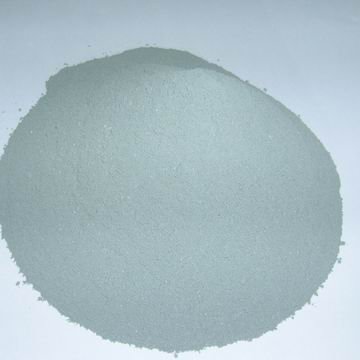
Microsilica particles range from 0.1 to 0.5 µm — two orders of magnitude finer than cement grains. With a BET surface area of 15,000–30,000 m²/kg, every kilogram added consumes significant mix water just to wet its surface. That water is no longer available for lubrication between aggregate particles. In an undensified silica fume slurry, this effect can reduce initial slump by 80–120 mm within 15 minutes of batching if no countermeasures are taken.
Beyond physical adsorption, the early-stage pozzolanic reaction accelerates C-S-H gel nucleation. Even before calcium hydroxide reaches saturation, silica fume surfaces begin consuming alkalis and forming weak gel bridges. These bridges raise static yield stress rapidly, which is why delayed placement or drum revving often results in a mix that cannot be pumped. Identifying the grade of silica fume used — such as choosing a 92 Grade Silica Fume For Concrete product with controlled particle agglomeration — becomes the first leverage point in controlling the hydration time window.
Adjusting PCE Superplasticizer Strategies for Microsilica Mixes
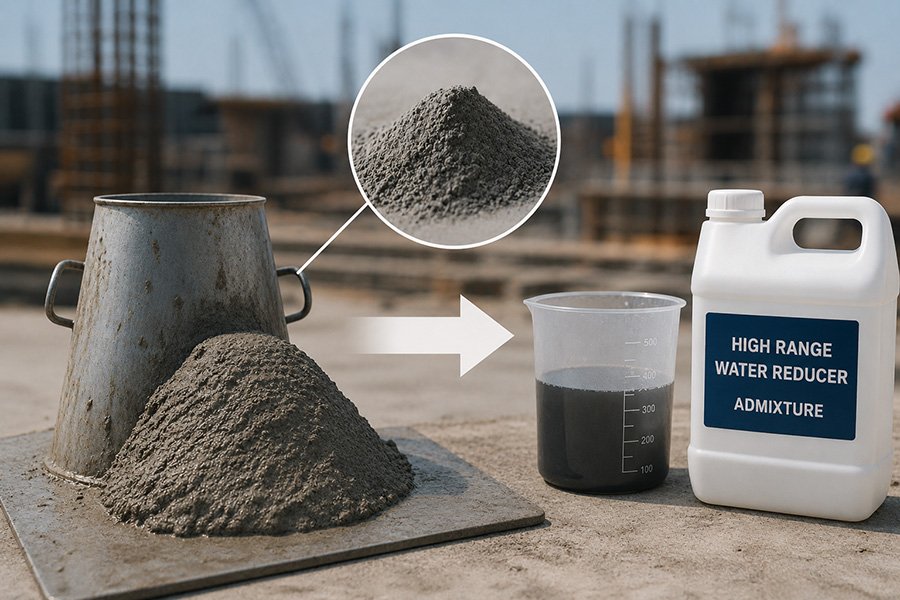
Traditional slump retention approaches — overdosing a standard PCE or adding lignosulfonate — fail catastrophically in silica fume systems. The negative surface charge of silica fume adsorbs PCE polymers preferentially, depleting the dispersant that cement grains require. A far more effective method is splitting the superplasticizer dosage: 60–70% at batching, with the remaining 30–40% added at the job site as a slump-recovery dose. This staged addition can extend the workable life from 30 minutes to over 90 minutes without increasing the w/b ratio.
Equally critical is PCE molecular architecture. Short-side-chain, high-charge-density polycarboxylates maintain better steric hindrance across silica fume’s surface, resisting the competitive adsorption that causes slump collapse. When paired with a densified silica fume source — such as 94 Grade Silica Fume For Concrete — batching compatibility improves markedly because the densification process pre-wets and partially compacts particles, reducing the instantaneous water demand spike upon first contact with the mix water.
Temperature and Truck Agitation: The Two Slump Killers Engineers Overlook
Concrete delivered at 32°C with silica fume can lose workability twice as fast as the same mix at 21°C. Elevated temperatures accelerate dissolution of the amorphous SiO₂ surface, hastening gel formation inside the drum rather than in the formwork. A practical field table correlating temperature exposure to slump life helps batch plants set realistic delivery windows:
| Concrete Temperature | Silica Fume Dosage (kg/m³) | Approximate Slump Half-Life (min) | Mitigation Strategy |
|---|---|---|---|
| 20°C | 30 | 60–75 | Standard split-dose PCE |
| 28°C | 30 | 35–45 | Chilled water + ice; delay silica fume addition |
| 35°C | 25 | 20–30 | Use densified grade only; apply drum retarder |
| 38°C+ | 20 | <20 | Reschedule pour or switch to night batching |
Excessive drum revolutions compound the problem. Agitation shears fragile early C-S-H bridges but also introduces air and friction heat. A rigid rule for silica fume mixes: limit total revolutions before discharge to 300, and never allow a mixer to sit idle — slow rotation (1–2 rpm) rather than stopping preserves uniformity without building yield stress. For refractory-grade formulations requiring exceptionally low calcium hydroxide content post-cure, 96 Grade Silica Fume For Refractory grades supply even higher purity SiO₂, reducing side reactions that might otherwise stiffen the mix prematurely during long-haul delivery.
Sequencing and Timing: When You Add Silica Fume Changes Everything
The order of batching ingredients exerts as much influence on slump retention as the PCE admixture design. Three proven sequences emerge from field trials and laboratory rheometry:
- Pre-blend with cement. Dry-mixing silica fume with cement for 30 seconds before adding water disperses microsilica onto larger cement grain surfaces, reducing the instantaneous water demand by up to 20%.
- Water-first method. Charging 80% of mix water and full PCE dose before any powder addition creates a dispersant-rich liquid phase. Silica fume enters a pre-dispersed environment and never contacts raw water alone — critical for undensified grades.
- Delayed silica fume addition. Batching cement, aggregates, and water first, then adding silica fume after 2 minutes of mixing, produces an encased particle structure. The interfacial transition zone improves while the paste remains fluid for an additional 20–25 minutes.
Mixing plants accustomed to low-grade silica fume frequently overlook that grade choice dictates which sequence works best. An 85 Grade Silica Fume, with its moderately lower SiO₂ content and coarser particle distribution, often tolerates conventional batching sequences better than a 92 or 94 grade, making it a pragmatic drop-in replacement where logistics prevent sequence changes.
Mix Design Adjustments That Buy You 45 Extra Minutes
When silica fume concrete must travel longer or wait at congested job sites, adjusting the w/b ratio upward by 0.02–0.04 can extend slump life significantly — but only if done by adding water-cement paste, not raw water. A common field mistake is adding water to the drum, which dilutes the paste fraction and destroys the particle packing density that silica fume was intended to achieve. Instead, hold back 5–7% of the total cementitious binder and blend it with the extra water as a slurry, then meter that slurry into the mixer on-site. This technique preserves the original paste volume while increasing spread.
Silica fume dosage itself warrants recalibration. Reducing microsilica from 10% to 7% of cementitious content cuts the early water demand surge substantially while retaining 85–90% of the long-term strength gain and most of the chloride impermeability benefit. The 92 Grade Silica Fume For Refractory formulation, when applied in high-performance concrete under ASTM C1240 specifications, achieves dense particle packing at these slightly lower dosages without the slump volatility that accompanies 10%+ addition rates.
Field Protocols for Rescuing a Silica Fume Load That Is Stiffening Too Fast
A load arriving at 100 mm slump when 180 mm was specified represents a $200–$400 rejection event — but not every stiff load merits rejection. A structured field intervention sequence saves many loads while protecting structural integrity:
- Verify total revolutions and temperature. If the drum has exceeded 350 revolutions or concrete temperature surpasses 35°C, reject immediately — no admixture can fully recover workability without irreversibly damaging the C-S-H nucleation pattern.
- Apply a mid-range water reducer, not a high-range PCE re-dose. Lignosulfonate-based mid-range admixtures at 200–400 mL per 100 kg of cementitious material can recover 30–50 mm of slump without the severe set retardation that a second PCE shot causes.
- Mix at maximum drum speed for exactly 2 minutes, then re-test. High shear temporarily disrupts gel bonds but introduces heat — 2 minutes is the empirically determined safe window before frictional temperature rise negates the fluidity gain.
- If slump recovers to within 30 mm of target, place the material in secondary structural elements (parapets, approach slabs, temporary works) where the performance margin allows minor workability deviations without compromising the primary spec.
Stopping drum rotation entirely during a slump crisis guarantees stiffening. Helical action at 2–4 rpm must continue — silica fume concrete allowed to sit static for more than 5 minutes can build sufficient yield stress to shear the hydraulic drive coupling when mixing resumes.
Material Selection as a Preventative Strategy Against Future Slump Failures
Engineers who repeatedly battle slump loss often trace the root cause to inconsistent silica fume properties. Bulk density, LOI, and agglomeration state vary significantly between suppliers and even between production batches. Densified microsilica with a bulk density above 500 kg/m³ disperses more gradually in the mixer, flattening the water-demand curve during the critical first 10 minutes. In contrast, undensified grades with bulk density around 200 kg/m³ exhibit a spike-and-crash workability profile that demands exacting superplasticizer timing. Requiring supplier test reports that include a slump retention curve — not just a single-point spread measurement — provides the data necessary to adjust batching sequences before a failure occurs. Proactive communication with your supplier about particle size distribution and LOI values is often the most cost-effective slump retention tool available.
Frequently Asked Questions
Q: What is the acceptable slump loss rate for silica fume concrete per ASTM C1240?
A: ASTM C1240 does not specify a maximum slump loss rate, but typical specification limits for HPC/UHPC range from 25–75 mm loss within 30–45 minutes. For silica fume concrete, a loss exceeding 100 mm in 30 minutes indicates incompatibility or an excessive dosage (e.g., >10–15% by weight of cement).
Q: Which superplasticizer type works best to mitigate slump loss in silica fume concrete?
A: Polycarboxylate ether (PCE) superplasticizers with a high water-reduction rate (≥30%) and a long slump retention profile (e.g., 90–120 minutes at 25°C) are most effective. PCEs reduce the w/b ratio to 0.25–0.35 while maintaining a workable slump of 200–250 mm. Dosage typically ranges from 0.8–2.5% by weight of cementitious material.
Q: How does the batching sequence affect slump loss when using silica fume?
A: Delayed addition of silica fume—adding it 30–60 seconds after water and coarse aggregate—can reduce initial water demand by 5–10% and cut slump loss by up to 40%. Overmixing (beyond 3–4 minutes) or adding silica fume dry before water often accelerates slump loss due to faster agglomeration of silica fume particles and a rapid increase in ionic strength.
Q: What is the recommended water-to-binder ratio to control slump loss in silica fume concrete?
A: For typical structural concrete (25–40 MPa), a w/b ratio of 0.35–0.40 combined with a silica fume dosage of 5–10% yields a 150–200 mm initial slump with retention of 100–150 mm after 60 minutes. For UHPC (w/b = 0.18–0.22), slump loss can reach 200–250 mm in 30 minutes without ultrafine fillers and a dedicated PCE admixture.
Q: Can temperature control prevent rapid slump loss in silica fume concrete?
A: Yes. At a concrete temperature of 30°C, slump loss can accelerate 2–3 times versus 20°C. Using chilled water (5–10°C) or ice to keep the mix temperature below 25°C often reduces the slump loss rate by 50–70% and delays initial set by 30–60 minutes. This is critical for hot-weather placements (ambient >35°C).
About Henan Superior Abrasives (HSA)
Henan Superior Abrasives (HSA) is a China-based manufacturer and global supplier of high-quality silica fume (microsilica) for concrete and refractory applications. Supplying both densified and undensified grades compliant with ASTM C1240 and EN 13263, HSA serves customers in 30+ countries with reliable microsilica solutions for HPC, UHPC, precast concrete, shotcrete, and other high-performance construction materials.
Get a Quote or Free Sample
Ready to improve your concrete performance with premium silica fume? Contact our technical team today — we respond within 24 hours and can arrange free samples for qualified projects.
- 📧 Email: sales@superior-abrasives.com
- 💬 WhatsApp: +86-186-3863-8803