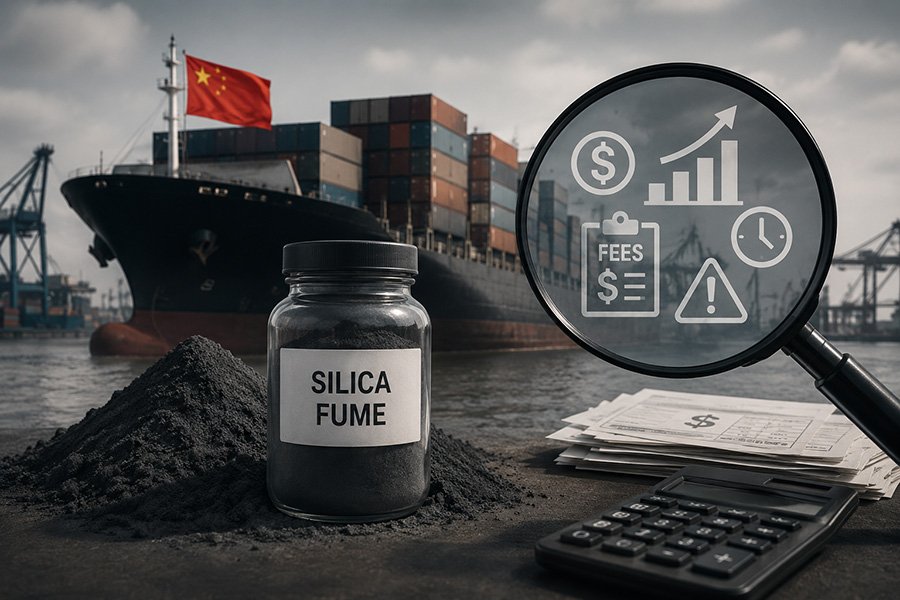
A single container of silica fume that does not meet ASTM C1240 upon arrival can add $12,000–$18,000 in unbudgeted costs—extra superplasticizer, extended batching correction time, and in severe cases, rejected UHPC precast elements. Engineering teams that focus only on ex‑works pricing often discover that logistics penalties, specification gaps, and quality verification represent the real procurement risk. This article maps every hidden cost layer importers of Chinese microsilica face, so structural and materials engineers can build a total landed‑cost model that protects both concrete performance and the bottom line.
When Spec Sheets Lie: The Cost of Undetected LOI and SiO₂ Drift
Loss on ignition (LOI) above the standard 3–6% limit quietly erodes pozzolanic efficiency. Even when a supplier certifies 92% SiO₂, elevated LOI means carbonaceous residuals are diluting reactive silica. The result is a loss of 15–25% in calcium‑silicate‑hydrate (C‑S‑H) gel formation at the same dosage, leading engineers to compensate with higher binder loads or excessive high‑range water reducer. A 1% LOI increase beyond 6% can demand an extra 0.8–1.2 kg of PCE superplasticizer per cubic meter of UHPC to maintain workability. Across a 5,000 m³ project, that translates directly into $8,000–$15,000 of unplanned admixture cost.
Equally damaging is the interfacial transition zone (ITZ) densification failure that occurs when SiO₂ content fluctuates between shipments. If a mix design was optimized for 96%‑grade silica fume and subsequent deliveries slip to 92%, particle packing and ITZ hydration kinetics change. The concrete loses its designed impermeability, often manifesting weeks after placement. Such risks reinforce why specifying material is not enough; rigorous incoming inspection routines and a clear understanding of the supplier’s beneficiation process become critical cost‑avoidance measures.
- Carbon content above 3% LOI: Lowers pozzolanic reactivity and increases water demand.
- SiO₂ grade substitutions: Inconsistent purity disrupts ITZ packing density in silica fume for concrete cement applications.
- BET surface area variance: An unadvertised drop in specific surface reduces filler effect and early strength gain.
Demurrage, Detention, and the True Cost of Port‑Side Delays
Proforma invoices rarely mention that an imprecise Bill of Lading or missing fumigation certificate can strand a 20‑ft container at the port for five to ten days. Demurrage charges at major entry hubs now range from $75 to $150 per day after the free‑time window closes, while truck detention at the warehouse loop adds $300–$800 per incident. For a full 20‑tonne shipment of densified silica fume, such delays not only pile up direct fees but also disrupt just‑in‑time batching schedules on large infrastructure projects. Contractors then absorb idle plant costs that can exceed the material invoice itself.
Another overlooked expense is chassis split and container yard shuffling. When a shipment arrives during peak season without a pre‑arranged chassis appointment, a “split” can occur, forcing the container to be moved multiple times within the terminal. Each extra move can cost $100–$200. While these fees may appear as minor line items, they compound across multiple containers, especially for undensified microsilica which is often lighter per bag and shipped in higher volume per project cubic metre. The table below crystallises typical hidden logistics costs importers only discover once the vessel has docked.
| Hidden Logistic Cost | Typical Range (per 20‑ft container) | Triggering Event |
|---|---|---|
| Port demurrage | $75–$150 / day | Customs hold, missing documents |
| Chassis split fee | $150–$400 | Peak‑season terminal congestion |
| Fumigation re‑treatment | $300–$600 | Solid wood packing non‑compliance (ISPM 15) |
| Customs exam (X‑ray or intensive) | $200–$500 | HS code flagging or random inspection |
| Late payment warehousing | $30–$60 / day | Banking delays on letter of credit |
Moisture Pickup, Bag Integrity, and Real Volume Yields
Undensified silica fume shipped in 25 kg woven bags breathes with ambient humidity. A 1–2% moisture gain during ocean transit may not seem alarming until it manifests as caked powder that cannot be pumped into silos. Unloading stoppages on a UHPC casting line can cost $2,000–$4,000 per day in lost precast productivity. Densified grades reduce this risk, yet poorly densified material may still collapse into lumps under pressure, destroying the flowability required for automatic batching.
Bag breakage and weight shortfalls also represent hidden volume losses. A 25 kg bag that averages 24.2 kg due to inconsistent filling practices robs the mixer of 3.2% of the purchased pozzolan. Over a 20‑tonne order, that’s 640 kg of missing reactive silica, equivalent to the dosage for nearly 30 m³ of high‑performance concrete. Such shortages often slip through unless the buyer insists on certified net weight per bag and random container scanning upon arrival. When densified micro silica powder is delivered in bulk bags, even small tears caused by fork‑tine handling introduce a secondary cost: contamination that forces the entire bulk bag out of specification.
Standards Compliance Testing: You Pay Twice When Documentation Fails
A supplier’s mill certificate showing SiO₂ 96% and LOI 2.5% provides a starting point, but few project specs accept foreign certificates without independent verification. Major consultants require ASTM C1240 or EN 13263 compliance tests by an accredited third‑party laboratory. That testing, at $400–$800 per lot, adds a direct cost. If the material fails—for example, wet sieve residue exceeds 1.5%—the buyer faces the decision to either ship back a container (logistics costs that can exceed $5,000) or field‑adjust the concrete mixture at the batching plant, often requiring additional cement and admixture that erases any purchase savings.
Regional specification traps amplify this risk. A shipment initially ordered for a Middle Eastern project referencing Japanese JIS 6207 micro silica fume specification may not meet the tighter 7‑day pozzolanic activity index required. Adapting to such mismatches post‑shipment leaves the engineer with no clean contractual remedy, effectively shifting the correction cost onto the end user. Importers who incorporate pre‑shipment inspection (PSI) by an agency like SGS or CIQ into their landed cost from day one convert a potential hidden expense into a controlled investment.
Currency Slippage, Letter of Credit Fees, and Payment Term Traps
Pricing microsilica in USD when the Yuan is strengthening may protect the supplier, yet the buyer’s local currency depreciation during the 30–60‑day sea transit can inflate the effective cost by 3–5%. That change alone erases a significant portion of the per‑tonne savings that motivated the overseas purchase. Without a forward exchange contract or negotiation of split‑currency terms, procurement managers end up with a delivered cost $30–$60 per tonne higher than the approved budget.
Complex documentary letter of credit (L/C) requirements introduce further hidden fees. Each amendment—often necessitated by a changed vessel name or a minor packing list discrepancy—costs $100–$250. A single L/C that undergoes two amendments and requires extended bank confirmation can consume $800 in banking charges, all off the primary invoice. Structuring payment terms toward a 30% advance and 70% against copy documents with a trusted supplier dramatically reduces these friction costs.
Environmental Surcharges and Regulatory Moves That Impact Entry
Increasingly, destination ports levy environmental surcharges on containerized mineral powders. These “dust levies” or special handling fees, often $150–$250 per container, appear only on the terminal operator’s invoice after unloading. Many procurement teams classify them under general logistics, but they are directly attributable to the physical form of silica fume. Proactive shippers mitigate this by providing sealed bulk bags with inner polyethylene liners and certifying dust‑free unloading, a practice that qualified exporters embed into their cost; less mature suppliers let the burden fall on the consignee.
Additionally, certain regions now require REACH‑like registration or biocide‑free certification for mineral admixtures used in potable water structures. When a specifier discovers this requirement during placement, the time required to obtain supplemental certification can halt work. The resulting extended storage and remobilisation costs far exceed the price of the silica fume itself. Choosing a supplier with proven documentation for EN 13263, BS EN 934, and the relevant regional health registrations removes that legal uncertainty from the project’s critical path.
Frequently Asked Questions
Q: What hidden cost surprises importers of Chinese silica fume most frequently?
A: Spec non‑compliance—undetected high LOI or low SiO₂—triggers a chain of expenses: extra superplasticizer (0.8–1.2 kg/m³ in UHPC), potential ITZ failure, and third‑party re‑testing costs. These unbudgeted items often total $10,000–$18,000 for a single container, far outweighing any initial price advantage.
Q: How can I verify silica fume purity before shipment to avoid hidden quality costs?
A: Mandate a pre‑shipment inspection (PSI) by an accredited agency such as SGS or CIQ to test SiO₂, LOI, and wet sieve residue per ASTM C1240 or EN 13263. Bank the cost (typically $400–$800 per lot) into your landed‑cost model, and condition final payment on passing results. This converts an unknown risk into a defined quality gate.
Q: Do all silica fume shipments from China require fumigation, and what happens if it’s missing?
A: Yes, any shipment using solid wood pallets or crating must comply with ISPM 15 fumigation standards. If the required stamp is absent or a certificate is incorrect, the container will be held at port for re‑treatment at $300–$600 plus demurrage days. Plastic pallets or heat‑treated timber eliminate this recurring hidden cost entirely.
Q: How significant are moisture‑induced volume losses in undensified microsilica?
A: Undensified silica fume can gain 1–2% moisture during ocean transit, causing caking and weight inaccuracies. A systematic shortfall of 3.2% (24.2 kg per 25 kg nominal bag) across a 20‑tonne container equals 640 kg of lost reactive material, enough to treat 30 m³ of high‑performance concrete. Insist on sealed inner liners and certified net weights to control this loss.
Q: What are the true costs of using a silica fume that barely meets LOI limits?
A: A microsilica with LOI at the 6% ceiling of ASTM C1240 still consumes excess PCE admixture and delays hydration. For every 1% LOI increment beyond 3%, anticipate a 0.5–1.0 kg/m³ increase in superplasticizer demand and a 3–5% reduction in 28‑day compressive strength in UHPC. These effects compound across a high‑volume pour, erasing initial material savings.
About Henan Superior Abrasives (HSA)
Henan Superior Abrasives (HSA) is a China-based manufacturer and global supplier of high-quality silica fume (microsilica) for concrete and refractory applications. Supplying both densified and undensified grades compliant with ASTM C1240 and EN 13263, HSA serves customers in 30+ countries with reliable microsilica solutions for HPC, UHPC, precast concrete, shotcrete, and other high-performance construction materials.
Get a Quote or Free Sample
Ready to improve your concrete performance with premium silica fume? Contact our technical team today — we respond within 24 hours and can arrange free samples for qualified projects.
- 📧 Email: sales@superior-abrasives.com
- 💬 WhatsApp: +86-186-3863-8803