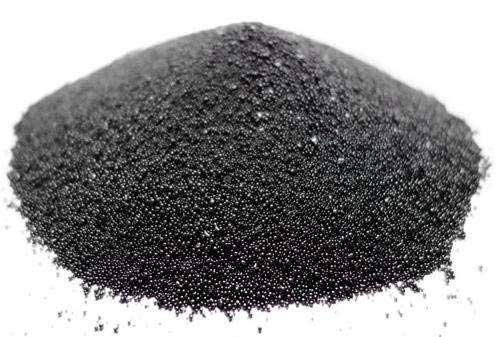
Silica fume is widely used to enhance strength, durability, and impermeability of concrete—but it is also well known for causing poor workability. This effect comes from several material-level mechanisms rather than a single factor.
Technical explanation
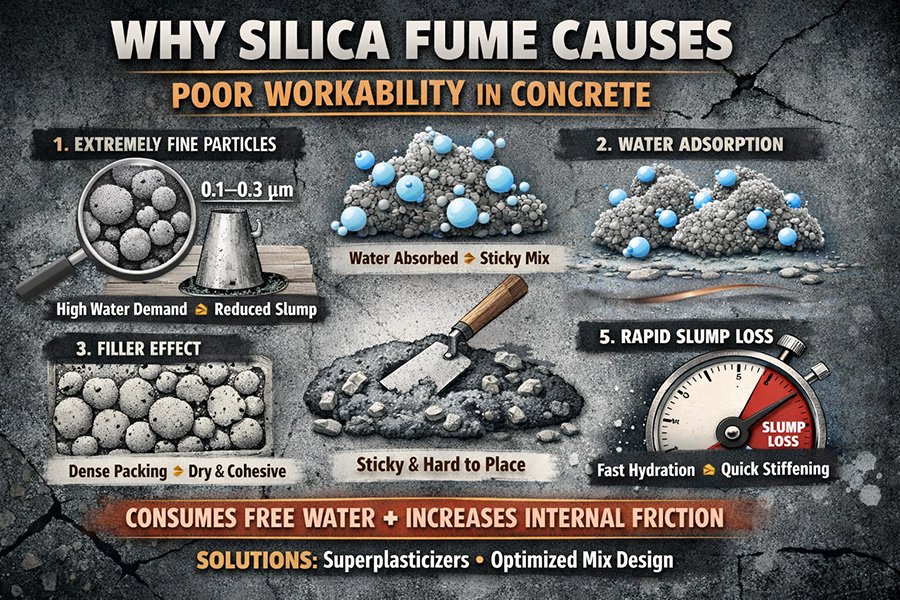
1. Extremely Fine Particle Size (High Surface Area)
Silica fume particles are about 0.1–0.3 μm, nearly 100 times finer than cement.
- This creates a huge specific surface area
- More water is required to wet the particles
- Free water in the mix is rapidly absorbed
Result:
➡️ Higher water demand → stiffer mix → reduced slump
2. Strong Water Adsorption Effect
Silica fume particles have:
- High surface energy
- Amorphous SiO₂ structure
- They physically adsorb mixing water onto their surfaces.
Result:
➡️ Less lubricating water between aggregates
➡️ Concrete becomes sticky and less flowable
3. Particle Packing & Filler Effect
Silica fume fills the microscopic voids between cement grains (micro-filler effect):
- Improves density and strength
- Reduces bleeding and segregation
However:
- Reduced bleeding means no surface water
- Internal friction between solids increases
Result:
➡️ Mix feels “dry” and difficult to place or finish
4. Increased Cohesion and Stickiness
Because of its fineness:
- Silica fume increases paste cohesion
- Aggregates are more tightly bound
Result:
➡️ Concrete becomes sticky, not free-flowing
➡️ Pumping and finishing become more difficult
5. Rapid Slump Loss
Silica fume accelerates:
- Early hydration reactions
- Formation of C-S-H gel
Result:
➡️ Slump loss occurs faster than in normal concrete
➡️ Workability decreases quickly after mixing
How to Improve Workability When Using Silica Fume
To counteract poor workability, concrete producers usually:
Use High-Range Water Reducers (Superplasticizers)
- Polycarboxylate-based admixtures are most effective
- Restore flow without increasing water–cement ratio
Optimize Silica Fume Dosage
- Typical dosage: 5–10% by cement weight
- Excessive dosage worsens workability
Adjust Mix Design
- Slightly increase paste volume
- Optimize fine aggregate grading
Use Densified or Slurry Silica Fume Properly
- Ensure good dispersion to avoid agglomeration
- Poor dispersion exaggerates workability problems