When a microsilica dosing error of just 1–2% by weight of cementitious material can reduce 28‑day compressive strength by 5–8 MPa, the root cause is often not the mix design but the packaging. A jumbo bag that fails to discharge completely, a soluble paper bag that resists dissolution, or a torn bulk bag exposing silica fume to humidity—each directly compromises the pozzolanic reaction and the final C‑S‑H gel density. This article examines how 1000 kg jumbo bags and 20 kg soluble bags affect batching precision, material integrity, and total project economics, equipping specifiers and concrete professionals to choose the right packaging for high‑performance and UHPC applications.
The Role of Packaging in Microsilica Performance
Microsilica’s extreme fineness—with a BET surface area often exceeding 15 m²/g—makes it highly susceptible to pre‑hydration and agglomeration. Once amorphous SiO₂ particles come into contact with moisture, they begin a premature pozzolanic reaction, forming hard lumps that will not properly disperse in the mixer. Effective packaging must serve as a true moisture barrier, maintaining the product’s reactive potential from factory silo to concrete batching plant.
Furthermore, the packaging system must support accurate, repeatable dosing. Even a 0.5% variation in silica fume addition can alter the water demand and the interfacial transition zone (ITZ) porosity, especially in UHPC where the w/b ratio is often below 0.20. Poor packaging that leads to silo bridging, residue left in bags, or manual weighing errors directly undermines the very precision that engineers specify. For a deeper analysis of workability challenges, why silica fume can reduce concrete workability explains how particle dispersion failures translate into slump loss.
1000 kg Jumbo Bags: Bulk Handling and Potential Pitfalls
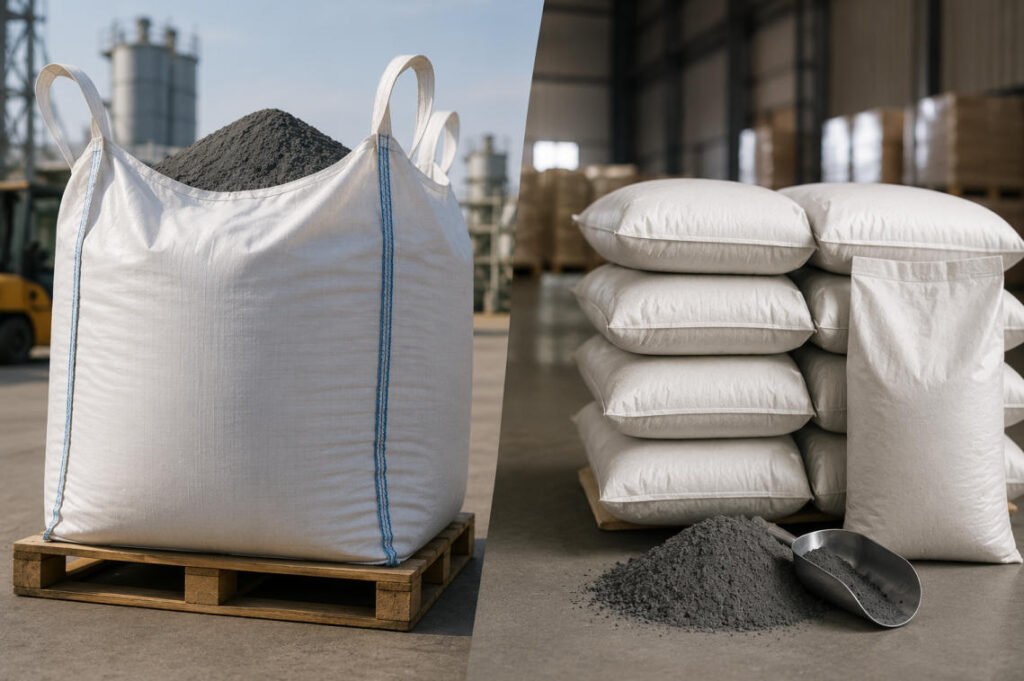
Jumbo bags, also known as FIBCs (flexible intermediate bulk containers), supply approximately 20 metric tonnes per full truckload. Their high payload reduces packaging waste per tonne and is often preferred for large‑scale infrastructure projects or precast plants with silo storage and automated dosing equipment. A single 1000 kg bag can feed a day’s production without interruption, minimizing the number of bag‑handling steps.
However, critical limitations arise when batching from jumbo bags without a dedicated silo. Discharge often requires a hoist and a specifically designed dispensing frame; the bag’s internal liner can trap up to 2–3 kg of material, especially with densified microsilica that compacts under its own weight. If operators attempt to split a jumbo bag into smaller increments by weight, accuracy rarely exceeds ±1% of the bag’s total mass. Moisture ingress through the top spout after partial use is another risk—once opened, the hygroscopic powder can form indurated clumps that later clog augers or remain undispersed in the mix, creating weak zones in the hardened concrete.
20 kg Soluble Bags: Precision and Practicality for Batching
Each 20 kg soluble paper bag serves as a pre‑weighed, single‑batch dose that eliminates manual weighing at the site. The operator simply tosses the required number of bags directly into the mixer, where the paper rapidly disintegrates—usually within 15 to 45 seconds under normal shear—releasing the silica fume into the mixing water and cement paste. No dust is generated, and no bag residue needs disposal, making this packaging particularly valuable for dry‑batch plants, tunnel lining, and remote casting yards where enclosed dosing equipment is unavailable.
Batching accuracy is inherently high. With a fill tolerance of ±0.1 kg per bag, a 400 kg cementitious mix requiring 8% silica fume (32 kg) simply calls for two bags. There is no weighing error accumulation from a large container. For UHPC incorporating fine microsilica 970U with SiO₂ ≥ 97%, this dosing precision ensures the particle packing model is exactly met, preserving the required flowability and mechanical properties. The paper itself is treated to dissolve completely in both fresh and salt‑water mixes, with no adverse effect on PCE superplasticizer efficiency.
Cost of Ownership: Comparing Waste, Labor, and Logistics
While the purchase price per tonne of microsilica in 20 kg soluble bags is typically 8–12% higher than in jumbo bags due to bagging and paper costs, the total cost of ownership often reverses when site‑side variables are accounted for. Labor, material loss, dust control equipment, and rejected batches due to inaccurate dosing all contribute to a project’s real bottom line. The table below compares the two packaging systems across key operational parameters.
| Parameter | 1000 kg Jumbo Bag | 20 kg Soluble Bag |
|---|---|---|
| Dosing accuracy | ±1 kg (0.1%) if entire bag used; up to ±3% if split | Consistently ±0.1 kg per unit, regardless of total dosage |
| Material loss / residue | Up to 0.3% retained in bag and liner | <0.05% (complete dissolution) |
| Handling equipment | Forklift, hoist, discharge frame required | Manual; no special equipment |
| Dust exposure | High during discharge unless closed system | Negligible |
| Storage vulnerability | Partial bags at risk of moisture ingress | Sealed units remain protected until use |
For high‑volume ready‑mix plants that consume a full jumbo bag per batch and have automated vacuum transfer, the per‑tonne packaging premium of soluble bags may not be justified. In contrast, a precast facility producing UHPC façade panels with variable mix designs will typically find the precision and reduced labor of 20 kg bags yield a lower cost per cubic meter of placed concrete. Including a grade such as 94% silica fume for concrete in soluble bag format can simplify logistics without compromising performance.
Environmental and Safety Considerations
Occupational exposure to respirable crystalline silica is a serious health concern. Jumbo bag discharge can release dust plumes that exceed the 0.05 mg/m³ respirable silica limit unless a full containment system is used. Soluble bags eliminate this hazard because the powder is never exposed to the air before entering the mixer. From a waste perspective, while jumbo bag fabric and polypropylene liners must typically be landfilled or sent to specialized recycling, the soluble paper bags disappear into the mix, leaving zero solid waste behind.
Environmentally conscious projects may also weigh the embodied carbon of packaging. The paper used for soluble bags is a renewable material, whereas the woven polypropylene of FIBCs has a higher carbon footprint per kilogram. However, the larger packaging mass of multiple 20 kg bags per tonne of microsilica can offset some of that advantage. Selecting the right packaging must therefore align with both the project’s environmental management plan and the Health & Safety protocol on silica dust.
Selecting the Right Packaging for Your Project Specifications
Choice of microsilica packaging is not a one‑size‑fits‑all decision. It depends on the project scale, site infrastructure, mixer type, and the specific silica fume grade being used. For example, a low‑cost microsilica 85 grade for mass concrete in remote locations might be most economically delivered in jumbo bags, provided a weigh batching system is available. Conversely, a dense silica fume with SiO₂ ≥ 96% destined for a critical bridge overlay will benefit from the exact dosing that soluble bags provide, reducing the risk of a high‑cost rejection.
When the concrete mix design demands a high dosage of silica fume—8–12% bwoc is typical for UHPC—20 kg soluble bags simplify quality control because each bag represents a fixed contribution to the cementitious content. Plants with automated batching can program the number of bags instead of relying on load‑cell accuracy for small weight increments. For projects that regularly use silica fume for concrete cement, ordering a mixed shipment of jumbo bags for bulk production and soluble bags for trial mixes or specialized elements is a common, pragmatic strategy.
Storage conditions also dictate packaging choice. Sites with limited covered storage and high humidity should strongly prefer the hermetic seal of individual 20 kg soluble bags. A single compromised jumbo bag can render 1000 kg of material unusable, whereas a damaged soluble bag sacrifices only 20 kg. Evaluating the moisture control capability of the site during the entire consumption window is as critical as assessing the ex‑works price per tonne.
Frequently Asked Questions
Q: Do soluble paper bags fully dissolve in all concrete mixers?
A: Yes, certified soluble bags designed for microsilica disintegrate within 15–45 seconds under normal mixer shear in both pan and drum mixers. The paper is manufactured with water‑soluble adhesives and leaves no fibrous residue that could affect air‑void structure or PCE performance.
Q: What is the batching accuracy difference between jumbo bags and soluble bags?
A: Soluble bags guarantee a fill tolerance of ±0.1 kg per unit (0.5% of bag weight), enabling a silica fume dosage precision of ±0.2 kg for a typical 40‑kg cementitious admixture. Jumbo bags weighed in their entirety can achieve ±1 kg, but when split, the error often increases to 3% or more due to non‑uniform discharge.
Q: Can undensified microsilica be supplied in 20 kg soluble bags?
A: Yes, but undensified microsilica has an extremely low bulk density (150–250 kg/m³), so a 20 kg bag is physically larger. Special compaction during bagging is applied to ensure the bags are manageable. Densified grades are more common in soluble bags because of their higher density and reduced volume.
Q: Are jumbo bags suitable for ASTM C1240‑compliant silica fume?
A: Absolutely. Jumbo bags can preserve the required pozzolanic activity index and moisture content, provided the inner liner is intact and the bag is stored under cover. ASTM C1240 does not specify packaging type; it mandates chemical and physical properties, which are independent of the bag format.
Q: How should I store opened jumbo bags to prevent silica fume degradation?
A: Once a jumbo bag is opened, the remaining material must be transferred to an airtight silo or resealed with a moisture‑tight clamp on the spout. In high‑humidity environments, even partial exposure can initiate pre‑hydration within 48 hours, reducing the reactive SiO₂ content and causing hardened lumps that are difficult to disperse.
About Henan Superior Abrasives (HSA)
Henan Superior Abrasives (HSA) is a China-based global supplier of high-quality silica fume (microsilica) for concrete and refractory applications. Supplying both densified and undensified grades compliant with ASTM C1240 and EN 13263, HSA serves customers in 30+ countries with reliable microsilica solutions for HPC, UHPC, precast concrete, shotcrete, and other high-performance construction materials.
Get a Quote or Free Sample
Ready to improve your concrete performance with premium silica fume? Contact our technical team today — we respond within 24 hours and can arrange free samples for qualified projects.
- 📧 Email: sales@superior-abrasives.com
- 💬 WhatsApp: +86-186-3863-8803