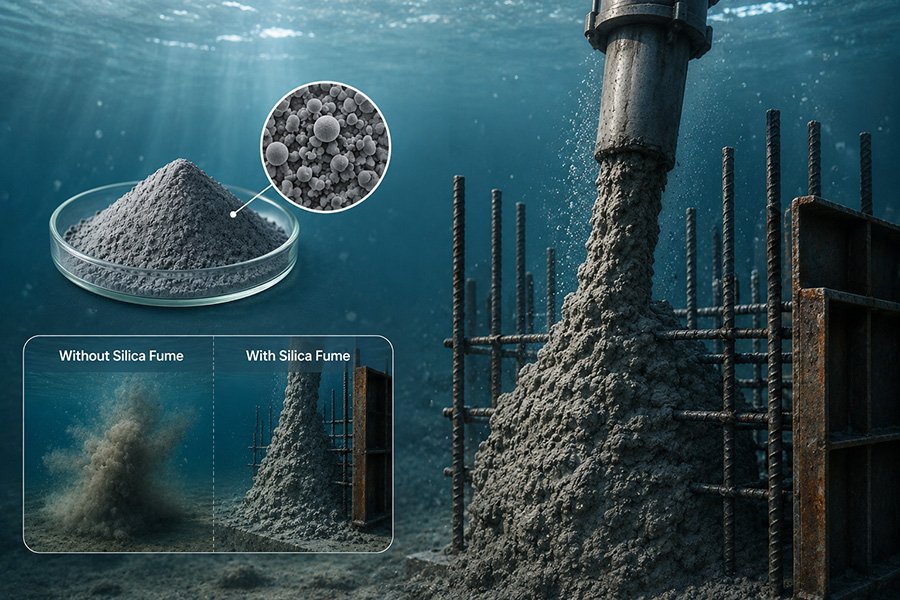
Underwater concrete placement carries a hard-to-see risk: cement washout silently erodes mix integrity. Within seconds of contacting water, freshly mixed paste begins to disperse, stripping away the binder that holds aggregate together. The result is not merely a surface defect—compressive strength can drop by 30–50%, permeability soars, and rebar corrosion accelerates. Repair costs for deteriorated bridge piers, lock structures, or offshore foundations often exceed the original construction budget. Silica fume, an ultrafine pozzolanic material, addresses this at the level of particle physics, turning a vulnerable suspension into a cohesive, erosion-resistant mass.
The Physics of Washout: Why Concrete Fails Underwater
Cement paste in ordinary concrete behaves like a dilute suspension once immersed. Turbulence, water currents, and the simple act of free fall through a water column generate shear forces that strip cement grains from the aggregate surface. This loss is not uniform—it concentrates in the outer layer of a placement, creating a weak, porous skin and leaving internal pockets of lean, sandy matrix. Beyond the immediate strength penalty, washout elevates the water-cement ratio locally, disrupting the intended microstructure. Even with careful tremie placement techniques, up to 10–15% of the cementitious material can escape into the surrounding water, a figure confirmed by turbidity measurements and mass balance studies.
The interfacial transition zone (ITZ) between paste and coarse aggregate suffers most. Where cement grains have been washed away, hydration products fail to bond, leaving microcracks that propagate under load. In reinforced concrete, the problem doubles: lost cover concrete depth plus chloride ingress paths dramatically shorten service life. These mechanisms explain why specifications for underwater concrete now frequently demand anti-washout admixtures and supplementary cementitious materials capable of preserving paste integrity from placement through initial set.
How Silica Fume Builds Internal Cohesion at the Microscale
Silica fume transforms underwater concrete not through viscosity-building polymers alone, but through a permanent, chemically bonded structure. Its primary particles, with a BET surface area typically between 15 and 30 m²/g, fill the spaces between cement grains, replacing water-filled voids with solid siliceous matter. This physical particle packing effect immediately thickens the paste and reduces bleeding. More critically, silica fume’s amorphous SiO₂ reacts with the calcium hydroxide liberated during cement hydration—the pozzolanic reaction—generating additional calcium-silicate-hydrate (C-S-H) gel. That gel, the main strength-giving phase in concrete, densifies the matrix further, especially in the vulnerable ITZ.
Three intertwined mechanisms lock the mix together:
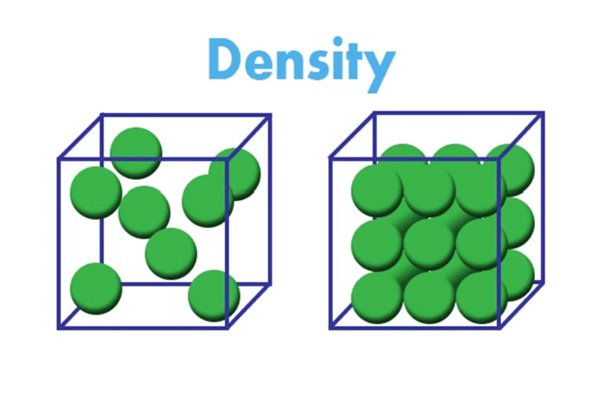
- Particle packing densification: Extremely fine microsilica particles bridge the gap between cement and filler, reducing the percolation of water through the fresh paste.
- Reduced free water: The immense surface area adsorbs mixing water, transforming it into tightly held films that resist shear-induced displacement.
- Pozzolanic intergrowth: C-S-H needles stemming from the silica fume reaction weave through existing hydration products and aggregate surfaces, forming a continuous, interlocking bond that grows stronger with age.
Under severe washout conditions, the combined effect is dramatic. While a plain cement mix may lose 15% of its mass after a plunge test, an equivalent mix containing 8–10% silica fume by weight of cement often restricts mass loss to under 3%. Such data, along with detailed investigations into the effect of micro silica fume on concrete strength, confirms that cohesion improvements translate directly into long-term mechanical performance.
Comparative Performance: Silica Fume vs. Conventional Underwater Concrete
Lab and field trials quantify silica fume’s impact clearly. The table below summarizes typical data from studies on underwater concrete with and without microsilica, based on a w/b ratio of 0.38 and a superplasticizer to maintain flow.
| Property | Control (Plain Cement) | 8% Silica Fume (by cement weight) | 12% Silica Fume (by cement weight) |
|---|---|---|---|
| 28-day compressive strength (cylinder, MPa) | 42 | 58 | 65 |
| Washout mass loss (%) | 14.2 | 4.1 | 2.5 |
| Turbidity of surrounding water (NTU) | >800 | 120 | 80 |
| Chloride ion permeability (Coulombs) | 3,200 | 1,100 | 850 |
| Slump flow retention after 30 min (mm) | 450 | 430 | 420 |
Strength gain continues well beyond 28 days because the pozzolanic reaction proceeds slowly, consuming calcium hydroxide that would otherwise remain vulnerable to leaching. For ultra-high performance concrete (UHPC) formulations used in deep-water caissons and tunnel segments, silica fume contents often climb to 20–25% in concert with optimized particle packing and high-range water reducers. These mixes achieve compressive strengths exceeding 150 MPa while maintaining nearly zero washout loss.
Mix Design Essentials: Superplasticizers, Dosage, and Dispersion
Harnessing silica fume’s full potential demands a disciplined mix design. Because microsilica’s high surface area would otherwise demand a prohibitive amount of mixing water, a PCE superplasticizer is mandatory. Typical dosage ranges from 5% to 15% silica fume by weight of cement (bwoc), with 8–10% serving as the sweet spot for balanced workability and washout resistance. Lower SiO₂ grades (85–92%) still provide cohesion but may require slightly higher addition rates to match the performance of a 96% grade, as shown in test reports for 94-grade silica fume for oil well cementing, where high-temperature, high-pressure washout demands are severe.
Successful dispersion is non-negotiable. Silica fume agglomerates—common in undensified bulk powder if not properly sheared—can create micro-inhomogeneities that weaken the ITZ instead of strengthening it. High-shear mixing, preferably in a central batch plant, combined with a delayed addition sequence (adding silica fume after initial water and superplasticizer blending), ensures uniform wet-out. The w/b ratio can then be kept low, frequently in the 0.30–0.35 range, yielding a paste with high yield stress that resists dilution even in turbulent water. It is important to distinguish genuine amorphous silica fume from crystalline byproducts; a quick comparison of silica fume vs. silicon metal powder highlights the vast difference in pozzolanic reactivity and suitability for hydraulic binders.
Quality Assurance and Standards Compliance
Specifying silica fume for underwater concrete demands adherence to recognized international standards, primarily ASTM C1240 and EN 13263. These standards set limits on critical parameters: SiO₂ content must exceed 85%—higher grades (96–98%) are preferred for washout-resistant mixes—loss on ignition (LOI) should be below 6%, and the specific surface area must be reported. They also govern the pozzolanic activity index, which confirms the material’s ability to enhance strength. When sourcing silica fume, engineers look for consistency in particle size distribution, as even minor variations can shift rheology and washout behavior.
Field verification extends beyond lab certificates. A simple on-site washout bucket test, loosely based on the CRD-C 61 test method, measures mass loss after a standardized drop through water. For silica fume concrete, typical mass loss must remain below 5%, and turbidity of the test water should not exceed 150 NTU. Underwater core samples later provide the ultimate proof: a dense, tightly bonded matrix with no visible segregation. With a properly designed and quality-assured silica fume system, underwater structures can achieve a service life matching or exceeding their above-ground counterparts, making microsilica an economic necessity rather than an optional additive.
Frequently Asked Questions
Q: What silica fume grade offers the best washout resistance for underwater concrete?
A: A grade with SiO₂ ≥94%, LOI below 3%, and BET surface area of 15–25 m²/g provides optimal cohesion. While 85–92% grades also work, higher purity accelerates the pozzolanic reaction and forms more C-S-H gel. Dosage of 8–12% by weight of cement is typical for severe exposure.
Q: How does silica fume physically prevent cement washout?
A: Three mechanisms act in concert: (1) Sub-micron particles fill intergranular spaces, reducing water channels; (2) high surface area adsorbs free water, increasing paste viscosity; (3) the pozzolanic reaction grows C-S-H needles that lock aggregate and cement grains together, resisting shear forces from surrounding water.
Q: Does adding silica fume affect the workability of underwater concrete?
A: Yes, it reduces slump and flow due to the high surface area. However, a polycarboxylate-based (PCE) superplasticizer readily restores workability without adding water. When properly dispersed, silica fume mixes can achieve slump flows of 500–650 mm and retain that flow for 60 minutes, suitable for tremie placement.
Q: Can undensified silica fume be used in bulk underwater placements?
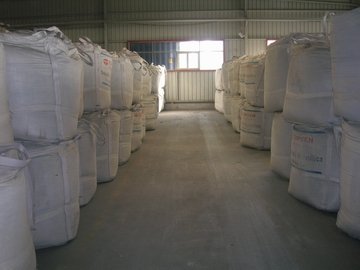
A: Absolutely. Undensified silica fume disperses more rapidly than densified forms, making it ideal for ready-mix plants with high-shear mixing. Densified silica fume is easier to transport and handle in large volumes, and both forms perform equally well when mixing is adequate and ASTM C1240 specifications are met.
Q: What is the typical dosage range for silica fume in marine concrete?
A: For general underwater construction, dosages range from 5–10% bwoc. Highly aggressive environments (tidal zones, splash zones, or deep-water caissons) often use 10–15% to minimize chloride ingress and washout. Higher doses require careful superplasticizer adjustment to avoid early stiffening.
About Henan Superior Abrasives (HSA)
Henan Superior Abrasives (HSA) is a China-based global supplier of high-quality silica fume (microsilica) for concrete and refractory applications. Supplying both densified and undensified grades compliant with ASTM C1240 and EN 13263, HSA serves customers in 30+ countries with reliable microsilica solutions for HPC, UHPC, precast concrete, shotcrete, and other high-performance construction materials.
Get a Quote or Free Sample
Ready to improve your concrete performance with premium silica fume? Contact our technical team today — we respond within 24 hours and can arrange free samples for qualified projects.
- 📧 Email: sales@superior-abrasives.com
- 💬 WhatsApp: +86-186-3863-8803