When a high-profile bridge deck or architectural precast panel arrives on site with uneven blue-grey mottling instead of the specified uniform tone, the immediate cost is a rejected batch, a delayed pour cycle, and forensic testing bills that can exceed $15,000 per incident. Architects and structural engineers spec silica fume for its unmatched strength and durability gains, yet many still encounter color variability that triggers aesthetic non-compliance. This article breaks down the precise chemical and physical mechanisms behind silica fume-induced concrete discoloration and delivers actionable mix design and curing controls to achieve consistent, spec-ready surface appearance.
1. The Fundamental Mechanism: Why Pozzolanic Refinement Alters Optical Properties
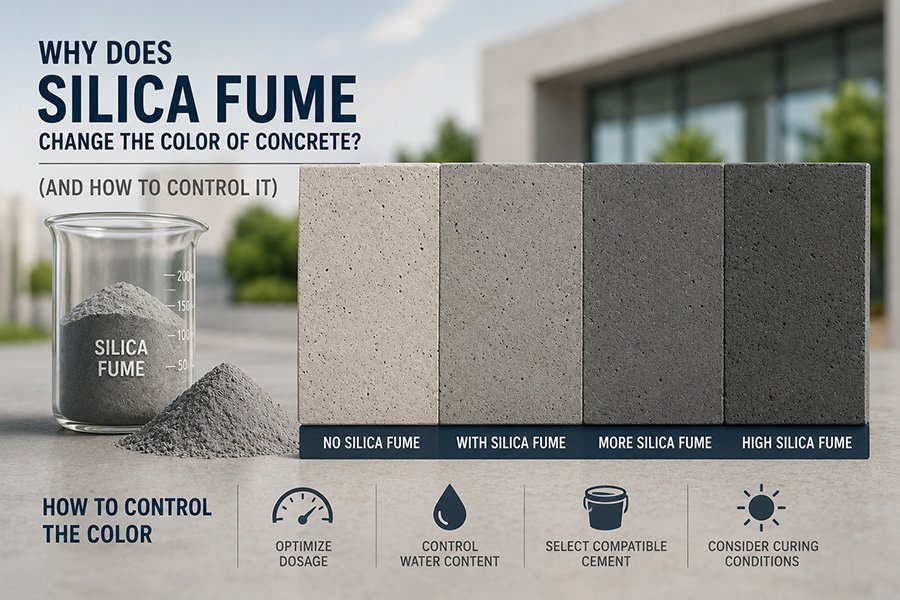
Unlike ordinary gray cement paste that reflects light diffusely, silica fume-modified concrete develops a distinctly darker, often bluish-black hue when wet and a lighter gray tone when cured. The primary driver is not pigment but a radical densification of the cementitious matrix. With a median particle size of 0.1–0.3 µm and a BET surface area exceeding 15,000 m²/kg, microsilica particles fill capillary voids and consume calcium hydroxide (CH) through the pozzolanic reaction, converting weak, light-scattering CH crystals into additional dense C-S-H gel. This refined microstructure reduces internal light refraction, causing the surface to absorb more light and appear darker.
Secondary color shifts arise from carbon content. During the ferrosilicon smelting process that produces silica fume, residual carbon in the form of graphite or amorphous carbon becomes entrained in the collected fume. Higher carbon levels impart a signature slate-blue tone in the fresh state. Densified forms of silica fume, such as our 92 Grade Silica Fume For Concrete, undergo a mechanical agglomeration process that can slightly shear carbon particles, affecting how they disperse and influence final surface color.
2. Carbon Content, LOI, and the Blue-Black Tint in Fresh Concrete
Loss on Ignition (LOI) is the direct proxy for carbon content in silica fume, and it remains the most potent variable governing initial wet color. Standard gray cement typically exhibits LOI below 3%; silica fume grades for concrete range from below 1.0% to above 2.5% depending on the source and post-processing. Engineers observing an unexpectedly dark, almost ink-like bleed water should first verify the silica fume’s LOI certificate against the ordered specification. Carbon particles, being hydrophobic and extremely fine, migrate with bleed water and concentrate at the surface, creating localized dark patches.
A common specification failure mode occurs when a contractor orders a 92% SiO₂ grade for mechanical performance but receives a high-LOI batch originally intended for refractory applications where color is irrelevant. The technical fix is to specify silica fume with LOI ≤ 1.5% and confirm a minimum SiO₂ content threshold through XRF analysis on the delivery certificate, referencing ASTM C1240 limits.
3. How Silica Fume Grade and Purity Dictate Surface Tone Stability
Silica fume is not a single commodity; four commercially distinct grades exist, and each leaves a different optical fingerprint. The table below correlates silica content, LOI, and typical color behavior to guide specification.
| Grade | SiO₂ Content (wt%) | Typical LOI (%) | Color Impact in Concrete |
|---|---|---|---|
| 85 Grade | 83–88 | 2.0–3.5 | Pronounced blue-black bleeding; high risk of differential curing streaks |
| 92 Grade | 90–94 | 0.8–1.5 | Controlled dark grey; minimal surface carbon migration |
| 94 Grade | 93–95 | 0.5–1.2 | Stable medium grey; preferred for architectural UHPC |
| 96 Grade | 95–97.5 | <0.8 | Lightest tone of all grades; near-white potential in HPC blends |
Selecting a 94 Grade Silica Fume For Concrete offers a balance between ultra-high reactivity and low carbon tinting. For projects where the lightest possible cured matrix is essential—such as white architectural panels—a 96 Grade Silica Fume For Refractory can be specified, provided the high SiO₂ purity does not compromise fresh-state workability through excessive water demand.
4. Mix Design Variables That Amplify or Suppress Color Variation
Color inconsistency rarely originates from silica fume alone. It emerges from the interaction between microsilica dosage, cement alkali content, water-binder ratio, and superplasticizer chemistry. At dosages above 8% by mass of cementitious material, the densification of the interfacial transition zone (ITZ) becomes so pronounced that surface moisture evaporation rates change dramatically, creating a “case-hardening” effect that traps moisture beneath a tight surface skin and produces dark, map-cracking-like color boundaries.
Key mix design adjustments include:
- Maintain w/b ratio ≤ 0.35 — excess free water mobilizes carbon particles to the surface during bleeding, intensifying blotchiness.
- Select a PCE superplasticizer compatible with high-SiO₂ fines — incompatible dispersants cause microsilica flocculation, which manifests as grey specks on formed surfaces.
- Limit silica fume dosage to 5–10% in non-massive sections — exceeding 12% without a corresponding increase in curing rigor nearly guarantees color variation due to autogenous shrinkage microcracking.
- Blend with a light-colored cement — high-MgO or high-iron cements compound the darkening effect; use a low-C₄AF white or off-white cement for critical architectural finishes.
5. Placement, Finishing, and Curing Protocols That Lock in Uniform Color
Even a perfectly proportioned silica fume mix will mottle if site practices ignore its zero-bleed rheology. Silica fume concrete exhibits virtually no bleeding; surface water evaporates instead of being replenished from below. Without immediate curing, the surface desiccates within minutes, leaving lighter, powdery patches adjacent to darker, still-moist zones. This is the leading cause of rejection for flatwork and formed vertical surfaces alike.
- Apply an evaporation retarder or fog mist immediately after screeding — do not wait for bleed water to appear, because it will not.
- Use a single-pass power trowel technique with minimal re-wetting; hard troweling silica fume concrete after initial set tears open the dense surface and exposes unhydrated cement, creating permanent white streaks.
- Wet cure continuously for a minimum of 7 days at 20°C, or apply a high-solids curing membrane within 15 minutes of final finish. The pozzolanic reaction that densifies the C-S-H gel requires sustained internal humidity; interruption during the first 72 hours produces irreversible light-colored hydration fronts.
- For precast elements, match steam-curing ramp rates to the silica fume grade. A 92 Grade Silica Fume For Refractory blend in a castable may tolerate faster ramp-up, but in dense UHPC panels, a maximum 20°C/hour rate prevents thermal gradients that separate carbon fines from the matrix.
6. Diagnostic Flow When an On-Site Color Failure Occurs
When a delivered element fails a visual inspection, a systematic forensic approach isolates the root cause and prevents recurrence. Do not assume the silica fume supplier is at fault before ruling out batching and curing variables. The following table maps observed color defect patterns to probable causes and corrective actions.
| Observed Defect | Probable Cause | Immediate Corrective Action |
|---|---|---|
| Uniform dark grey but with isolated light patches | Inadequate mixing dispersion; undensified silica fume agglomerates acting as CH sinks | Increase mixing time to 90 seconds after all materials charged; verify shear energy input |
| Dark surface with distinct pour-lift boundaries | Surface crusting due to delayed curing between lifts | Reduce maximum time between lifts to under 45 minutes; apply wet burlap at cold joints |
| Permanent blue-grey core with lighter cured skin | High-LOI silica fume in a low-w/b ratio mix; carbon trapped in bulk but surface oxidized | Switch to an 85 Grade Silica Fume only if color is secondary to insulation value, otherwise upgrade to 94 Grade minimum |
| Efflorescence-like white film over a dark matrix | Alkali-carbonate reaction; soluble alkalis reacting with atmospheric CO₂ in the dense pore network | Reduce cement alkali content to below 0.6% Na₂O equivalent; apply penetrating silane sealer |
7. Specification Language to Enforce Color Consistency Across Borders
Procurement professionals and specifiers managing international supply chains must embed color-relevant parameters directly into the silica fume purchase order and concrete performance specification. Without explicit criteria, material certified solely to ASTM C1240 or EN 13263 will meet strength and durability metrics while still causing aesthetic rejection. A robust specification addresses three dimensions of color risk:
“The silica fume shall exhibit a Loss on Ignition (LOI) not exceeding 1.2% when tested in accordance with EN 196-2 and shall produce no visible surface mottling greater than a Delta E of 3.0 (CIE Lab) between formed and unformed surfaces when measured on a 28-day cured, dry-cut prism.”
Require the supplier to provide a retained sample from the production lot and, for critical architectural elements, a miniature mix trial casting with the same cement and admixtures planned for the project. Digital colorimetry documentation prior to bulk shipment eliminates disputes that otherwise arise only after formwork is stripped. Specifying one consistent, high-purity grade for the entire project—rather than blending multiple shipments—reduces the variable that causes the most field headaches: batch-to-batch carbon content swings.
Frequently Asked Questions
Q: Does silica fume always darken concrete?
A: No. Color shift depends on dosage, carbon content (LOI), and dispersion. At 5–10% by weight of cement, silica fume often produces a darker or bluish-gray shade. Very low LOI (<1%) and densified grades may show less darkening.
Q: What causes silica fume to make concrete look darker?
A: Finer particles (BET surface area 15–30 m²/g) fill voids and densify the ITZ, reducing light scattering. Unburned carbon in the silica fume also absorbs more visible light, deepening the gray tone.
Q: Can I lighten concrete if silica fume makes it too dark?
A: Yes—use high-purity silica fume (LOI < 2%), keep dosage at 5–7%, and ensure thorough mixing. White cement or titanium dioxide pigment at 2–5% by weight of binder can offset darkening in architectural concrete.
Q: How do I achieve consistent color in silica fume concrete across batches?
A: Control water-to-binder ratio (±0.02), use the same silica fume source, and maintain identical curing temperature and moisture. ASTM C1240 requires a uniform carbon content—specify a maximum 1% LOI variation.
Q: Does densified silica fume affect color differently than undensified?
A: Yes. Densified silica fume can have pockets of undeagglomerated fines that cause localized color variation. Undensified (bulk or slurry) disperses more evenly, producing a more uniform final color.
About Henan Superior Abrasives (HSA)
Henan Superior Abrasives (HSA) is a China-based manufacturer and global supplier of high-quality silica fume (microsilica) for concrete and refractory applications. Supplying both densified and undensified grades compliant with ASTM C1240 and EN 13263, HSA serves customers in 30+ countries with reliable microsilica solutions for HPC, UHPC, precast concrete, shotcrete, and other high-performance construction materials.
Get a Quote or Free Sample
Ready to improve your concrete performance with premium silica fume? Contact our technical team today — we respond within 24 hours and can arrange free samples for qualified projects.
- 📧 Email: sales@superior-abrasives.com
- 💬 WhatsApp: +86-186-3863-8803