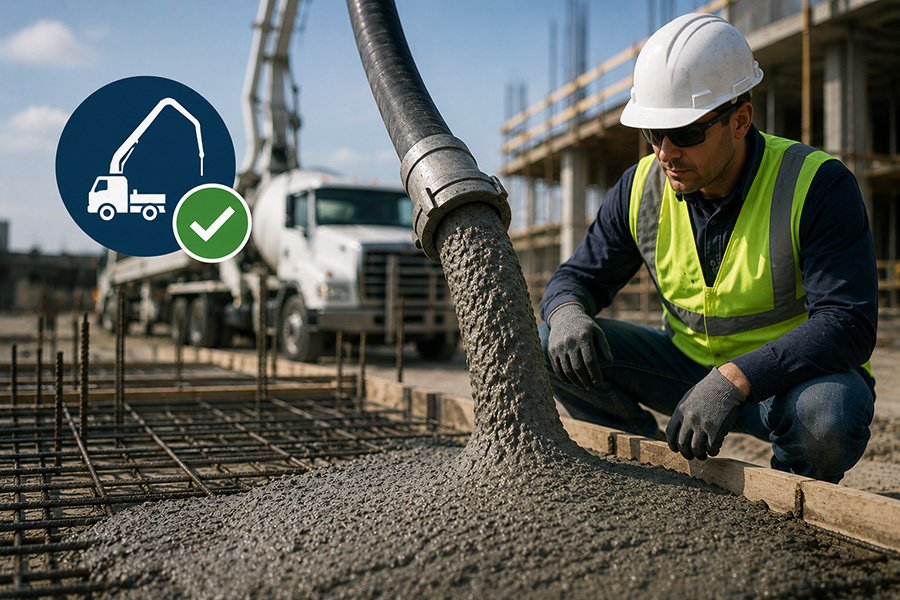
Silica fume concrete can plug a high-rise pump line in under 45 seconds—costing crews an entire shift in downtime, hammering, and pipe replacement. The primary cause is rarely a single failure; it is almost always a cascade of unchecked interactions between mix design, superplasticizer timing, and pipeline pressure. What contractors need is not a simple yes or no answer to “Can you pump silica fume concrete?” but a systematic troubleshooting framework that isolates each variable before it triggers a catastrophic blockage.
Why Silica Fume Concrete Becomes Unpumpable: The Viscosity Trap
Adding undensified silica fume sharply increases the paste’s yield stress and plastic viscosity because of its extreme specific surface area—typically 15,000 to 30,000 m²/kg via BET measurement. This enormous surface demands much more water to wet particle surfaces, yet high-performance concrete (HPC) and ultra-high-performance concrete (UHPC) specifications enforce w/b ratios below 0.25. The resulting paste rheology can transition from shear-thinning to dilatant under the high shear rates inside a pump line, instantly locking aggregates into a plugged mass.
Engineers often misdiagnose this as an aggregate gradation problem. In reality, the interfacial transition zone (ITZ) densification provided by silica fume’s pozzolanic reaction is a long-term strength asset but a short-term pumping liability. Coping with this requires a deliberate shift in how we sequence batching and how we select the polycarboxylate ether (PCE) superplasticizer chemistry.
Selecting the Correct Silica Fume Grade for Your Pumping Application
Not all silica fume grades exert the same rheological demand. Densified silica fume, produced through mechanical agglomeration, disperses more gradually and reduces the instantaneous water demand spike compared to undensified powder. For general HPC pump mixes, an 85 Grade Silica Fume with moderate SiO₂ content often balances reactivity with manageable viscosity. For refractory applications where pumping is part of the installation, specialist grades designed for gunning or pumping provide the necessary flow characteristics without sacrificing hot strength.
Selection must also align with local standards. Conforming to ASTM C1240 or EN 13263 ensures the material’s loss on ignition (LOI) and oversize particle percentages are controlled—both factors strongly influence how uniformly the material reacts with PCE superplasticizers during shear.
Mix Design Adjustments: Overcoming the Particle Packing Paradox
Pumping silica fume concrete successfully hinges on optimizing particle packing to free up trapped water while maintaining the pozzolanic efficiency that generates secondary C-S-H gel. A poorly designed mix forces the paste into the pump’s lubrication layer, leaving a dry, high-friction aggregate core to stall inside the pipe.
The following table outlines critical mix parameters and their direct effect on pumpability, based on field data from multiple UHPC and HPC pours.
| Parameter | Risk Threshold | Pump-Friendly Target | Mechanism Affected |
|---|---|---|---|
| w/b ratio (with silica fume) | Below 0.22 without PCE adjustment | 0.24 – 0.28 (adjust with PCE to meet strength) | Paste viscosity; lubrication layer continuity |
| Silica fume dosage (by cement wt.) | Exceeding 12% in undensified form | 6 – 10% (densified preferred for high-volume pumping) | Yield stress; ITZ densification rate |
| PCE dosage timing | Full upfront addition to dry blend | Staggered or delayed addition after initial wetting | Slump retention; competitive adsorption with silica fume |
| Fine aggregate angularity | 100% manufactured sand with high fines | Blend with natural sand or reduce ultra-fines content | Inter-particle friction during pipeline shear |
For projects requiring exceptional chemical resistance alongside pumpability, a 92 Grade Silica Fume for concrete offers an effective middle ground—high SiO₂ reactivity for C-S-H gel formation without the extreme plastic viscosity spike seen in 96-grade materials. For refractory placements where pumping is required, consider the analogous 92 Grade Silica Fume for refractory grade, which is tailored for castable rheology at high temperatures.
Batching Sequence and Superplasticizer Compatibility: The 90-Second Rule
Conventional batching sequences often fail when silica fume is treated as a direct cement replacement added at the start. Silica fume particles compete aggressively with cement grains for PCE superplasticizer molecules. When PCE adsorbs preferentially onto silica fume’s high-energy surface, cement flocculation remains unbroken, and the mix exhibits a false slump—a stiff appearance that suddenly liquifies under pump pressure, then over-shears and segregate
To prevent this, adopt a proven staggered batching method:
- Pre-wet the silica fume: Blend it with the full batch water and 30–40% of the PCE dose for 60–90 seconds before adding cement. This saturates the most reactive surface sites and reduces competitive adsorption on cement grains.
- Break cement flocs: Introduce cement and aggregate only after the silica fume slurry is homogeneous, ensuring the remaining PCE can efficiently disperse the binder system.
- Monitor shear history: Limit mixing energy after the final water addition to prevent irreversible breakdown of the stabilizing PCE layer.
Pipeline Setup and Pump Configuration: Pressure Drop Diagnostics
Even a perfectly batched load will block if the pump setup ignores the dense, low-bleed nature of silica fume concrete. Unlike conventional mixes that form a thick, stable lubrication layer, silica fume mixes produce a thin lubrication film that degrades rapidly under erratic pressure fluctuations. Sharp reductions in pipe diameter, worn pump seals, or excessive flexible hose can rupture this film, forcing the mix into plug flow with zero boundary slip.
Contractors should pressure-map their pipeline before each pour. A sudden rise in line pressure exceeding 50 bar over the calculated baseline is a reliable early warning of incipient plug formation. Using 94 Grade Silica Fume for concrete formulations can slightly improve lubrication layer stability compared to lower-grade alternatives, thanks to its optimized particle size distribution that aids packing in the paste fraction. When specifying for structural elements where compressive strength and pore refinement are non-negotiable, this grade provides a measurable edge in preventing bleed-induced blockages.
Troubleshooting Field Blockages: A Systematic Recovery Protocol
When a blockage occurs, instinct often makes the problem worse. Crews sometimes rev the pump or add water at the hopper—both actions can force the concrete into a dense, immovable plug deeper into the line. Instead, follow a controlled diagnostic sequence:
- Isolate and decompress: Stop the pump immediately and relieve line pressure using the bleed valve to prevent a dangerous reverse surge.
- Locate the plug acoustically: Tap with a hammer along the steel pipeline. A dull, solid thud (rather than a ringing tone) pinpoints the blockage’s location within a few joints.
- Remove, don’t push: Open the joint nearest the plug’s center and clear it manually. Attempting to re-prime through a blocked section can blow packings and shear pins.
- Adjust before restarting: Before resuming the pour, increase the PCE dose of the remaining load by 0.1–0.2% by binder weight, verify the slump, and consider reducing the silica fume dosage if allowable under specification.
For applications such as refractory linings where the concrete must pump into complex forms and survive extreme thermal cycling, a 96 Grade Silica Fume for refractory may be mandated despite its higher pumping difficulty. In these cases, pre-testing the mix with the exact pump and line length at full scale is not optional—it is the only reliable way to tune PCE dosage and batching sequence before the critical pour.
Verifying Pumpability Before the Pour: Beyond the Slump Test
A slump cone reading alone is dangerously misleading for silica fume mixes. A 650 mm flow table spread can mask a mix that will rapidly build structure and lock up under sustained shear within 20 minutes of batching. Instead, on-site verification should include a rheometer check for plastic viscosity and a mini-slump cone test for flow retention at 0, 30, and 60 minutes. Coupling this with an air content check confirms that PCE is not entraining excessive air under high-shear mixing, which would increase compressibility and destroy the lubrication layer during pumping.
The pozzolanic reaction that delivers impermeability and high strength in cured concrete begins the moment silica fume contacts water and alkalis. Respecting that chemical timeline—rather than fighting it with aggressive retempering—separates predictable, repeatable pumping outcomes from costly pipeline failures.
Frequently Asked Questions
Q: Why does silica fume concrete often cause pump blockages?
A: Silica fume particles (0.1–0.2 µm) have a high specific surface area (15–25 m²/g per ASTM C1240) that adsorbs a large portion of the mixing water. This drastically reduces the paste lubricity and increases the yield stress of the mix. Without adequate PCE superplasticizer dosing (typically 1–2% by mass of cementitious material), the concrete becomes stiff and cohesive, leading to line plugs, especially in bends or reducers.
Q: What is the optimal slump or slump flow for pumpable silica fume concrete?
A: For conventional pumping, a slump of 150–200 mm (6–8 in.) is recommended. For HPC/UHPC mixes containing 8–15% silica fume by cement weight, a slump flow of 500–700 mm with a T50 time of 3–7 seconds (ASTM C1611) indicates high deformability without excessive segregation. A too-low slump (<100 mm) creates high friction and blockage risk; a too-high flow (>750 mm) may lead to bleeding and pressure loss.
Q: How should the mix design be adjusted to improve pumpability of silica fume concrete?
A: Increase the paste volume by 5–10% compared to standard concrete, maintain a w/b ratio between 0.30 and 0.38, and use a polycarboxylate-based HRWRA (dosage 1.5–2.5% of binder). Replace 5–10% of fine aggregate with silica fume to enhance particle packing. Adding 15–25% fly ash or slag as a second SCM reduces the internal friction and thins the lubricating layer. Ensure the sand content is 38–42% of total aggregate to improve cohesion.
Q: Does silica fume concrete require a special pump or pipeline setup?
A: Yes. Use a piston pump with a minimum diameter of 125 mm (5 in.) for normal concrete, or 150 mm for UHPC. The boom line should have no more than two 90° bends per 100 m, and step reducers must be gradual (e.g., 150→125 mm over 1 m). Priming the line with a 1:1 cement-water grout followed by a lean mortar “slug” reduces friction. For long-distance pumping (>300 m), a positive-displacement pump with at least 150 bar capacity is required.
Q: How can a contractor troubleshoot a slow or erratic pump output on site?
A: First, verify the concrete temperature does not exceed 32°C (90°F) — silica fume concrete has a high heat of hydration and can flash-set in hot lines. Check superplasticizer dosage: an underdosed mix (high yield stress) will cause surging; overdose leads to bleeding and pump cavitation. Use a pressure gauge at the pump outlet: 80–120 bar is typical for horizontal pumping; above 150 bar indicates a pending blockage. If flow fluctuates, reduce the pump stroke rate by 20% and add a retarder (0.2–0.5% of binder weight) to extend workability.
About Henan Superior Abrasives (HSA)
Henan Superior Abrasives (HSA) is a China-based manufacturer and global supplier of high-quality silica fume (microsilica) for concrete and refractory applications. Supplying both densified and undensified grades compliant with ASTM C1240 and EN 13263, HSA serves customers in 30+ countries with reliable microsilica solutions for HPC, UHPC, precast concrete, shotcrete, and other high-performance construction materials.
Get a Quote or Free Sample
Ready to improve your concrete performance with premium silica fume? Contact our technical team today — we respond within 24 hours and can arrange free samples for qualified projects.
- 📧 Email: sales@superior-abrasives.com
- 💬 WhatsApp: +86-186-3863-8803