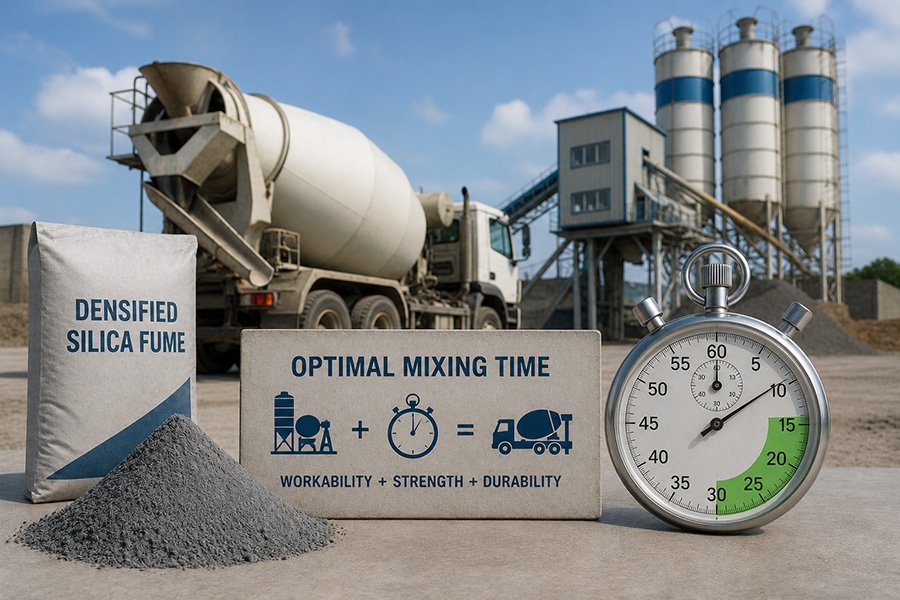
In ready-mix plants, insufficient mixing of densified silica fume allows agglomerated microsilica particles to survive the batching cycle, acting not as a reactive pozzolan but as inert fillers that compromise compressive strength, increase permeability, and create localized weak zones in the interfacial transition zone. This directly risks structural non-conformance, costly rejected loads, and failure to meet ASTM C1240 or EN 13263 performance criteria. The core technical challenge is not simply “longer mixing,” but matching shear energy and time to the dissolution kinetics of the densified grains.
Why Densified Silica Fume Demands Different Mixing Logic
Densified silica fume is not merely a compressed version of the undensified powder. The densification process creates interlocked agglomerates, typically 0.3–1 mm in size, held together by weak Van der Waals forces and mechanical interlocking. In undensified products, particles with a BET surface area of 15–25 m²/g disperse almost instantly under high-range water reducers. Densified grains, however, must undergo a two-stage process: first, external mechanical shearing and water ingress break the agglomerate; second, the liberated primary particles—averaging 0.15 µm—disperse throughout the paste to enable the pozzolanic reaction with calcium hydroxide.
What complicates mixing in a ready-mix drum is the variable shear environment. A stationary truck waiting in a queue provides virtually zero dispersion energy, while a high-speed central mixer in a precast plant can over-shear the material. Engineers specifying high-performance concrete (HPC) must therefore abandon any generic “90-second mixing rule” and instead calibrate time against mixer type and the specific agglomerate hardness of the material. A 94-grade silica fume with a tighter particle size distribution, for example, will often require different energy input than an 85-grade product used for less demanding strength classes. For projects where early-age strength gain is critical, selecting a consistent 94 Grade Silica Fume For Concrete can reduce variability during mixing validation trials.
Physiochemical Threshold: From Agglomerates to C-S-H Gel
The consequences of inadequate mixing are not immediately visible in the fresh state. A slump test might meet specification, and the surface finish may appear uniform. Internally, however, undisrupted densified grains persist as silica fume “nuggets” that never participate in pore refinement. This is because the dissolution of SiO₂ and its subsequent reaction to form calcium-silicate-hydrate (C-S-H) gel can only occur when the particle is wetted and separated at the micron scale. Undispersed agglomerates act instead as weak micro-inclusions, often creating porous halos around themselves that increase the average pore diameter by an order of magnitude.
A robust quality-assurance protocol should verify dispersion, not just slump and air content. A practical field method involves taking a wet-sieved mortar sample and spreading it on a black glass plate; visible dark specks indicate surviving agglomerates. Such specks correlate strongly with a reduction in 28-day strength of 8–15 MPa in UHPC mixes, precisely because the unreacted core of the agglomerate fails to densify the ITZ between paste and aggregate.
Mixing Time Matrix by Equipment Type
There is no single absolute figure for optimal mixing time. The variable is not time alone, but the total specific mixing energy (kJ/kg) imparted to the plastic concrete. The following table provides field-validated benchmarks based on common plant configurations for a target agglomerate dispersion efficiency exceeding 95%. These values assume the silica fume is batched with the coarse aggregate and water before cement is added, a sequence that pre-wets the grains under high-shear inter-particle grinding.
| Mixer Type | Mixing Speed (rpm) | Minimum Wet Mixing Time (seconds) | Recommended w/b Ratio Addition Point |
|---|---|---|---|
| Twin-Shaft Central Mixer | 30–45 | 60–75 | Before 30s of mixing elapsed |
| Planetary Counter-Current | 20–30 | 90–110 | During initial 20s, staggered |
| Ready-Mix Truck (Charge Speed) | 12–18 | 120–180* | Full charge prior to 60s mark |
| Ready-Mix Truck (Stationary Idle) | 0–5 | Insufficient at any duration | Must agitate at charge speed |
*Truck-mixed loads carrying densified silica fume should run at maximum rated charge speed (not merely agitating speed) for the designated period. Count mixing time from the moment all powders touch water, not from batch completion.
Optimizing Sequence to Minimize Total Mixing Time
Even a well-calibrated mixing duration fails if the batching sequence does not exploit the synergistic scouring action of coarse aggregate. The goal is to use the aggregate as a grinding medium to mechanically erode the densified grains before the cement paste builds significant viscosity. A structured sequence reduces the required mixing time by 20–30% compared to simply adding silica fume last among powders.
- Charge 50–70% of the mix water and all coarse aggregate into the mixer. Begin rotation.
- Introduce the total measured dose of densified silica fume directly onto the wetted aggregate stream. The impact and tumbling action initiates agglomerate breakdown without paste interference.
- Add the full cementitious binder content after a 15-second delay, when silica fume grains have visibly darkened from moisture uptake.
- Dose the remaining water and PCE superplasticizer gradually over the next 30 seconds to maintain a shear-friendly, low-viscosity suspension during the critical dispersion window.
This method is particularly effective when using higher-purity densified fume destined for refractory service, where any silica agglomerate surviving the mixing cycle can become a critical flaw during thermal cycling. In high-purity formulations, the physical dispersion challenge mirrors that of materials formulated for concrete, though the end-use context differs. A 92 Grade Silica Fume For Refractory product often carries similarly tight agglomerate strength specifications, reinforcing the principle that mechanical pre-dispersion is universal practice.
Impact of PCE Superplasticizer on Dispersion Kinetics
Polycarboxylate ether (PCE) superplasticizers do not directly break open densified agglomerates—that remains a mechanical shear function. However, PCE architecture critically accelerates the secondary dispersal of freed primary particles. By adsorbing onto the silica fume surface, PCE polymers create electrosteric repulsion that prevents re-agglomeration. In mixes without sufficient PCE, even adequately sheared-out particles can flocculate again in the high-ionic-strength pore solution, effectively undoing the mixing work.
A loss-on-ignition (LOI) value above 3.0% on a densified product typically signals surface carbon that can interfere with PCE adsorption, requiring an increase of 0.1–0.2% in admixture dosage to achieve equivalent particle separation. For standard ready-mix operations using an 85-grade product in moderate-strength applications, balancing LOI and PCE dosage becomes a cost determinant in the mixing equation. Consistent 85 Grade Silica Fume with a stable carbon content simplifies this calibration, allowing the plant to lock in a proven mixing protocol without batch-by-batch admixture adjustments.
Validation Protocols: When Is the Mix “Done”?
Defining optimal mixing time requires an objective endpoint beyond visual observation. A practical, immediate validation method is the wash-out sieve test, using a 45 µm (No. 325) sieve. Collect a representative mortar sample from the discharged concrete, wash it gently through the sieve, and examine the retained material. If any dark, glassy particles are visible to the naked eye or under a low-power lens, substantial agglomerates persist.
A more quantitative approach measures the electrical conductivity evolution of the mixing water over time. As silica fume dissolves and releases alkali ions, the pore solution conductivity increases rapidly during effective dispersion but plateaus if agglomerates remain shielded. A conductivity curve that stabilizes within the designated mixing window confirms full wetting is achieved. For projects demanding the highest available pozzolanic performance, validating dispersion of a 92 Grade Silica Fume For Concrete through this method ensures that subsequent strength development follows the predicted maturity curve without hidden strength-limiting defects.
Cost of Over-Mixing vs. the Price of Under-Dispersion
Plant managers often resist extending mixing cycles, citing reduced truck utilization and increased wear on blades and drums. These are real operational costs but must be weighed against the far greater risk of under-dispersion. A single rejected 10 m³ load due to compressive strength failure at 28 days represents a direct loss far exceeding weeks of marginal productivity gains.
- Over-mixing effect: Extended shearing beyond the full-dispersion point can raise concrete temperature by 2–4°C and entrain additional air, slightly increasing slump. Compensation via minor superplasticizer or retarder adjustments is straightforward.
- Under-mixing effect: Undispersed agglomerates create a permanent, unquantified strength deficit. The failure mode is brittle, unpredictable, and may not appear until cores are extracted—a time when remediation costs are catastrophic.
- Mixer wear reality: Drum blade wear attributable to silica fume extension is negligible compared to wear from coarse aggregate. The economic argument for short mixing holds little validity under scrutiny.
In high-purity refractory castables where fused silica or tabular alumina forms the aggregate skeleton, the same principles apply with even greater severity. A 96 Grade Silica Fume For Refractory used in a low-cement castable will cause catastrophic hot modulus of rupture loss if agglomerates survive mixing, because the unreacted silica pockets act as flux concentration points at service temperature.
Frequently Asked Questions
Q: What is the recommended mixing time for densified silica fume in a ready-mix plant?
A: For twin-shaft or planetary mixers, a wet mixing time of 60–90 seconds after all materials are in the drum is standard. High-energy mixers may reduce this to 45 seconds, but never below 30 seconds. Addition of the silica fume with the aggregates (before cement and water) helps pre-disperse the densified pellets.
Q: Why is extended mixing needed for densified silica fume compared to undensified?
A: Densified silica fume has agglomerated pellets (0.1–5 mm) which require shear energy to break down into primary particles (0.1–0.5 µm). Without 60+ seconds of mixing, residual agglomerates create weak zones and reduce strength by up to 20%. ASTM C1240 defines dispersion quality control using a wash-sieve test.
Q: Can I add densified silica fume directly to the truck mixer, and how long should I mix?
A: Direct addition into a truck mixer is not recommended without a pre-slurry step. If unavoidable, add with 10–15% of mix water and agitate at mixing speed (10–14 rpm) for at least 5 minutes, then add remaining materials and mix another 5–7 minutes. Total mixing time from drum introduction to discharge should exceed 8 minutes at mixing speed.
Q: How does water addition timing affect mixing time requirements?
A: Delaying water addition by 15–30 seconds after cement and silica fume are in the mixer can cause dusting and poor wet-out, increasing required mixing time to over 120 seconds. Best practice: introduce water immediately after binder charge and use a high-range water reducer (PCE superplasticizer) 10–15 seconds later for optimal dispersion.
Q: What is the maximum acceptable undispersed residue in the wash-sieve test per ASTM C1240?
A: For densified silica fume, the residue retained on a 45 µm (No. 325) sieve after wet-sieving should typically be ≤ 10% by mass of the silica fume sample. In concrete, a field dispersion test (washing freshly mixed concrete through a 75 µm sieve) should show less than 2% retained residue from the silica fume portion for adequate mixing.