
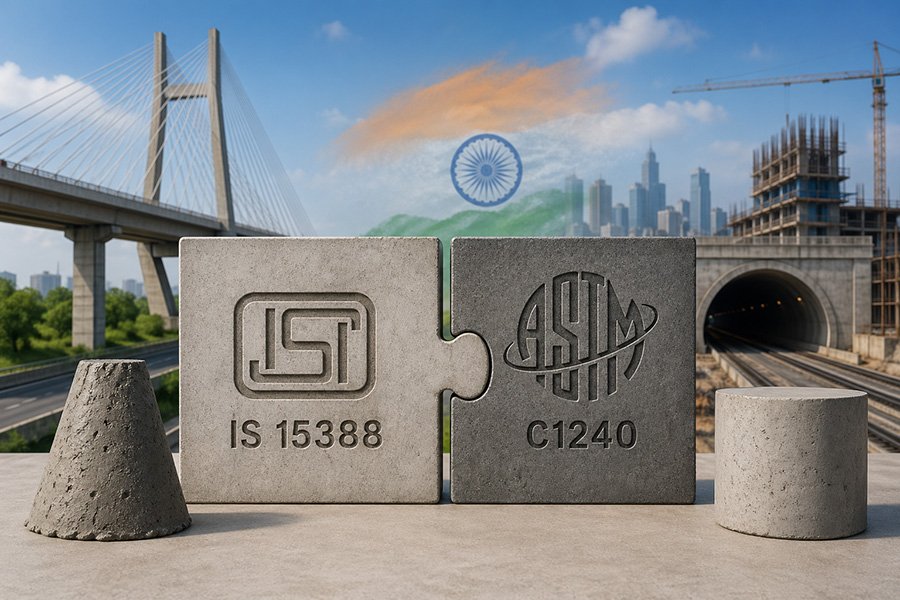
Engineers specifying microsilica for Indian infrastructure projects face a recurring dilemma: must a silica fume conform strictly to IS 15388 (Indian standard), or is a product meeting the globally recognised ASTM C1240 sufficient? The wrong answer leads to rejected deliveries, delayed approvals, or—worse—concrete that falls short of durability requirements in India’s aggressive service environments. This article dissects the technical backbone of both standards, identifies where they align and where they diverge, and gives procurement teams the criteria to select materials that simultaneously satisfy both frameworks.
Understanding IS 15388 and ASTM C1240: Scope and Intent
IS 15388:2003 (reaffirmed) specifies requirements for silica fume used as a mineral admixture in concrete, closely mirroring the scope of ASTM C1240. Both standards define chemical composition, physical properties, moisture control, and pozzolanic activity as quality benchmarks. Yet their origins differ: IS 15388 was developed with Indian raw materials and construction practices in mind, while ASTM C1240 emerged from North American and European silica fume production and performance data.
The critical consequence for infrastructure projects is that a microsilica product might comfortably pass ASTM C1240 but fail a single IS 15388 parameter—typically because of a tighter limit on loss on ignition (LOI) or a different strength activity test protocol. Understanding these nuances prevents non-compliant stockpiles from reaching the batching plant.
Chemical Requirements: Where the Standards Align and Diverge
Both IS 15388 and ASTM C1240 set minimum silicon dioxide (SiO2) content as a primary purity indicator, alongside maximum limits for moisture and LOI. The table below summarises the key chemical criteria for concrete-grade silica fume under the two systems, revealing that while broad alignment exists, the Indian standard introduces a dual‑grade structure that creates an important crossover point with ASTM C1240.
| Parameter | IS 15388 Grade 1 | IS 15388 Grade 2 | ASTM C1240 |
|---|---|---|---|
| SiO2 (min %) | 85.0 | 90.0 | 85.0 |
| Loss on Ignition (max %) | 4.0 | 2.0 | 6.0 |
| Moisture Content (max %) | 3.0 | 3.0 | 3.0 |
| Available Alkalis (max % as Na2O) | 1.5 | 1.5 | 1.5 (optional requirement) |
A product marketed as “85 Grade” may readily meet ASTM C1240 and IS 15388 Grade 1, but it falls short of the 90 % SiO2 threshold required for IS Grade 2. For high‑performance concrete (HPC) and ultra‑high‑performance concrete (UHPC) in Indian bridges and metros, Grade 2 or an equivalent 92‑grade silica fume for concrete is often mandated to ensure maximum pozzolanic efficiency and minimal carbon interference.
Physical Property and Pozzolanic Activity Requirements
Physical specifications—particle fineness, oversize retention, and pozzolanic activity index (PAI)—are where compatibility tests become most decisive. ASTM C1240 prescribes a minimum strength activity index of 105 % at 7 days when tested with portland cement. IS 15388 takes a markedly different route.
- IS 15388 requires a pozzolanic activity index at least 85 % of control at 7 days using ordinary portland cement, but the test method (IS 1727) differs in cement type, sand grading, and curing from ASTM C311/C1240 procedures.
- IS 15388 explicitly limits oversize on a 45‑µm sieve to 10 % max for undensified and 5 % max for densified silica fume; ASTM C1240 simply states a maximum oversize of 10 % by a wet sieving method when requested.
- The Indian standard also imposes a control on variation in water demand (not exceeding 10 percentage points above the control mix), a test absent from the core ASTM C1240 table.
Because the strength activity index is measured against different baselines, a direct numerical comparison is unreliable. Engineers accustomed to ordering against ASTM C1240 must verify that their microsilica can clear the IS 1727 PAI hurdle using a representative Indian cement before a dual‑compliance claim is valid.
Densified vs Undensified Microsilica: Implications for Compliance
Silica fume is supplied either undensified (bulk density typically 200–350 kg/m³) or densified (500–700 kg/m³). While ASTM C1240 remains agnostic to form—applying the same chemical and physical limits—IS 15388 explicitly differentiates the two and sets stricter oversize criteria for densified grades. This reflects the Indian market’s historical preference for undensified material in concrete, driven by concerns about poor dispersion of densified clumps in low‑shear drum mixers still common on many project sites.
For infrastructure works governed by Ministry of Road Transport & Highways (MoRTH) or Delhi Metro Rail Corporation (DMRC) technical specifications, the specifier is gradually accepting densified silica fume provided it meets the tighter 5 % oversize limit and demonstrates full pozzolanic reactivity through qualification trials. A reliable 94‑grade silica fume for concrete, densified to high uniformity, can satisfy both IS 15388 oversize limits and the ASTM C1240 pozzolanic‑activity benchmark, provided the mixing protocol ensures adequate de‑agglomeration.
Meeting Both Standards in Indian Infrastructure Projects: Practical Procurement Strategies
Procurement managers and QA/QC engineers should not assume a product carrying an ASTM C1240 certificate automatically qualifies under IS 15388. The safest route is to request a third‑party test report covering both standards on the same production lot. A typical dual‑qualification package demonstrates SiO₂ ≥90 %, LOI ≤2.0 %, PAI by IS 1727 ≥85 %, and PAI by ASTM C311 ≥105 %—a profile that aligns with IS 15388 Grade 2.
In a recent metro viaduct project, the specification originally called for IS 15388 Grade 1 with ASTM C1240 as a secondary reference. Early deliveries of an 85‑grade silica fume met both limits chemically but showed a marginal PAI shortfall under IS 1727 when retested at the project lab, highlighting the importance of pre‑qualification testing with local cementitious binders. Shifting to a mid‑range 92‑grade product resolved the gap without over‑specifying. For refractory‑grade applications where ultra‑high purity is non‑negotiable, a 96‑grade silica fume for refractory may be relevant, though concrete projects rarely require SiO₂ above 94 %.
Ultimately, compatibility is not about matching every decimal of a table. It is about confirming that the critical performance levers—pozzolanic reactivity, consistency of the C‑S‑H gel enhancement, and effect on the interfacial transition zone—are reproducible under Indian batching conditions. By anchoring the technical evaluation in the most stringent subset of the two standards, project teams can specify with confidence and avoid rework.
Frequently Asked Questions
Q: Can silica fume meeting ASTM C1240 be automatically accepted for IS 15388 projects in India?
A: Not automatically. While ASTM C1240 and IS 15388 share many chemical limits, the Indian standard applies a different pozzolanic activity index test (IS 1727), tighter LOI options in Grade 2, and distinct oversize limits for densified powder. A product with only an ASTM certificate should undergo additional testing per IS 15388 before approval.
Q: What is the minimum SiO₂ content required by IS 15388 and how does it compare to ASTM C1240?
A: IS 15388 Grade 1 requires at least 85 % SiO₂—identical to ASTM C1240—while IS 15388 Grade 2 mandates a minimum 90 % SiO₂. For Indian infrastructure projects aimed at 100‑year design life (e.g., marine bridges), Grade 2 with ≥90 % SiO₂ is typically specified to maximise pozzolanic reaction and reduce permeability.
Q: How does the pozzolanic activity index test differ between IS 15388 and ASTM C1240?
A: IS 15388 uses IS 1727, which employs Indian ordinary Portland cement, standard sand, and specific curing conditions. ASTM C1240 references ASTM C311, using different cement and sand grading. The two methods can yield different percentage values for the same silica fume, so a direct numerical crossover is not valid without laboratory correlation.
Q: For Indian infrastructure megaprojects, which silica fume grade is most commonly specified to satisfy both codes?
A: A 92‑94 % SiO₂ grade silica fume typically satisfies both the premium IS 15388 Grade 2 limits (≥90 % SiO₂, LOI ≤2.0 %) and the ASTM C1240 requirement of ≥85 % SiO₂ while routinely achieving the ASTM 105 % strength activity index. Such grades are common in HPC and UHPC mixes for metro rail and major bridge decks.
Q: Does undensified or densified silica fume pose greater compliance risk when crossing between IS 15388 and ASTM C1240?
A: Densified silica fume carries a slightly higher compliance risk under IS 15388 because the standard imposes a stricter oversize limit (≤5 % on 45 µm sieve) compared with the 10 % limit for undensified powder. Proper mixing energy to break down agglomerates is essential. Undensified product usually meets both standards’ oversize requirements more easily but increases handling and dosage accuracy challenges.
About Henan Superior Abrasives (HSA)
Henan Superior Abrasives (HSA) is a China-based manufacturer and global exporter of high-performance industrial minerals, including <strong>silica fume (microsilica)</strong>, silicon carbide, and related abrasive materials. Serving concrete producers, construction engineers, and materials specifiers across 30+ countries, HSA supplies both <em>densified</em> and <em>undensified</em> silica fume grades compliant with <strong>ASTM C1240</strong> and <strong>EN 13263</strong> — powder form only, engineered for maximum pozzolanic reactivity and seamless integration into HPC, UHPC, and specialty concrete mixes.
Get a Quote or Free Sample
Ready to improve your concrete performance with premium silica fume? Contact our technical team today — we respond within 24 hours and can arrange free samples for qualified projects.
- 📧 Email: sales@superior-abrasives.com
- 💬 WhatsApp: +86-186-3863-8803