
HSA_Auto

How Does Silica Fume Affect the Curing Process of High-Performance Concrete?

How Does Silica Fume Affect the Curing Process of High-Performance Concrete?

Silica fume’s pozzolanic reactivity accelerates early-age strength gain, but it also dramatically alters moisture retention kinetics—if curing regimes fail to compensate, microcracking from autogenous shrinkage can compromise chloride resistance and reduce service life by 15–30% in high-performance concrete (HPC) bridges, marine structures, and nuclear containment shells. Solving this requires understanding how silica fume shifts the […]

How Does Silica Fume Affect the Curing Process of High-Performance Concrete? Read More »

Is Silica Fume Effective in Preventing Chloride-Induced Corrosion in Seawater?

Is Silica Fume Effective in Preventing Chloride-Induced Corrosion in Seawater?

Unchecked chloride ingress in marine concrete structures does not merely reduce service life—it drives multi-million-dollar rehabilitation programs decades ahead of schedule. Patching spalled bridge piles in tidal zones or replacing corroded precast seawall panels involves not just material cost but operational downtime and safety risk. Engineers specifying high-performance concrete for these environments face a critical

Is Silica Fume Effective in Preventing Chloride-Induced Corrosion in Seawater? Read More »

Why Does Silica Fume Change the Color of Concrete? (And How to Control It)

Why Does Silica Fume Change the Color of Concrete? (And How to Control It)

When a high-profile bridge deck or architectural precast panel arrives on site with uneven blue-grey mottling instead of the specified uniform tone, the immediate cost is a rejected batch, a delayed pour cycle, and forensic testing bills that can exceed $15,000 per incident. Architects and structural engineers spec silica fume for its unmatched strength and

Why Does Silica Fume Change the Color of Concrete? (And How to Control It) Read More »

How to Calculate the Exact Water-to-Binder Ratio When Using Microsilica

How to Calculate the Exact Water-to-Binder Ratio When Using Microsilica

A miscalculated water-to-binder (w/b) ratio when silica fume enters a high-performance concrete mix can silently erase the very durability gains the specifier demanded, shifting a 100-year service life design toward premature chloride ingress and costly structural repair. The core challenge is not that microsilica is difficult to use, but that its extreme specific surface area—often

How to Calculate the Exact Water-to-Binder Ratio When Using Microsilica Read More »

Can You Pump Silica Fume Concrete? A Troubleshooting Guide for Contractors

Can You Pump Silica Fume Concrete? A Troubleshooting Guide for Contractors

Silica fume concrete can plug a high-rise pump line in under 45 seconds—costing crews an entire shift in downtime, hammering, and pipe replacement. The primary cause is rarely a single failure; it is almost always a cascade of unchecked interactions between mix design, superplasticizer timing, and pipeline pressure. What contractors need is not a simple

Can You Pump Silica Fume Concrete? A Troubleshooting Guide for Contractors Read More »

How to Prevent Plastic Shrinkage Cracking in Silica Fume Concrete

How to Prevent Plastic Shrinkage Cracking in Silica Fume Concrete

Plastic shrinkage cracking in silica fume concrete can cut a slab’s service life by 30% or more before curing even begins. When bleed water evaporates faster than it rises, capillary tension builds in the near-surface paste – and at w/b ratios below 0.40, silica fume’s extreme fineness virtually eliminates bleeding. Engineers specifying high-performance concrete (HPC)

How to Prevent Plastic Shrinkage Cracking in Silica Fume Concrete Read More »

What is the Optimal Mixing Time for Densified Silica Fume in Ready-Mix Plants?

What is the Optimal Mixing Time for Densified Silica Fume in Ready-Mix Plants?

In ready-mix plants, insufficient mixing of densified silica fume allows agglomerated microsilica particles to survive the batching cycle, acting not as a reactive pozzolan but as inert fillers that compromise compressive strength, increase permeability, and create localized weak zones in the interfacial transition zone. This directly risks structural non-conformance, costly rejected loads, and failure to

What is the Optimal Mixing Time for Densified Silica Fume in Ready-Mix Plants? Read More »

CIF Mumbai vs FOB Qingdao

CIF Mumbai vs FOB Qingdao: Calculating the True Cost of Silica Fume for Indian Buyers

The Hidden Cost Trap in Silica Fume Procurement for Indian Projects A Mumbai-based precast yard recently lost INR 3.2 lakh on a single UHPC pour after selecting a silica fume supplier based solely on the FOB Qingdao price. The delivered cost, after factoring in freight, insurance, and customs, was 28% higher than the initial quote.

CIF Mumbai vs FOB Qingdao: Calculating the True Cost of Silica Fume for Indian Buyers Read More »

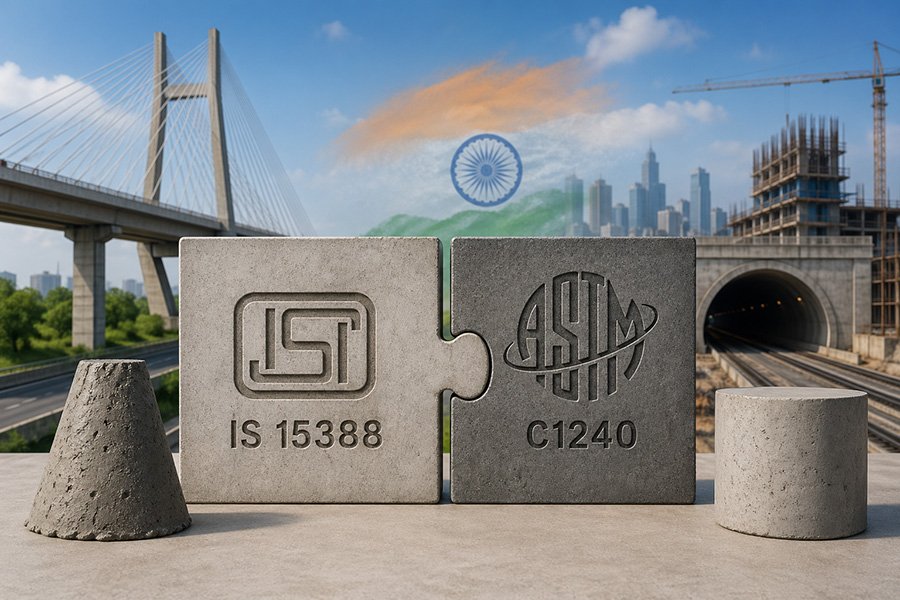
IS 15388 and ASTM C1240

IS 15388 and ASTM C1240: Are They Compatible for Indian Infrastructure Projects?

Engineers specifying microsilica for Indian infrastructure projects face a recurring dilemma: must a silica fume conform strictly to IS 15388 (Indian standard), or is a product meeting the globally recognised ASTM C1240 sufficient? The wrong answer leads to rejected deliveries, delayed approvals, or—worse—concrete that falls short of durability requirements in India’s aggressive service environments. This

IS 15388 and ASTM C1240: Are They Compatible for Indian Infrastructure Projects? Read More »

Scroll to Top