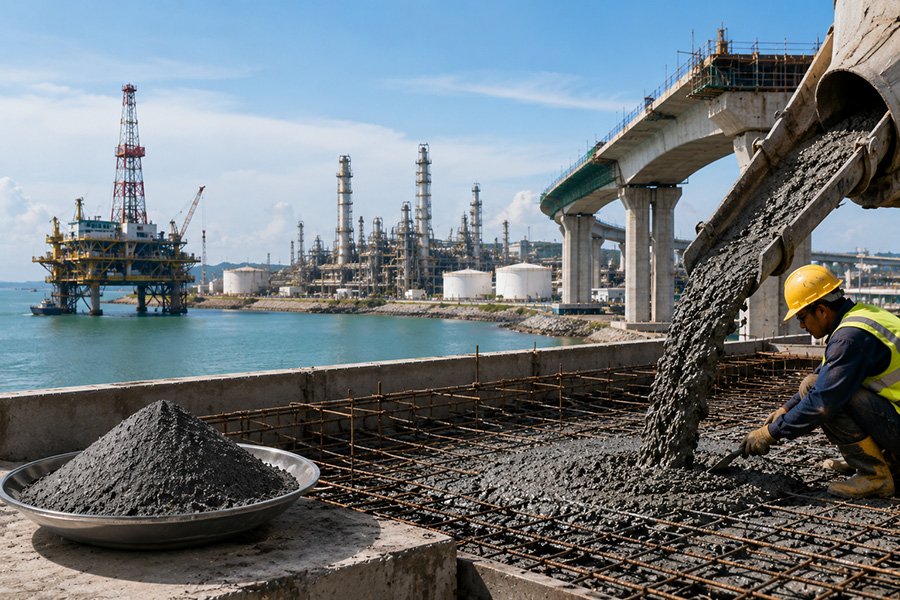
Brunei Darussalam is a small sultanate on the northwest coast of Borneo with a population of around 450,000 — and an outsized role in the global energy economy. Oil and natural gas account for roughly 90% of the country’s exports and more than half of its GDP, and the hydrocarbons sector touches almost everything built on its soil, from the onshore and offshore wells of Brunei Shell Petroleum to the LNG plant at Lumut and the petrochemical complex at Pulau Muara Besar. Alongside that, Brunei is investing heavily in transport and marine infrastructure, most visibly the 30 km Sultan Haji Omar ‘Ali Saifuddien Bridge (Temburong Bridge), one of the longest bridges in Southeast Asia, which crosses the chloride-rich waters of Brunei Bay.
Two very different industries, but they converge on a single material requirement: concrete and cement that can withstand extreme temperature, aggressive chemical, and marine exposure. That is exactly the territory where silica fume — also called microsilica — delivers its greatest value, and why a growing number of Bruneian oilfield service companies, contractors, and ready-mix producers source it from a reliable supplier.
Brunei’s Oil, Gas, and Infrastructure Landscape
Brunei’s oil and gas industry is dominated by mature but technically demanding assets. Onshore fields such as Seria, the country’s oldest producing area, coexist with deep offshore gas fields that are increasingly high-temperature and high-pressure. In these wells, cementing is not a formality: the cement sheath must isolate zones, support casing, and hold its compressive strength at bottom-hole temperatures that can exceed 110°C. That is precisely the condition in which ordinary Portland-cement slurry suffers strength retrogression, making silica fume a near-mandatory addition rather than an optional enhancement.
The same economy funds a substantial infrastructure pipeline. The Temburong Bridge, opened in 2020, is a marine structure par excellence — kilometres of viaduct and pile-supported deck standing in tidal, salt-laden water and exposed to a hot, humid, high-rainfall equatorial climate. Concrete in this environment faces chloride ingress, sulfate exposure, and aggressive carbonation all at once, which is why marine-grade mixes here increasingly specify a pozzolanic addition such as silica fume for marine concrete structures to meet the durability demands of a design life measured in decades.
What Silica Fume Is and Why It Works in Brunei’s Conditions
Silica fume is an ultra-fine amorphous silicon dioxide (SiO2) collected from the off-gases of silicon and ferrosilicon smelting, with particles roughly 100 times finer than cement grains. In both oil well cementing and structural concrete it performs two complementary functions. First, its enormous specific surface area triggers a rapid pozzolanic reaction with the calcium hydroxide produced during cement hydration, converting a weak, leachable byproduct into dense calcium silicate hydrate (C-S-H). Second, its fine particles physically pack into the voids between cement grains — a micro-filling effect that densifies the hardened matrix and sharply reduces permeability. The combined effect on concrete strength and durability is why silica fume sits at the heart of both HPHT well cement design and high-performance marine concrete.
How Silica Fume Solves Brunei’s Core Challenges
1. Preventing Strength Retrogression in High-Temperature Wells
Above roughly 110°C, the calcium silicate hydrate in a cement sheath can transform into a weak, porous phase, causing the set cement to lose compressive strength and permeability — a failure known as strength retrogression. Adding 30–40% silica fume by weight of cement stabilizes the C-S-H structure at high temperature, preserving compressive strength and integrity in Brunei’s deeper and hotter wells. This application is the focus of our 92-grade silica fume for oil well cementing.
2. Tighter Zonal Isolation and a More Impermeable Cement Sheath
Good zonal isolation depends on a cement sheath that does not let formation fluids migrate through it. Silica fume’s micro-filling effect reduces slurry permeability and free-water content, producing a denser, more impermeable sheath that protects casing and reduces the risk of gas channelling — a priority in the gas-bearing reservoirs that anchor Brunei’s LNG supply chain.
3. Chloride Resistance for Marine and Coastal Infrastructure
Chloride ions from seawater are the primary corrosion threat to reinforced concrete in Brunei Bay and along the coast. By refining the pore structure, silica fume dramatically slows chloride diffusion, delaying the onset of reinforcement corrosion and extending the service life of bridges, ports, and coastal protection works — the same principle behind our guidance on microsilica for bridge engineering.
4. High Strength for Structural and Precast Elements
From bridge pylons and prestressed girders to the heavy structural frames of industrial plants, silica fume boosts both early and ultimate compressive strength. This lets designers use leaner sections, cut curing time on precast production lines, and achieve the high-strength grades increasingly specified on flagship infrastructure projects.
5. Chemical Resistance for Refinery and Petrochemical Environments
Brunei’s downstream assets — the Lumut LNG facility and the Pulau Muara Besar refinery and petrochemical complex — expose concrete and refractory linings to thermal cycling and chemical attack. Silica fume densifies the matrix against sulfate and acid ingress and, in castables, improves hot strength, making it a standard ingredient in high-strength non-shrink grout and refractory formulations used across oil, gas, and petrochemical plants.
Where Brunei Projects Are Applying Silica Fume
| Application | Brunei Context | Key Silica Fume Benefit |
|---|---|---|
| Oil and gas well cementing | Onshore Seria and offshore gas wells, HPHT conditions | Prevents strength retrogression, tight zonal isolation |
| Marine bridges and viaducts | Temburong Bridge across Brunei Bay | Chloride resistance, extended service life |
| Ports and coastal protection | Muara Port and shoreline works | Low permeability, sulfate resistance |
| Refinery and petrochemical concrete | Lumut LNG, Pulau Muara Besar complex | Chemical and thermal resistance, high strength |
| High-rise and precast structural elements | Urban development in Bandar Seri Begawan | Higher strength grades, faster mold turnaround |
| Non-shrink grout and repair mortars | Equipment foundations and structural repair | High strength, low shrinkage, durable bond |
Best Practices for Specifying Silica Fume in Brunei
- Match grade to the job. Use 92%+ SiO2 densified silica fume for oil well cementing and marine concrete; choose undensified grades where rapid dispersion in slurry or wet-mix concrete is required.
- Dose for temperature in well cementing. High-temperature wells typically require silica fume at 30–40% by weight of cement to suppress strength retrogression; confirm with well-specific slurry design and the operator’s specification.
- Prioritize permeability class for marine work. For chloride-exposed structures, design around the permeability and chloride-diffusion requirements first, then confirm strength — durability, not raw strength, usually governs service life.
- Pair with a compatible superplasticizer. Silica fume raises water demand; a high-range water reducer is essential to maintain workability at the low water-cement ratios durability demands.
- Verify standards compliance. For well cementing, align slurry testing with API practice and request certificates of analysis covering SiO2 content, fineness, and pozzolanic activity index from your supplier.
Frequently Asked Questions
Why is silica fume essential in high-temperature oil well cementing?
At bottom-hole temperatures above roughly 110°C, ordinary cement paste can lose strength through a phase change known as strength retrogression. Silica fume reacts with the cement to form a stable, high-strength C-S-H phase that resists this degradation, preserving the integrity of the cement sheath in deep, hot wells.
What grade of silica fume should be used for Brunei’s marine bridges and coastal structures?
Marine and chloride-exposed concrete typically specifies densified silica fume with 92% SiO2 or higher, dosed at 5–10% of cementitious material by weight, to achieve the low permeability and low chloride diffusion required for long service life in seawater.
Can silica fume be supplied efficiently to Brunei for both oilfield and construction use?
Yes. Brunei is well served by sea freight through Muara Port, and silica fume is routinely shipped in bulk bags and containers into the region, supplying both oilfield service companies and ready-mix or precast producers on predictable lead times.
Does silica fume help with gas migration and zonal isolation in cementing?
Yes. By reducing slurry permeability and free-water content and by stabilizing the set-cement microstructure, silica fume contributes to a tighter cement sheath that resists gas channelling and improves zonal isolation in gas-bearing reservoirs.
Is silica fume suitable for Brunei’s hot, humid tropical climate during concrete placement?
It is, with the right handling. Silica fume’s pozzolanic reaction performs well in warm climates, but the high ambient temperatures and humidity make curing especially important — moist curing or curing membranes should be applied promptly to prevent early-age drying of the low water-cement ratio mixes silica fume is typically used in.
About HSA Microsilica
HSA Microsilica, operated by Henan Superior Abrasives (founded in 2001), is a specialized manufacturer and global supplier of silica fume, densified and undensified microsilica, and related pozzolanic materials for the oil and gas, concrete, refractory, and construction chemicals industries. With rigorous quality control and export experience across Asia, the Middle East, Europe, and the Americas, HSA Microsilica supplies material aligned to API, ASTM C1240, and other international standards, providing full documentation — including certificates of analysis and pozzolanic activity data — with every shipment.
For oilfield service companies, contractors, and ready-mix or precast producers sourcing silica fume for well cementing, marine infrastructure, or petrochemical projects in Brunei and the wider Southeast Asian region, HSA Microsilica offers densified and undensified grades suited to oil well slurry, marine concrete, and high-performance structural applications. Contact our team to discuss grades, bulk pricing, and shipment scheduling for your next project.