A miscalculated water-to-binder (w/b) ratio when silica fume enters a high-performance concrete mix can silently erase the very durability gains the specifier demanded, shifting a 100-year service life design toward premature chloride ingress and costly structural repair. The core challenge is not that microsilica is difficult to use, but that its extreme specific surface area—often spanning 15,000 to 30,000 m²/kg—fundamentally alters water demand in a way that ordinary cement-replacement math fails to capture. This article provides a rigorous, step-by-step method for calculating the exact w/b ratio when silica fume is present, ensuring your mix design meets strength targets, avoids plastic shrinkage cracking, and satisfies the strictest project specifications.
Why Conventional Water-to-Cement Logic Fails With Microsilica
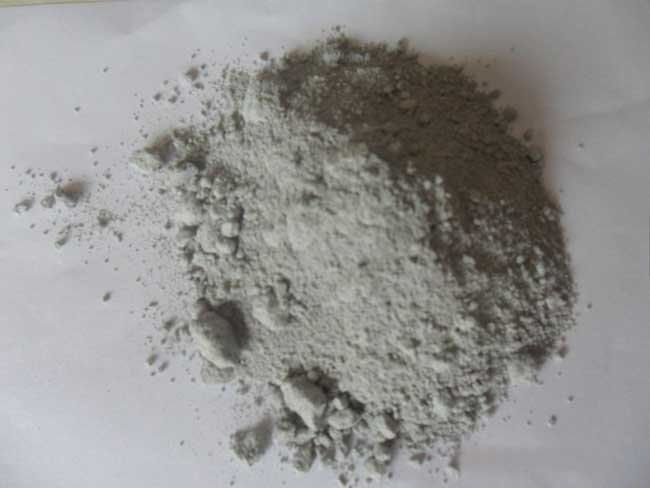
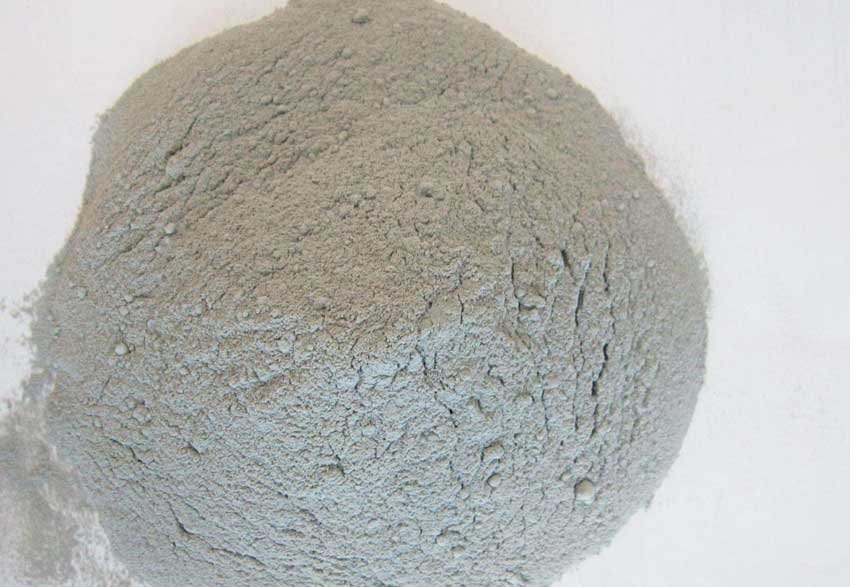
In a traditional Portland cement mixture, increasing the w/c ratio from 0.35 to 0.45 is a straightforward volume-of-water adjustment that proportionally reduces compressive strength and increases permeability. Microsilica, however, is not an inert filler—it is a highly reactive pozzolan whose particle size is roughly 1/100th that of a typical cement grain. Replacing 8% of cement mass with an undensified silica fume like Microsilica 970 U introduces roughly 50,000 to 100,000 fine particles for each cement grain displaced, sharply increasing the total surface area that must be wetted. Using cement mass alone as the denominator ignores the physical and chemical water demand of these ultrafine particles, leading to a mix that borrows water from workability and starves the pozzolanic reaction.
Engineers who treat silica fume as a direct 1:1 cement substitute by weight, without adjusting the binder definition, routinely encounter false low w/b ratios on paper and a harsh, unworkable mix in the field. The consequence is often an on-site addition of water—a decision that dilutes the pore solution, spikes the effective w/b ratio, and collapses the compressive strength curve. Understanding the effect of micro silica fume on the concrete strength requires recognizing that silica fume consumes calcium hydroxide to form secondary C-S-H gel, a space-filling reaction that demands a precise aqueous environment. The water framework must account for total binder, not just cement.
Defining the Water-to-Binder Ratio With Precision
The transition from water-to-cement (w/c) to water-to-binder (w/b) ratio is not merely a semantic shift; it is a fundamental redesign of the mix equation. The binder mass (B) is the arithmetic sum of all cementitious and pozzolanic materials in the mixture:
- Portland cement (CEM I, CEM II, or equivalent)
- Silica fume (densified or undensified, conforming to ASTM C1240 or EN 13263)
- Supplementary cementitious materials such as fly ash (Class F or C) and ground granulated blast-furnace slag (GGBS)
- Ultrafine inert fillers if they are explicitly included in the project’s binder definition by the specifier
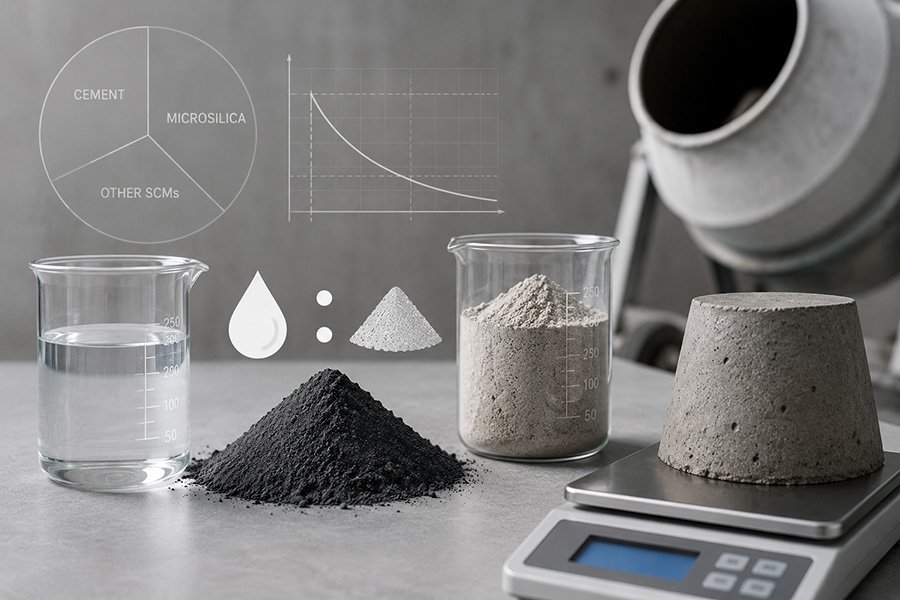
The formula is deceptively simple: w/b ratio = mass of free mixing water / total mass of binder. Free water excludes the moisture absorbed by aggregates in their saturated surface-dry (SSD) state. However, the precision lies in correctly assigning a k-value or reactivity coefficient to silica fume if the project specification (such as Eurocode 2 or ACI 318) employs an efficiency-factor approach rather than an absolute mass summation. When no k-value is permitted, the full kg-for-kg contribution of silica fume must be entered into the denominator without discount. A mix containing 380 kg/m³ of cement and 40 kg/m³ of silica fume therefore carries a binder mass of 420 kg/m³, and a target w/b of 0.22 demands roughly 92.4 liters of free water—a tight constraint that typically mandates high-range water-reducing admixtures.
Laboratory Step-by-Step: Calculating the Exact Ratio for a 1 m³ Batch
Accurate batching begins not at the mixer, but in the calculations for a volumetric cubic meter. Specifiers using a densified product like Microsilica 950 D must account for its bulk density and carbon content, reflected in the loss on ignition (LOI) value, to avoid an unintentional reduction in reactive binder. The following table maps a direct calculation for a UHPC-style mix targeting a 0.20 w/b ratio, where silica fume replaces 10% of the cement mass by weight.
| Component | Mass (kg/m³) | Calculation Note |
|---|---|---|
| Cement (CEM I 52.5N) | 675 | Selected for high C₃S content and early strength gain |
| Silica fume (ASTM C1240, densified) | 75 | 10% replacement of cement mass; total binder = 750 kg/m³ |
| Free mixing water | 150 | Adjusted after polycarboxylate ether (PCE) saturation dosage |
| Calculated w/b ratio | 0.20 | 150 kg water ÷ 750 kg binder; excludes aggregate moisture |
Verify this ratio during trial mixing by measuring the PCE superplasticizer demand. At a 0.20 w/b ratio, most silica-fume blends will not reach self-consolidating flow without a PCE dosage typically ranging from 1.2% to 2.0% by binder weight, depending on the BET surface area of the silica fume and the carbonaceous impurities that adsorb polymer molecules. A sudden spike in viscosity at constant water content indicates either insufficient wet-out time for densified grains to disperse into primary particles, or a LOI exceeding the supplier’s certified 2.5% threshold, which sequesters mixing water and admixture.
The Role of High-Range Water Reducers in Releasing Trapped Water
Microsilica particles, particularly in their undersified state, carry a weak electrostatic charge that encourages agglomeration. These agglomerates trap water in interstitial voids, making it unavailable for either particle dispersion or cement hydration. When the specifier adopts a certified source like the China SGS Standard Microsilica, consistent particle size distribution reduces this water-trapping tendency, but the actual w/b ratio still depends on a PCE-based superplasticizer to liberate the trapped fraction.
- First, add all dry binder components and coarse/fine aggregates to the pan mixer and dry blend for 30 seconds to break down any soft silica-fume lumps.
- Introduce 80% of the calculated free water and allow a 60-second mixing phase to wet the high-surface-area silica fume, protecting the PCE from excessive early adsorption.
- Add the remaining 20% water pre-blended with the polycarboxylate ether, and continue mixing for another 90 seconds until a dispersed, rheologically stable paste coats all aggregate surfaces.
Without this sequence, a mix designed at a 0.22 w/b ratio can behave like a 0.18 ratio, producing a sticky, zero-slump mass that defies placement. The superplasticizer does not change the calculated w/b ratio—the water mass remains the same—but it shifts the effective water availability, enabling the ratio to deliver its designed workability and compacted particle packing at the interfacial transition zone (ITZ).
Verifying Spec Compliance Using ASTM C1240 and EN 13263
Global project specifications do not accept a theoretical w/b ratio alone; they require confirmation that the silica fume itself meets chemical and physical thresholds that directly impact water demand. ASTM C1240 mandates a maximum LOI of 6.0%, while many performance-based specifications for HPC and UHPC further narrow this to below 2.5%. An elevated LOI, indicative of unburned carbon, can add 3–8 kg of unaccounted water demand per cubic meter, skewing the true w/b ratio and suppressing the pozzolanic reaction that transforms calcium hydroxide into dense C-S-H gel.
Engineers should cross-check the supplier’s certification for the silica fume’s SiO₂ content (minimum 85% under ASTM C1240, with UHPC grades frequently exceeding 92%) and specific surface. A silica fume with a lower-than-expected surface area might indicate excessive quartz contamination, reducing reactivity and leaving excess free water in the pore network—a condition that inflates the effective w/b ratio beyond the calculated value. In high-risk marine or sulfate-exposure environments, this discrepancy can be the difference between a chloride diffusion coefficient of 1×10⁻¹² m²/s and one five times higher.
Field Adjustments: When Aggregate Moisture Attacks Your Ratio
The most precise laboratory w/b ratio collapses the moment dry aggregate stockpiles become rain-soaked. Calculating the exact w/b ratio on-site requires subtracting the mass of water carried into the mixer by fine and coarse aggregates above their SSD condition. For a 1 m³ batch using 700 kg of sand at a 6% total moisture content—with an SSD absorption of 1%—the extra water load is 35 kg. If the batch card targets 140 kg of total free water at a 0.24 w/b ratio, those 35 kilograms of surface moisture push the actual free water to 175 kg, yielding a true ratio of 0.30. This 25% increase in the w/b denominator can lower 28-day compressive strength by 15–20 MPa in a high-strength mix, completely undermining the silica fume’s role in reducing pore connectivity.
Regular moisture probes and a mandatory water correction calculation before every pour are the only defenses. When paired with a densified microsilica like Microsilica 950 D, which disperses efficiently under high-shear mixing, maintaining the target ratio becomes a function of rigid batch-water accounting rather than a variable open to operator discretion.
Frequently Asked Questions
Q: What is the standard water-to-binder ratio when using microsilica in high-performance concrete?
A: For HPC, the w/b ratio typically ranges from 0.25 to 0.35 when microsilica replaces 5–10% of cement by mass. Due to microsilica’s high surface area (15–30 m²/g via BET), additional water is needed to maintain workability—usually 0.1 to 0.2 kg of water per kg of microsilica added. Always follow ASTM C1240 or EN 13263 to adjust the total water content.
Q: How do I account for undensified vs. densified microsilica when calculating water demand?
A: Undensified microsilica (<350 kg/m³ bulk density) requires an extra 0.15–0.25 kg water per kg microsilica to overcome high air entrapment. Densified grades (500–650 kg/m³) need about 0.10–0.15 kg water per kg. Use a polycarboxylate (PCE) superplasticizer to keep the w/b ratio low while achieving target slump flow.
Q: Should the water needed for microsilica slurry be included in the w/b calculation?
A: Yes. When pre-mixing microsilica into a slurry (common for UHPC), all water from the slurry counts toward the total binder water. For example, if you add 10L water to 50 kg microsilica, that 10L is part of the effective water content. Without slurry, calculate the free-water demand based on microsilica’s LOI and surface area (per ASTM C1240).
Q: What is the exact formula for w/b ratio with microsilica replacement?
A: w/b = (Total water mass) / (Cement mass + Microsilica mass). If cement = 400 kg, microsilica = 40 kg (10% bwoc), and total water (including admixture water) = 132 kg, then w/b = 132 / 440 ≈ 0.30. Always subtract water in the superplasticizer from the effective water to avoid overestimation.
Q: How does microsilica affect the interfacial transition zone (ITZ) water requirement?
A: Microsilica refines the ITZ by consuming portlandite through pozzolanic reaction to form additional C-S-H gel. This reduces porosity at the aggregate-paste interface, lowering the effective w/b needed to achieve the same strength. Typically, 5–10% microsilica can reduce the optimum w/b by 0.02–0.05 compared to plain cement.
About Henan Superior Abrasives (HSA)
Henan Superior Abrasives (HSA) is a China-based manufacturer and global supplier of high-quality silica fume (microsilica) for concrete and refractory applications. Supplying both densified and undensified grades compliant with ASTM C1240 and EN 13263, HSA serves customers in 30+ countries with reliable microsilica solutions for HPC, UHPC, precast concrete, shotcrete, and other high-performance construction materials.
Get a Quote or Free Sample
Ready to improve your concrete performance with premium silica fume? Contact our technical team today — we respond within 24 hours and can arrange free samples for qualified projects.
- 📧 Email: sales@superior-abrasives.com
- 💬 WhatsApp: +86-186-3863-8803