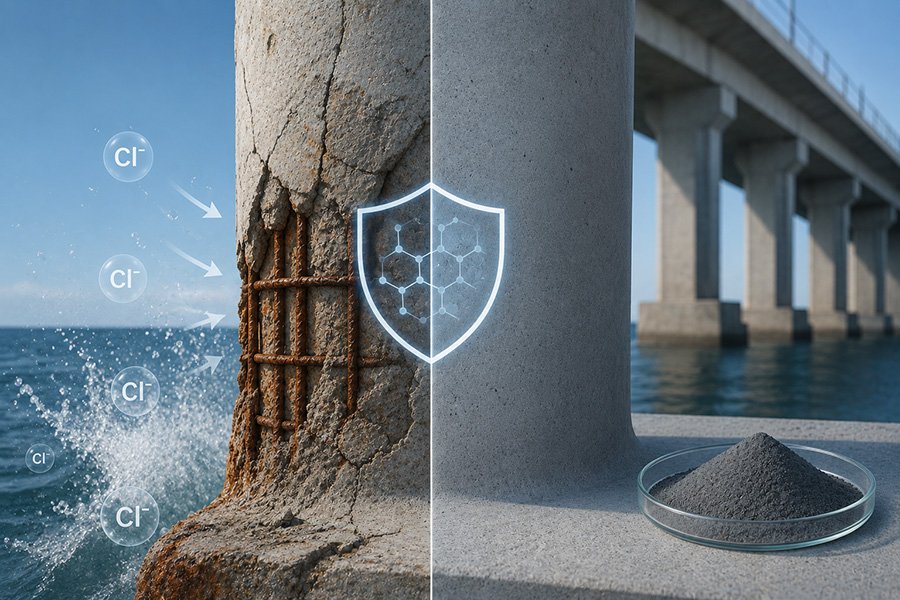
Unchecked chloride ingress in marine concrete structures does not merely reduce service life—it drives multi-million-dollar rehabilitation programs decades ahead of schedule. Patching spalled bridge piles in tidal zones or replacing corroded precast seawall panels involves not just material cost but operational downtime and safety risk. Engineers specifying high-performance concrete for these environments face a critical question: Is silica fume effective in preventing chloride-induced corrosion in seawater, or does its well-documented refinement of mechanical properties fail to translate into long-term electrochemical protection?
Chloride Ingress: The Primary Deterioration Mechanism in Marine Concrete
Corrosion initiation in reinforced concrete exposed to seawater follows a predictable sequence governed by Fick’s second law of diffusion. Chloride ions penetrate the concrete cover, eventually reaching the steel reinforcement surface in sufficient concentration to depassivate the protective alkaline film. Once the chloride threshold—typically 0.4% to 1.0% by mass of cement—is exceeded, pitting corrosion begins in the presence of moisture and oxygen. The resulting expansive rust products exert tensile stresses far exceeding concrete’s tensile capacity, leading to cracking, delamination, and progressive section loss.
Traditional mitigation strategies rely on increased cover depth and reduced water-binder (w/b) ratios to slow ingress. However, in aggressive splash and tidal zones where wetting-drying cycles accelerate capillary suction, these measures alone often prove insufficient. Concrete technologists therefore turn to supplementary cementitious materials capable of modifying pore structure at the sub-micron level. This is where microsilica’s unique particle physics enters the equation.
Pore Refinement and the Pozzolanic Impermeability Barrier
Silica fume’s protective function against chlorides stems not from chemical binding alone but from radical physical densification of the cementitious matrix. Comprised of amorphous SiO₂ spheres averaging 0.1 to 0.15 microns in diameter—roughly 100 times finer than portland cement grains—the material initiates a dense pozzolanic reaction with calcium hydroxide liberated during cement hydration. This reaction produces additional calcium-silicate-hydrate (C-S-H) gel directly within the capillary pore network and critically refines the interfacial transition zone (ITZ) surrounding aggregate particles.
The resulting microstructure exhibits a pronounced reduction in interconnected porosity, particularly in the 0.01 to 0.1 micron pore diameter range responsible for rapid chloride diffusion. When properly dispersed—often requiring polycarboxylate ether (PCE) superplasticizers to overcome high specific surface area—a silica fume-modified paste achieves capillary pore discontinuity that plain portland cement systems cannot replicate even at significantly lower w/b ratios. This continuous, tortuous pore network physically obstructs chloride ion migration paths.
Electrochemical Evidence: Migration Coefficients and Corrosion Thresholds
Laboratory studies using rapid chloride migration (RCM) tests and bulk diffusion cells consistently demonstrate that silica fume replacement levels of 8–10% by weight of cement reduce chloride diffusion coefficients by an order of magnitude compared to control mixes. Field exposure data from long-term marine sites corroborates these findings. However, interpreting results requires nuance: lower diffusion does not automatically equate to inhibited corrosion if passivation is compromised by reduced pore solution pH.
The following table compiles published data comparing chloride transport properties and corrosion initiation periods for concretes with and without densified microsilica at equivalent workability.
| Mix Type | w/b Ratio | Chloride Diffusion Coefficient (×10⁻¹² m²/s) | Predicted Corrosion Initiation (Years, 50mm Cover) | Observed Surface Chloride (kg/m³) |
|---|---|---|---|---|
| OPC Control (CEM I 42.5) | 0.45 | 8.5 | 12–18 | 4.8 |
| OPC + 8% Silica Fume | 0.40 | 1.2 | 45–60 | 5.1 |
| OPC + 25% Fly Ash | 0.40 | 3.8 | 28–35 | 4.9 |
| OPC + 10% Silica Fume + 20% Fly Ash | 0.35 | 0.6 | 70+ | 5.0 |
Triple-blend systems incorporating both high-reactivity pozzolans and low-calcium fly ash exhibit remarkably suppressed diffusion, exceeding the performance of silica fume alone in some formulations. This synergy arises from combined early-age pore refinement and long-term pozzolanic continuity.
Practical Specification for Marine-Grade Silica Fume Concrete
Translating laboratory performance into durable field construction demands rigorous adherence to material standards and placement protocols. Not all silica fume products perform identically. Engineers must verify compliance with ASTM C1240 or EN 13263, which govern silica fume for use in concrete. Key parameters include SiO₂ content (minimum 85% per ASTM, though premium grades exceed 92%), loss on ignition (LOI) to control carbon content, and specific surface area measured by BET nitrogen adsorption—typically 15,000 to 25,000 m²/kg for optimal pozzolanic reactivity.
For marine HPC and UHPC applications, the following guidelines form a reliable specification baseline:
- Maintain a maximum w/b ratio of 0.38, measured against total cementitious content including silica fume.
- Use silica fume dosage between 7.0% and 10.5% by weight of cementitious materials for binary mixes; consider 5–7% in ternary blends with fly ash or slag.
- Employ a PCE-based high-range water reducer to achieve target slump without adding batch water, which negates densification benefits.
- Specify undensified or highly densified silica fume with verified dispersibility, particularly for ready-mix operations. Refer to product-specific datasheets such as those for 92 Grade Silica Fume For Concrete to confirm particle agglomeration behavior.
- Enforce extended moist curing—minimum 7 days at 20°C or equivalent maturity—to ensure full development of the pozzolanic C-S-H network before allowing drying.
Addressing Concerns: Carbonation, Sulfate Interaction, and Steel Passivation
Skeptics of silica fume in marine environments raise valid concerns regarding reduced alkaline reserve. Consumption of portlandite during the pozzolanic reaction lowers the concrete’s pH buffering capacity, potentially accelerating carbonation depths if concrete quality is poor or curing is curtailed. In submerged and tidal seawater exposure, however, carbonation rates are minimal. Where atmospheric zones exist above the splash line, a ternary blend incorporating a moderate percentage of fly ash or slag can be specified. This approach restores long-term alkalinity while preserving chloride resistance.
Another consideration involves sulfate interaction. Seawater contains approximately 2,700 mg/L of sulfates alongside chlorides. Fortunately, the same C-S-H densification that blocks chloride diffusion also dramatically reduces sulfate penetration. There is no evidence that silica fume’s chloride protection is diminished in the presence of typical seawater sulfate concentrations; rather, the combined attack resistance is superior to plain cement systems. For structures in high-sulfate soils adjacent to marine environments, selecting an appropriate grade—such as evaluating 94 Grade Silica Fume For Concrete or its refractory-grade equivalents—ensures chemical durability aligns with the full exposure profile.
Validating Performance: From Mix Design Trials to Long-Term Monitoring
Laboratory trial batches must replicate anticipated field placing and curing conditions, not idealized laboratory environments. Rapid chloride permeability (ASTM C1202) testing provides a useful index but is influenced by pore solution conductivity and should not replace migration coefficient determination. For critical infrastructure, bulk diffusion testing (ASTM C1556) on cores extracted from trial elements yields more reliable service-life modeling inputs.
Life-365 and other finite-difference service-life models now incorporate silica fume’s age-dependent diffusion decay factors, typically 0.2 to 0.4 for 8% replacement, indicating rapid early-age reduction in transport properties. However, models must be calibrated against project-specific verification data. A conservative design might specify 92 Grade Silica Fume For Refractory or a dedicated concrete-grade microsilica with certified particle size distribution to minimize batch-to-batch variability in permeability outcomes.
Field validation strategies include embedding chloride sensors at reinforcement depth during construction and performing regular half-cell potential surveys. Data from existing silica fume structures in the North Sea and Arabian Gulf confirm that properly executed silica fume concrete exhibits negligible chloride penetration past 15–25 mm depth after 20+ years of continuous tidal exposure—a performance level unattainable with plain portland cement at equivalent cover depths.
Frequently Asked Questions
Q: How does silica fume reduce chloride ion penetration in seawater concrete?
A: Silica fume particles (~0.1–0.5 µm) fill voids between cement grains, lowering the w/b ratio and dramatically refining pore structure. This reduces the chloride diffusion coefficient (DCl) by 5–10× vs. plain portland cement, as measured per ASTM C1202 (RCPT values drop from >3000 coulombs to <800 coulombs at 10% replacement).
Q: What replacement level of silica fume is optimal for chloride resistance in marine environments?
A: 8–12% by weight of cementitious materials is optimal per ACI 357R and EN 13263. Beyond 12%, workability decreases sharply, and overdosing may increase autogenous shrinkage. At 10% replacement, chloride binding capacity improves 30–40% due to refined C-S-H gel.
Q: Does silica fume also protect against corrosion from sulfate in seawater?
A: Yes—silica fume consumes Ca(OH)2 via pozzolanic reaction, reducing gypsum and ettringite formation. This lowers sulfate expansion by up to 50% at 10% replacement per ASTM C1012, complementing chloride resistance in tidal zones.
Q: Can densified silica fume match the corrosion protection of undensified silica fume?
A: Not if agglomerates persist. Undensified silica fume (bulk density 200–300 kg/m³) disperses more uniformly; densified (500–700 kg/m³) may leave 20–50 µm clusters that create weak ITZ zones. Use high-shear mixing or pre-dispersion for densified grades to maintain ASTM C1240 (<5% retained on 45 µm sieve) performance.
Q: What is the expected service life extension for silica fume concrete in a splash-zone seawall?
A: Life-365™ modeling shows a 40% reduction in corrosion initiation time for conventional concrete (w/c 0.45) vs. 10% SF concrete (w/c 0.35). At 50 mm cover, time-to-corrosion extends from ~15 years to >75 years, meeting UHPC-level durability targets for critical marine infrastructure.
About Henan Superior Abrasives (HSA)
Henan Superior Abrasives (HSA) is a China-based manufacturer and global supplier of high-quality silica fume (microsilica) for concrete and refractory applications. Supplying both densified and undensified grades compliant with ASTM C1240 and EN 13263, HSA serves customers in 30+ countries with reliable microsilica solutions for HPC, UHPC, precast concrete, shotcrete, and other high-performance construction materials.
Get a Quote or Free Sample
Ready to improve your concrete performance with premium silica fume? Contact our technical team today — we respond within 24 hours and can arrange free samples for qualified projects.
- 📧 Email: sales@superior-abrasives.com
- 💬 WhatsApp: +86-186-3863-8803