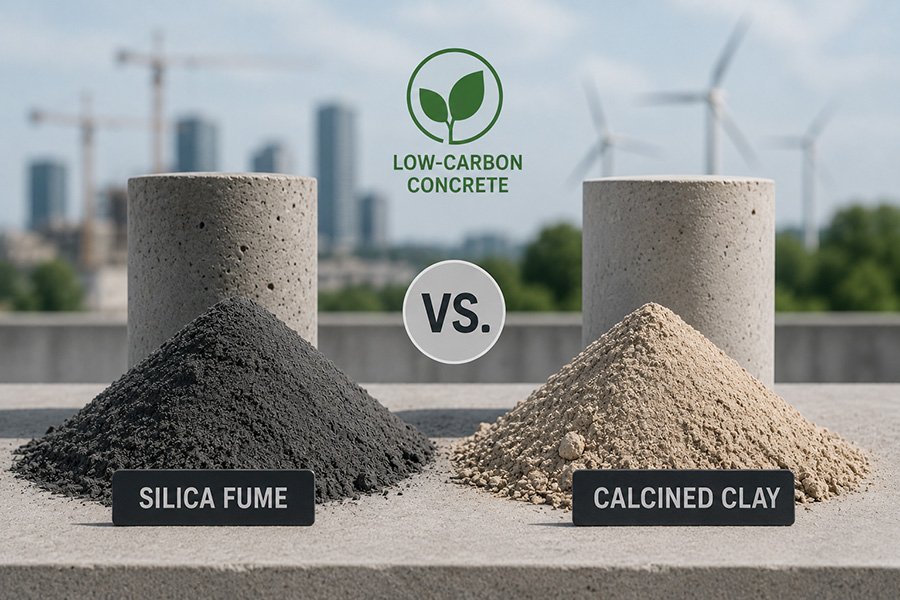
A misplaced supplementary cementitious material choice in low-carbon concrete can increase binder content by 8–12%, erase your clinker reduction gains, and still fail to meet 28-day strength targets. Engineers balancing CO₂ budgets against compressive strength and durability now face a direct comparison between densified silica fume and calcined clay—two SCMs with fundamentally different reaction kinetics, dosage windows, and specification compliance pathways. This analysis examines their mechanisms side by side to determine which delivers reliable performance in high-performance and ultra-high-performance concrete.
The Pozzolanic Mechanism: Reactive Surface Area Versus Aluminate-Driven Chemistry
Silica fume operates through a rapid pozzolanic reaction driven by its extreme specific surface area, typically 15,000–30,000 m²/kg BET. When mixed into concrete at 5–10% by weight of cementitious materials, the amorphous SiO₂—exceeding 85% in undensified silica fume and often 92–96% in properly processed grades—reacts with calcium hydroxide within hours. This consumes CH at the interfacial transition zone and precipitates dense calcium silicate hydrate (C-S-H) gel directly in the capillary pore network. The result is a measurable drop in ITZ porosity, often reducing the water-to-binder (w/b) ratio to 0.20–0.25 without bleeding.
Calcined clay relies on a different chemical route. Metakaolin, produced by heating kaolinite above 650°C, contains reactive alumina that combines with portlandite to form carboaluminate phases when limestone is present. This reaction is slower than silica fume’s, and its effectiveness hinges on amorphous content rather than surface area. Limestone calcined clay cement (LC³) blends, for example, require 30–50% clay substitution to achieve comparable pore refinement, shifting early-age strength development to later ages and demanding higher superplasticizer dosages to manage workability. The reaction is aluminosilicate-based, generating less C-S-H per unit of CH consumed.
Strength Development and Dosage Efficiency in HPC Mixes
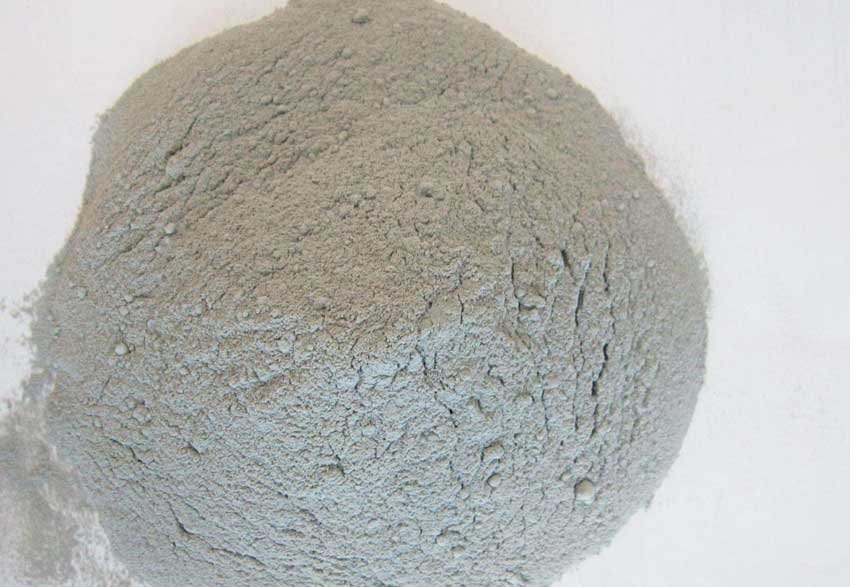
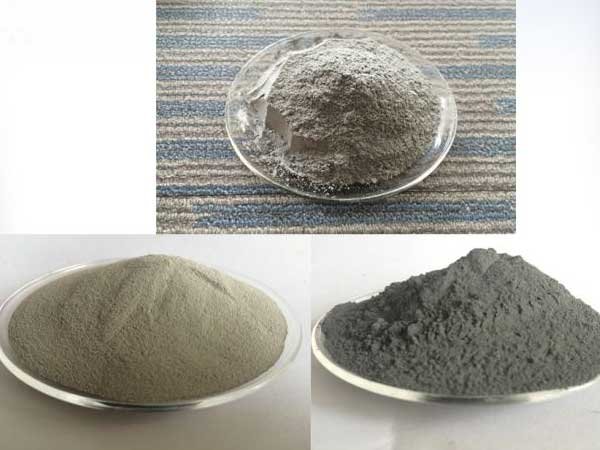
At equivalent substitution rates, silica fume delivers substantially higher early-age compressive strength. A 7.5% addition of 94-grade silica fume for concrete routinely achieves 80% of 28-day strength within 3 days under standard curing. The densification of microsilica particles—often to bulk densities of 500–700 kg/m³—does not compromise reactivity when proper mixing energy is applied, though undensified forms disperse faster in high-shear mixers. The dense particle packing effect, combined with rapid C-S-H formation, pushes 28-day compressive strength beyond 120 MPa in UHPC formulations.
Calcined clay blends, in contrast, demand 20–30% cement replacement to meet similar long-term strength benchmarks. Early-age strength—particularly before 7 days—can lag 15–25% behind silica fume-modified concretes due to slower aluminate reaction kinetics and higher water demand. A typical LC³ formulation with 30% calcined clay and 15% limestone might require a 0.45 w/b ratio to achieve adequate workability, whereas silica fume at one-third the dosage enables 0.22 w/b and superior particle packing. This dosage inefficiency matters when carbon accounting extends to transport and processing emissions, not just binder chemistry.
Durability Performance: Pore Structure, Chloride Resistance, and ASR Mitigation
| Durability Parameter | Silica Fume (7–10% dosage) | Calcined Clay (20–30% dosage) |
|---|---|---|
| Rapid chloride permeability (ASTM C1202) | ≤ 500 coulombs (very low) | 800–1,500 coulombs (low to moderate) |
| ITZ porosity reduction | Reduces by 30–50% due to C-S-H densification | Reduces by 10–20%, primarily from filler effect |
| Alkali-silica reaction (ASR) suppression | Effective at 5–7% dosage; captures alkalis in low Ca/Si gel | Requires 25%+ dosage; relies on aluminate binding mechanisms |
| Sulfate resistance | Excellent; low permeability limits sulfate ingress | Moderate; high alumina content may increase ettringite risk in severe exposures |
Silica fume’s ability to convert CH into low-permeability C-S-H gel across the entire ITZ produces concrete that routinely passes ASTM C1202 with coulomb values below 500—a threshold demanding less than 2,000 coulombs for “very low” chloride permeability. This performance derives from the fundamental mechanism: fine amorphous silica particles nucleate hydration products and fill submicron pores simultaneously. For infrastructure specifications requiring 100-year service lives in marine environments, this dual action often eliminates the need for additional corrosion inhibitors.
Calcined clay improves durability through pore refinement, but the effect is more incremental and dosage-dependent. Studies show that achieving equivalent chloride diffusion coefficients to 8% silica fume requires calcined clay replacement rates above 25%, which complicates mix design and increases superplasticizer demand. Aluminate-rich hydration products do contribute to chloride binding, yet the resulting Friedel’s salt formation is pH-sensitive and less reliable than the physical barrier created by C-S-H densification. For projects governed by EN 13263 or ASTM C1240 silica fume specifications, the performance margins are well-documented and statistically repeatable across cement chemistries.
Carbon Footprint: Active Chemistry Versus Substitution Volume
The low-carbon narrative for calcined clay depends on high-volume substitution. Clay calcination at 750°C releases roughly 200–300 kg CO₂ per tonne of metakaolin—far less than Portland cement’s 800–900 kg—but a typical mix demands three to four times more material than silica fume to achieve performance parity. Carbon accounting must therefore account for total binder mass: a mix with 8% silica fume replaces 80 kg of cement with 80 kg of SCM, while a calcined clay mix might replace 250 kg of cement with 250 kg of clay plus additional limestone. The net CO₂ savings narrow when transport distances, processing energy, and dosage are normalized to compressive strength.
85-grade silica fume offers a strategic middle ground in this equation. With LOI values controlled below 3% and consistent SiO₂ content, it delivers reliable pozzolanic performance at a lower unit cost than 92–96 grade variants. For engineers optimizing both carbon and budget, selecting the minimum silica fume grade that meets specification allows precise control over embodied carbon without over-engineering the SCM quality. The densification process itself, when properly executed, incurs negligible additional emissions and improves handling safety on site.
Specification Compliance and Supply Chain Assurance
- ASTM C1240 compliance: Silica fume must meet strict SiO₂ content, LOI, and fineness requirements—simplifying QC documentation for international projects.
- EN 13263 conformity: European standards for silica fume in concrete define particle size distribution and pozzolanic activity index, ensuring cross-border consistency.
- Calcined clay standards: No equivalent universal specification exists; LC³ adoption relies on project-specific performance testing, increasing approval timelines and technical risk.
Procurement teams managing multi-country infrastructure portfolios benefit from silica fume’s standardized specifications. Whether sourcing 92-grade silica fume for concrete for a Middle Eastern precast plant or exporting 94-grade microsilica to a European UHPC bridge project, the material properties remain predictably within specified limits. Calcined clay, by contrast, varies significantly with kaolinite purity and calcination process control, demanding extensive prequalification testing that can delay project starts by 4–8 weeks. For high-stakes applications like post-tensioned bridge decks or chloride-exposed marine piles, this supply chain variability introduces a risk that specification-driven engineering deliberately avoids.
Practical Mix Design Considerations
- Determine the target w/b ratio and required workability; silica fume demands PCE-based superplasticizers but maintains low w/b ratios, while calcined clay requires higher water and admixture dosages.
- Assess early-age strength requirements; specify silica fume for sections needing formwork removal within 12–18 hours or tensile strength for prestressing within 3 days.
- Verify long-term durability standards against project specifications; match the SCM to the performance test method (RCPT, bulk diffusion, ASR expansion) rather than accepting generic substitutions.
- Source materials with full mill certificates; confirm that densified silica fume or undensified grades meet the SiO₂ threshold your spec demands—whether 85%, 92%, or 96%—before approving alternative SCM proposals.
Calcined clay remains a viable supplementary material where high-volume substitution is acceptable and construction schedules allow for extended curing. It performs adequately in mass concrete where heat of hydration control is critical and strength gain can proceed over months. Yet in high-performance concrete where every percentage point of cement replacement must deliver proportional performance, silica fume’s superior pozzolanic efficiency per kilogram simplifies mix design and reduces both binder content and carbon footprint simultaneously. The choice ultimately hinges on whether you are optimizing concrete chemistry or merely diluting cement.
Henan Superior Abrasives (HSA) supplies densified and undensified silica fume to concrete producers and refractory manufacturers across more than 30 countries. With SiO₂ grades from 85% to 96%, production complies with ASTM C1240 and EN 13263, supported by full mill certification and technical consultation for mix optimization. Reach our engineering team at sales@superior-abrasives.com or via WhatsApp at +86-186-3863-8803 to discuss specification-grade microsilica for your next infrastructure or precast project.
Frequently Asked Questions
Q: Which has a lower carbon footprint—silica fume or calcined clay?
A: Calcined clay typically has a lower carbon footprint, around 0.25–0.30 kg CO₂/kg, compared to silica fume’s 0.5–0.7 kg CO₂/kg (ferrosilicon production). However, silica fume’s higher reactivity can reduce total cement content more aggressively, potentially offsetting its higher embodied carbon in certain mix designs.
Q: How does pozzolanic reactivity compare between the two?
A: Silica fume contains >85% amorphous SiO₂ with a BET surface area of 15–25 m²/g, achieving a strength activity index (SAI) of >105% at 7 days per ASTM C1240. Calcined clay (metakaolin) has 50–60% reactive alumina plus silica, with SAI values of 95–110% at 7 days—slightly lower but highly dependent on clay purity and calcination temperature (optimal 700–800°C).
Q: What are the practical limits for replacement levels in low-carbon concrete?
A: Silica fume is typically limited to 5–15% by weight of cementitious materials to avoid excessive water demand and shrinkage cracking. Calcined clay can replace 15–30% cement, especially in limestone-calcined clay (LC3) blends, achieving 40% clinker reduction without major strength loss.
Q: Which material better improves durability in aggressive environments?
A: Silica fume excels at reducing chloride permeability (e.g., <1,000 coulombs per ASTM C1202 at 10% replacement) and refining the ITZ. Calcined clay also reduces permeability and mitigates alkali-silica reaction (ASR) better than silica fume due to its aluminum content, which binds alkalis into C-A-S-H phases.
Q: How do costs compare for ready-mix producers?
A: Silica fume (densified) ranges $200–600/ton globally, while calcined clay costs $80–150/ton. However, silica fume’s lower dosage requirement (5–10% vs. 15–25%) often narrows the per-cubic-meter cost gap, especially when high early strength or ultra-low permeability is mandatory.
About Henan Superior Abrasives (HSA)
Henan Superior Abrasives (HSA) is a China-based manufacturer and global supplier of high-quality silica fume (microsilica) for concrete and refractory applications. Supplying both densified and undensified grades compliant with ASTM C1240 and EN 13263, HSA serves customers in 30+ countries with reliable microsilica solutions for HPC, UHPC, precast concrete, shotcrete, and other high-performance construction materials.
Get a Quote or Free Sample
Ready to improve your concrete performance with premium silica fume? Contact our technical team today — we respond within 24 hours and can arrange free samples for qualified projects.
- 📧 Email: sales@superior-abrasives.com
- 💬 WhatsApp: +86-186-3863-8803