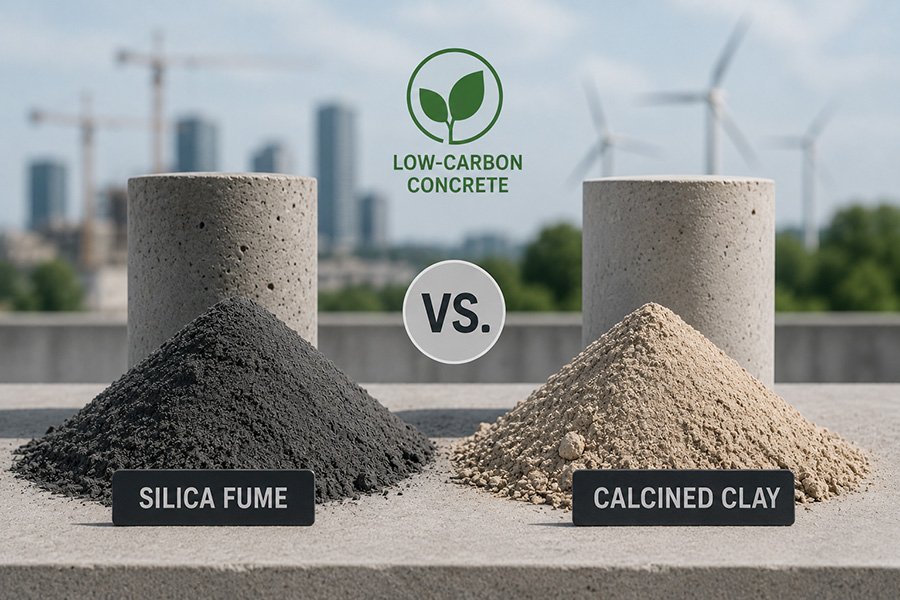

Silica fume’s pozzolanic reactivity accelerates early-age strength gain, but it also dramatically alters moisture retention kinetics—if curing regimes fail to compensate, microcracking from autogenous shrinkage can compromise chloride resistance and reduce service life by 15–30% in high-performance concrete (HPC) bridges, marine structures, and nuclear containment shells. Solving this requires understanding how silica fume shifts the water demand landscape from hydration onset through pore refinement.
Pozzolanic Reaction Kinetics and Internal Moisture Sinks
High-performance concrete containing silica fume exhibits a fundamentally different hydration trajectory from ordinary portland cement systems. The submicron amorphous SiO₂ particles, often with a BET surface area exceeding 15 m²/g, initiate the pozzolanic reaction within 1–3 days of water contact—far earlier than fly ash or slag. This reaction consumes calcium hydroxide (CH) and free water simultaneously to generate additional calcium-silicate-hydrate (C-S-H) gel, densifying the matrix and refining capillary porosity. While this enhances compressive strength and durability, it creates a critical moisture deficit.
As capillary pores transition from 50–100 nm diameters to 10–30 nm in silica fume-modified pastes, the internal relative humidity (RH) drops below 80% earlier in the curing timeline. This drop triggers self-desiccation, where the negative capillary pressure in partially emptied pores exerts tensile stress on the still-weak paste. Without external curing intervention, the resulting autogenous shrinkage can reach 400–600 microstrain—enough to initiate discrete cracking in restrained HPC elements. Specifiers targeting a maximum crack width below 0.2 mm for durability-class exposure zones must design curing protocols around this accelerated RH decay curve.
| Curing Parameter | Plain HPC (No Silica Fume) | Silica Fume HPC (8% bwoc) | Consequence of Under-Curing |
|---|---|---|---|
| Time to internal RH < 80% (sealed, 23°C) | 14–21 days | 3–7 days | Early-age surface microcracking |
| Autogenous shrinkage at 7 days (µε) | 100–200 | 350–600 | Loss of interfacial transition zone integrity |
| Evaporable water content at 28 days (%) | 8–12 | 4–6 | Reduced long-term hydration potential |
| Effective wet curing threshold (days) | 7 | 10–14 | Incomplete pozzolanic reaction; lower strength |
Moisture Curing: Duration Extension and Technique Selection
ASTM C1240-compliant silica fume, whether in densified or undensified form, demands a fundamental re-evaluation of moisture curing duration. While ACI 308R specifies a minimum 7-day wet cure for conventional concrete with Type I cement, silica fume HPC mixtures—particularly those designed below a 0.30 w/b ratio—require uninterrupted moisture supply for at least 10 days, with 14 days strongly recommended for elements exposed to drying environments in the first month. The mechanism is straightforward: the pozzolanic reaction continues for weeks, but only if free water remains available in the pore network.
Ponding and continuous fog spraying deliver superior results for flatwork and precast elements. Waterproof sheeting or curing membranes applied immediately after finishing can serve as practical alternatives on vertical surfaces, though specifiers must verify that the membrane’s moisture retention efficiency exceeds 85% under site conditions. In arid climates where evaporation rates surpass 1.0 kg/m²/hour, supplementary internal curing via pre-wetted lightweight fine aggregate or superabsorbent polymers (SAPs) has proven effective at mitigating self-desiccation in silica fume HPC bridge decks. Henan Superior Abrasives’ testing on their 92-grade silica fume for concrete confirms that combining external fogging with SAP internal curing reduces 28-day autogenous shrinkage by 40% compared to external curing alone, a finding consistent with published literature on UHPC curing optimization.
Curing Temperature Sensitivity and Maturity Effects
Silica fume amplifies concrete’s sensitivity to curing temperature in two opposing directions. Elevated temperatures (35–50°C) accelerate the pozzolanic reaction rate, rapidly consuming CH and densifying the interfacial transition zone (ITZ) around aggregate particles. This effect benefits precast operations where steam curing can yield 12–18-hour strength targets exceeding 50 MPa. However, rapid early heat evolution in mass concrete sections introduces a gradient-driven cracking risk—the core retains heat while the surface cools, and the low-permeability silica fume paste restricts moisture movement that could relieve thermal stress.
Cold-weather curing below 10°C presents a different failure mode. The pozzolanic reaction is thermally activated and slows dramatically, while portland cement hydration continues, creating a pore solution chemistry imbalance. Unreacted silica fume particles remain dispersed but do not contribute to strength gain. Site protocols must maintain concrete temperature above 15°C for the critical 72-hour window using insulated blankets or heated enclosures. Maturity-method sensors calibrated for silica fume mixes offer real-time control, ensuring that in-place strength development aligns with formwork removal and post-tensioning schedules without guesswork.
Specification Compliance: ASTM C1240, EN 13263, and Curing Interdependency
Engineers often treat silica fume selection and curing specification as independent line items during mix design approval. That separation is costly. A silica fume source that meets ASTM C1240 chemical requirements—minimum 85% SiO₂ for concrete-grade material, loss on ignition (LOI) below 6%—can still produce underperforming concrete if curing clauses are generic. The standard’s performance-based tests for strength activity index and accelerated pozzolanic activity assume controlled laboratory curing at 23°C and 100% RH; field conditions rarely replicate this.
EN 13263 takes a more prescriptive stance, requiring declaration of particle fineness and specific surface, which directly correlate with curing demand. Higher-surface-area silica fumes, including 94- and 96-grade refractory products sometimes diverted into high-durability concrete, intensify early water consumption. Procurement specialists integrating 94 grade silica fume for concrete into a low w/b design must simultaneously negotiate curing method specifications with the contractor—failing to do so has led to rejected cylinder breaks and costly project delays on recent infrastructure jobs in the Middle East. The most robust QA/QC frameworks link silica fume source approval to a mandatory pre-construction curing trial that replicates anticipated field RH and temperature profiles.
Internal Curing as a Mitigation Strategy for Autogenous Shrinkage
External water application cannot fully counteract the fine-pore self-desiccation mechanism in silica fume HPC because capillary continuity between the surface and interior pores becomes progressively restricted after 24–48 hours. Internal curing addresses this limitation by distributing water reservoirs—typically pre-wetted lightweight fine aggregate or cellulosic fibers—throughout the matrix at dosing rates of 5–8% by volume of total aggregate.
The process works by creating a moisture gradient that operates in reverse of external drying. As cement hydration and pozzolanic reactions lower the chemical potential of water in capillary pores, the internal reservoirs release absorbed water through a thermodynamic driving force. This maintains saturation within the developing C-S-H gel structure and dramatically reduces autogenous shrinkage, often by 50–70% at 28 days. Three practical considerations govern implementation:
- Internal curing water must be accounted for in the total w/b calculation; ignoring this contribution can produce an effective w/b 0.02–0.05 higher than mix design assumptions.
- The spatial distribution of reservoirs must achieve a critical spacing factor—typically <200 µm—to effectively protect the entire paste volume.
- Compatibility with PCE superplasticizer chemistry requires verification, as some SAPs desorb water containing admixture molecules, altering workability retention.
A well-designed internal curing program can reduce the mandatory external wet curing period by 20–30% for silica fume HPC without sacrificing long-term durability metrics. Specifiers evaluating 92 grade silica fume for concrete in pavements or water-retaining structures should include internal curing as a standard risk-reduction measure in the technical specification.
Steam Curing Protocols for Precast Silica Fume Elements
Precast plants producing bridge girders, tunnel segments, and architectural panels increasingly specify silica fume for its ability to achieve rapid turnaround without thermal cracking—provided the steam cycle is tuned to the material’s reactivity profile. A standard steam curing cycle for silica fume concrete differs markedly from conventional high-early-strength mixtures. The critical adjustment occurs during the temperature ramp and peak hold phases.
Delaying the onset of steam application by 3–5 hours after casting allows sufficient initial set and prevents microcracking from differential thermal expansion between paste and aggregate. Ramp rates should not exceed 20°C per hour for elements above 300 mm thickness; faster rates create surface-to-core temperature differentials that exceed the still-low tensile strength at 6–8 hours. Peak hold temperatures between 55°C and 65°C for 6–10 hours balance pozzolanic acceleration against the risk of delayed ettringite formation (DEF) and long-term expansion—a documented failure mode when silica fume concretes experience peak temperatures above 70°C with inadequate sulfate control. The cooling phase demands equal discipline: rates below 15°C per hour and a 4-hour humidity-maintained equalization period minimize residual thermal stress that manifests as map cracking weeks after demolding.
Sourcing consistency matters in steam-curing environments. Plants switching between multiple silica fume grades should recognize that 85 grade silica fume—with lower SiO₂ content and coarser particle distribution—exhibits less aggressive early water demand and greater tolerance for steam cycle variation than 92 or 94-grade densified products. This makes 85-grade an economical choice for non-structural precast where 24-hour strength targets below 40 MPa govern production. For 96 grade silica fume for refractory applications in precast thermal linings, the curing protocol shifts entirely toward dry-out profiles rather than hydration-driven strength gain, illustrating the breadth of curing knowledge required across product grades.
Frequently Asked Questions
Q: Why does silica fume make high-performance concrete more sensitive to early curing?
A: Due to its high specific surface area (15–25 m²/g by BET), silica fume accelerates the pozzolanic reaction with calcium hydroxide, consuming water rapidly. This increases the risk of plastic shrinkage cracking. Proper wet curing within the first 24 hours is critical; moisture loss should be prevented using wet burlap or curing compounds per ASTM C1240 guidelines.
Q: How does silica fume impact the required curing duration compared to ordinary concrete?
A: HPC with silica fume typically requires a minimum of 7 days of continuous moist curing, versus 3–7 days for plain concrete. The dense microstructure can slow water ingress, so extended curing ensures full hydration of cement and pozzolanic phases, maximizing 28-day strength (often exceeding 80 MPa).
Q: Can silica fume high-performance concrete be steam-cured, and what temperature is optimal?
A: Yes. Steam curing at 60–70°C for 12–24 hours is common for precast silica fume HPC. Higher temperatures (>85°C) can cause delayed ettringite formation. A pre-steaming rest period of 3–4 hours at 20°C is recommended to avoid thermal shock.
Q: Does silica fume reduce the risk of thermal cracking during mass concrete curing?
A: Silica fume reduces the total heat of hydration per unit of binder (as it replaces portland cement), lowering peak temperature rise. However, the faster early reaction can increase the early heat generation rate. In thick sections, controlled cooling (max ΔT of 20°C between core and surface) is still required.
Q: What is the effect of silica fume on internal curing requirements of HPC?
A: With w/b ratios below 0.30, autogenous shrinkage becomes significant. Silica fume exacerbates self-desiccation. Internal curing using pre-wetted lightweight aggregates or superabsorbent polymers is often needed to replace water consumed by pozzolanic reaction and maintain relative humidity >80% inside the matrix.
About Henan Superior Abrasives (HSA)
Henan Superior Abrasives (HSA) is a China-based manufacturer and global supplier of high-quality silica fume (microsilica) for concrete and refractory applications. Supplying both densified and undensified grades compliant with ASTM C1240 and EN 13263, HSA serves customers in 30+ countries with reliable microsilica solutions for HPC, UHPC, precast concrete, shotcrete, and other high-performance construction materials.
Get a Quote or Free Sample
Ready to improve your concrete performance with premium silica fume? Contact our technical team today — we respond within 24 hours and can arrange free samples for qualified projects.
- 📧 Email: sales@superior-abrasives.com
- 💬 WhatsApp: +86-186-3863-8803