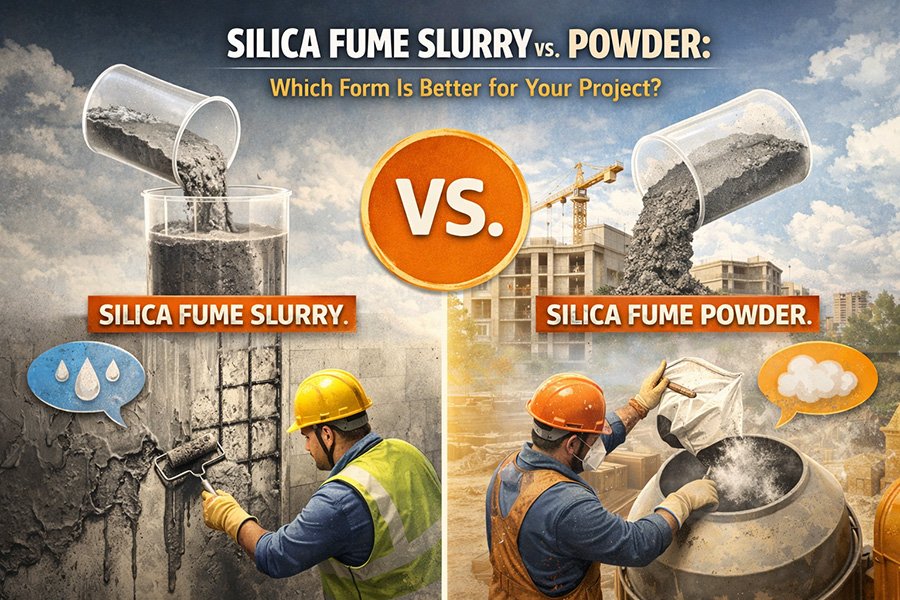
If you have ever sourced silica fume for a concrete project, you have likely encountered the same question: should you use powder or slurry? Both forms deliver the same fundamental material — amorphous silicon dioxide with a high surface area and strong pozzolanic reactivity — but they differ significantly in how they are handled, stored, dosed, and ultimately how they perform on-site. For engineers, contractors, and procurement teams evaluating their options, the choice deserves more than a passing thought.
This article cuts through the marketing noise to offer a clear, technical comparison of the two forms. The conclusion, supported by field experience and materials science, is that silica fume powder is the superior choice for the overwhelming majority of concrete applications — and understanding why will help you specify more confidently and avoid some costly logistical headaches.
What are the two forms?
Silica fume is produced as a fine, grey powder collected from the off-gases of electric arc furnaces used in silicon and ferrosilicon production. In its raw collected state, it is an extremely light, undensified powder with a bulk density of only 130–200 kg/m³ — so light that handling it poses practical challenges. To address this, it is commonly processed into two commercial forms:
Silica fume powder refers to either undensified powder (bulk density ~200 kg/m³) or densified powder (bulk density ~500–700 kg/m³), the latter produced by controlled agglomeration of the fine particles to improve flowability and reduce dusting. Densified powder is by far the most commercially dominant form worldwide. Silica fume slurry, by contrast, is produced by dispersing silica fume particles in water, typically at a solids content of 45–55% by mass. It is a viscous, grey liquid supplied in bulk tankers or IBC totes.
The case for silica fume powder
Silica fume powder — particularly in its densified form — has become the global standard for a reason. Its advantages span storage logistics, dosing precision, quality stability, cost efficiency, and application versatility.
Storage and shelf life are where powder excels most obviously. Densified silica fume powder can be stored in standard bulk silos or sealed bags for 12 months or more without degradation, provided it is kept dry. There is no requirement for temperature-controlled storage, no risk of biological growth, and no viscosity drift over time. Slurry, by contrast, is prone to particle settlement during prolonged storage, requiring agitation systems and regular mixing to maintain homogeneity. Settled slurry can be extremely difficult to re-disperse and may result in inconsistent dosing — a serious quality control risk for any structural concrete application.
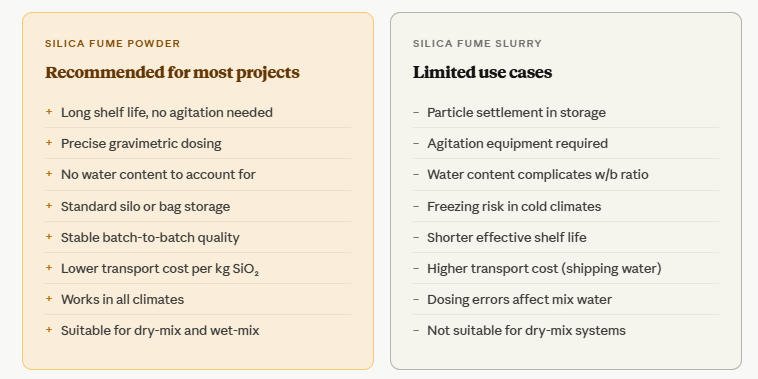
Dosing precision is another critical advantage of powder. In modern batching plants, silica fume powder is weighed gravimetrically alongside cement and fly ash — a process that is straightforward, auditable, and accurate to within ±0.5%. Slurry dosing is volumetric, and because slurry density varies with temperature, settlement state, and production batch, the actual silica fume content delivered to the mixer can deviate meaningfully from the target. For high-performance and UHPC mixes where the silica fume dosage is a critical design variable, this uncertainty is unacceptable.
The water content of slurry introduces a further complication that is easy to underestimate. A typical 50% solids slurry delivers one kilogram of water for every kilogram of silica fume. In a low water-to-binder (w/b) mix — say, w/b = 0.30 — a 20% silica fume addition via slurry can introduce enough additional water to push the effective w/b to 0.34 or higher if the batch water is not correctly adjusted. This is not a theoretical concern; it is a documented source of strength variability in ready-mix operations that have switched to slurry without recalibrating their mix designs.
50%
Water content in typical slurry — invisible water that must be accounted for in w/b calculation
12+ mo
Shelf life of densified silica fume powder in dry storage conditions
±0.5%
Dosing accuracy achievable with gravimetric powder batching
Transport economics further favor powder. Slurry is approximately half water by mass, which means that shipping slurry is, in effect, shipping expensive treated water alongside the active material. For international freight — which is the reality for most buyers sourcing from high-quality producers in China or elsewhere — this doubles the effective shipping cost per kilogram of silica fume solids. Powder, and especially densified powder with its higher bulk density, ships at a fraction of the cost per unit of active material.
Choosing slurry over powder is, in most cases, choosing to pay freight costs on water, manage an agitation system, and accept dosing uncertainty — in exchange for a marginal dispersion benefit that good mixing practice with powder achieves just as well.
The real drawbacks of silica fume slurry
To be fair, slurry was developed to address a genuine problem: early-generation undensified silica fume powder was notoriously difficult to handle. Its low bulk density meant it billowed into clouds of fine dust at any disturbance, creating respiratory hazards and metering challenges. Slurry eliminated dusting by fixing the particles in a liquid medium.
However, the development of densified silica fume powder — where particles are partially agglomerated into granules that break down readily in the mixer — largely solved the dust and handling problems that slurry was designed to address. Densified powder can be handled with standard pneumatic conveying systems, weighed in conventional hoppers, and introduced to the mixer without significant dusting. The primary technical argument for slurry has therefore been substantially eroded.
Cold climate warning: Silica fume slurry freezes at approximately 0°C. In cold climates, this requires heated storage tanks, insulated transport, and winterized handling infrastructure — costs and operational complexities that powder users never encounter. A frozen IBC of slurry is effectively unusable until thawed and re-agitated, with no guarantee that particle distribution has been fully restored.
Slurry also presents challenges for ready-mix producers operating multiple plants from a central supply. Powder can be shipped in bulk tankers or jumbo bags and pneumatically transferred to plant silos — a well-established, low-cost logistics chain. Slurry requires dedicated liquid storage tanks with agitation at each plant, a significantly higher infrastructure investment that rarely pays back for operations of typical scale.
When might slurry have an edge?
Intellectual honesty requires acknowledging the few scenarios where slurry has a genuine argument. In a large, highly automated precast facility producing a fixed mix design continuously, slurry can offer slightly easier real-time flow control through pump-fed liquid metering systems — particularly where dust control is a priority in enclosed production environments. Some UHPC producers have historically used slurry for this reason. However, these are specialist operations, and even in these contexts, the trend is toward high-quality densified powder with purpose-designed pneumatic batching, which matches the dispersion and handling benefits of slurry without its drawbacks.
| Factor | Powder | Slurry |
|---|---|---|
| Shelf life | 12+ months | 3–6 months (agitated) |
| Cold climate suitability | All climates | Freezes at 0°C |
| Dosing method | Gravimetric (precise) | Volumetric (variable) |
| Transport cost | Lower (no water freight) | Higher (50% water) |
| w/b ratio impact | None | Adds water to mix |
| Storage infrastructure | Standard silo / bags | Agitated liquid tanks |
| Dry-mix compatibility | Yes | No |
| International shipping | Straightforward | Costly and complex |
Quality standards: what to look for in powder
Whether specifying for HPC, UHPC, shotcrete, or precast applications, the quality of the silica fume powder matters as much as the choice of form. Key parameters to verify include SiO₂ content (≥ 92% for demanding applications, with ASTM C1240 setting a minimum of 85%), loss on ignition (≤ 3%), moisture content (≤ 3%), BET surface area (15,000–25,000 m²/kg), and chloride content (≤ 0.1%). Batch-to-batch consistency — verified through certificate of conformance documentation with each delivery — is equally critical for any quality-controlled concrete production environment.
Premium silica fume powder — ready to ship worldwide
Henan Superior Abrasives is a leading China-based manufacturer and global exporter of high-purity silica fume powder, supplying concrete producers, precast manufacturers, and specialty material companies across more than 30 countries.
Our silica fume powder is available in densified and undensified forms, fully compliant with ASTM C1240 and EN 13263, with complete certificate of conformance documentation on every shipment. sales@superior-abrasives.com.
Note: Henan Superior Abrasives supplies silica fume in powder form only. We do not offer silica fume slurry — ensuring you always receive maximum active material content with no water dilution, no settlement risk, and no cold-chain complexity.
Frequently asked questions
Is silica fume powder as easy to disperse in concrete as slurry?
Yes — when densified silica fume powder is used with a proper mixing sequence and an appropriate polycarboxylate ether (PCE) superplasticizer, dispersion quality is equivalent to slurry in all but the most extreme high-shear applications. Densified powder is designed to break down into its primary particle size under normal mixer action. The key is adding the powder together with the dry cementitious materials before water addition, or introducing it with a portion of the mix water during the early mixing stage. For UHPC applications requiring the highest possible dispersion, high-shear pan mixers are recommended regardless of whether powder or slurry is used.
How should I adjust my mix water when switching from slurry to powder?
When switching from slurry (typically 50% solids by mass) to powder, you must remove the water that was previously contributed by the slurry from your mix water calculation. For example, if your mix design called for 100 kg of slurry (delivering 50 kg of silica fume solids and 50 kg of water), switching to 50 kg of powder means you need to add back 50 kg of water to maintain the same w/b ratio. Recalculate your free water content accordingly and revalidate your target slump or flow with a trial mix before production. Superplasticizer demand may also change slightly, as powder requires slightly more dispersant at first contact compared to pre-wetted slurry particles.
Why doesn’t Henan Superior Abrasives supply silica fume slurry?
Henan Superior Abrasives has made a deliberate product strategy decision to focus exclusively on silica fume powder. Our reasoning is straightforward: powder delivers higher active material content per kilogram shipped, is more cost-effective for international customers, requires no specialized cold-chain handling, and gives buyers full control over water content in their mix designs. Supplying slurry would mean our customers pay to ship water across international freight lanes — a poor value proposition that we are not willing to offer. Our densified silica fume powder achieves equivalent or superior on-site performance to slurry when used with standard batching equipment and a suitable superplasticizer.
What is the difference between densified and undensified silica fume powder?
Undensified silica fume powder is the material in its natural collected state — extremely fine, very low bulk density (130–200 kg/m³), and prone to dusting. It is typically used in research settings or specialty applications where maximum surface area and reactivity at the point of addition is critical. Densified silica fume powder has been processed to form agglomerates with a bulk density of 500–700 kg/m³, making it far easier to handle, store in silos, and transport without dusting. The densification process does not alter the chemistry or reactivity of the individual silica fume particles — they disperse back to primary particle size under normal mixer action. For most construction and precast applications, densified powder is the practical choice. Henan Superior Abrasives supplies both grades.
What packaging options are available for silica fume powder from Henan Superior Abrasives?
Henan Superior Abrasives offers silica fume powder in multiple packaging formats to suit different project scales and logistics requirements: 25 kg multi-wall paper bags (standard for smaller projects and laboratory use), 500 kg and 1,000 kg jumbo bags / bulk bags (the most popular option for ready-mix and precast producers), and bulk loose powder for customers with pneumatic silo receiving systems. All packaging uses moisture-barrier inner liners to protect the material during sea freight and storage. Custom labeling and packing specifications are available for OEM and distributor customers. Contact our export team for current lead times and FOB pricing.