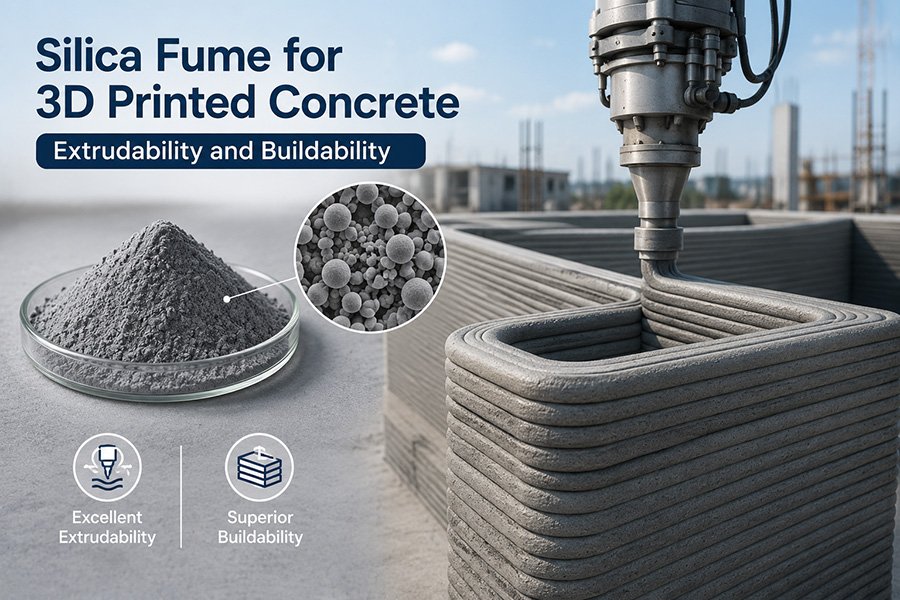
When automated 3D concrete printing fails, the cost is immediate. A nozzle blockage destroys an hour’s work; a collapse mid-build wastes material and delays tight schedules. The problem almost always traces back to a single root: the concrete cannot simultaneously flow and hold shape. Silica fume solves this conflict by modifying rheology, accelerating strength gain, and densifying the interfacial transition zone — the three pillars of extrudability and buildability.
Understanding Extrudability: Flow Without Segregation
Extrudability is not simply low viscosity. It requires the mix to pass through a narrow nozzle as a cohesive filament, without aggregate separation, water bleeding, or internal friction spikes. A high yield stress risks clogging; too low and the bead slumps. Silica fume, with an average particle size of 0.1–0.3 µm and a BET surface area exceeding 15,000 m²/kg, acts as a nanoparticle lubricant. Its spheres lodge between cement grains and fill the water-filled voids, continuously releasing trapped water during shear. This shear-thinning behaviour reduces extrusion pressure while raising the mix’s plastic viscosity just enough to stop segregation. In one case cited on the effect of silica fume on concrete, the addition of 8% microsilica by weight of cementitious (bwoc) cut dynamic segregation by more than 60% compared to a plain cement paste.
Equally important is the role of the spherical particle morphology. Unlike angular fly ash or irregular slag particles, fused silica fume nodules (especially in densified form) create a ball‑bearing effect during pumping. The thixotropic structure forms rapidly after extrusion, allowing the filament to maintain its cross‑sectional shape. Engineers often combine a medium‑grade silica fume — such as 94% SiO₂ — with a polycarboxylate ether (PCE) superplasticizer to fine‑tune the balance between open time and shape stability. Too much PCE and the bead spreads; too little and the printer stutters. Silica fume reduces the sensitivity to small dosage errors, creating a wider processing window.
Buildability and the Critical Role of Green Strength
Buildability hinges on the concrete’s ability to gain enough green strength after deposition to support the next printed layer without deformation. A delay of seconds can cause the bottom layers to bulge or the entire print to lean. Here, silica fume’s pozzolanic reactivity becomes a design tool. In the first 30 minutes after placement, calcium hydroxide liberated from cement hydration reacts with the amorphous SiO₂ to form additional calcium‑silicate‑hydrate (C‑S‑H) gel. This early‑age reaction, enhanced by the high specific surface area, bridges particles and locks the filament geometry. Laboratory trials on printable UHPC mixes show that replacing 12% cement with 96%‑grade silica fume can increase 30‑minute compressive green strength by up to 45% compared to a reference without microsilica.
Beyond bulk strength, silica fume densifies the interface between successive layers. The reduced water‑to‑binder ratio (w/b) and the filler effect at the layer‑to‑layer cold joint minimise porosity and improve bond tensile strength. When printing outdoor structural walls, this interfacial densification directly combats delamination under wind or thermal stress. In combination with a suitable retarder, the accelerated stiffening can be managed to allow a 20‑25 second inter‑layer interval — fast enough for a 2‑metre‑high wall in under an hour without slumping. For high‑rise 3DCP, consistent micro silica quality is non‑negotiable, as variability in SiO₂ reactivity can shift the open time unpredictably.
Particle Packing and the ITZ: Why Microsilica Matters for Layer Adhesion
The interfacial transition zone (ITZ) between printed layers is the weakest plane in 3D concrete. In ordinary mortar, the ITZ is rich in portlandite and larger pores, creating a pathway for crack propagation. Silica fume transforms this zone by filling the 0.1–1.0 µm gaps between cement grains and reacting with the CH crystals to convert them into dense C‑S‑H. The result is a narrower, stronger bond region with permeability up to two orders of magnitude lower. For 3DCP, where adhesion across a time‑separated interface is paramount, this translates into tensile bond strengths often exceeding 2.5 MPa, well above the 1.0 MPa typically required for structural continuity.
Optimal particle packing also raises the wet mass density, which stabilises the filament during stacking. A well‑graded mix using 5–8% microsilica, fine sand (0–1 mm), and a low w/b ratio achieves a packing density above 0.80, minimising voids without sacrificing flowability. When selecting silica fume, particle agglomeration must be considered. Densified silica fume disperses rapidly under high‑shear mixing and avoids the dust and handling issues of undensified powder, making it the default choice for automated batching systems in large‑scale printing plants.
Optimising Silica Fume Grade and Format for Print Feasibility
Not all silica fume grades perform equally in 3D printing. The SiO₂ purity, loss on ignition (LOI), and particle size distribution directly influence water demand, rheology, and strength development. A higher SiO₂ content typically indicates lower impurities and greater pozzolanic reactivity, but also increases water demand. The table below compares typical grades suitable for 3DCP applications.
| SiO₂ Grade | Typical BET (m²/g) | Water Demand Impact | Green Strength Gain | Print Application Suitability |
|---|---|---|---|---|
| 85% | ≥12 | Moderate | Low | Low‑cost, non‑structural prints |
| 92% | 15–18 | Moderate‑High | Moderate | General precast elements |
| 94% | 18–22 | High | High | Structural walls, columns |
| 96% | 20–25 | Very High | Very High | UHPC layers, bridges |
| 98% | 25–30 | Extremely High | Maximum | High‑precision UHPC, research |
For most commercial 3DCP applications, a 94% grade strikes the practical balance between reactivity and mix‑water demand. 94-grade silica fume for concrete provides ample pozzolanic acceleration while keeping PCE dosage within economical limits (1.0–1.8% bwoc). When paired with a densified format, it integrates smoothly into dry‑premix systems, eliminating the handling complications of undensified microsilica without sacrificing performance. Higher grades (96–98%) are reserved for ultra‑high‑performance mixes where every MPa of early strength is critical.
Critical Mix Design Adjustments for Printable Concrete
Silica fume cannot work in isolation. A printable mix demands simultaneous optimisation of several parameters. Maintaining cohesion during pumping and shape after deposition relies on precise adjustment of the following factors:
- Water‑to‑binder ratio (w/b): Typically 0.25–0.35 for UHPC‑based prints. Silica fume fills voids and reduces free water, enabling the low w/b needed for buildability without excessive PCE.
- Superplasticizer type and dosage: PCE‑based SPs are mandatory. Dosage ranges from 0.8–2.2% bwoc, depending on silica fume grade and aggregate fineness. Over‑dosing delays setting and weakens interlayer bond.
- Silica fume content: Effective range is 5–15% bwoc. Below 5% green strength improvement is negligible; above 15% the mix becomes overly cohesive, raising extrusion pressure and risking nozzle blockages.
- Aggregate gradation: Maximum aggregate size should not exceed one‑third of the nozzle diameter. Continuously graded fine sand (0–1 mm or 0–2 mm) combined with microsilica ensures homogeneous extrusion and minimal segregation.
- Viscosity‑modifying admixtures (VMAs): Used sparingly to fine‑tune thixotropy. When high‑reactivity silica fume is present, VMA dosage can often be reduced by 20‑30% without loss of shape stability.
Measuring the static yield stress and flocculation kinetics with a rheometer before full‑scale printing is essential. Even small batch‑to‑batch variations in silica fume LOI can shift the SP demand. A robust quality‑control protocol that references established concrete performance indices helps printers maintain consistent filament dimensions across multi‑day prints.
Scaling Up: Process Control Essentials for Industrial 3DCP
Moving from laboratory success to daily site production introduces variables that silica fume helps tame. Moisture content, mixing energy, and ambient temperature all alter rheology. Densified silica fume, with its low moisture absorption (typically <1.0% LOI), limits unpredictable changes in w/b ratio when stored in humid environments. Its bulk density of 500–700 kg/m³ allows pneumatic conveying and direct filling into silos, matching the automation demands of robotic printers. Uniform dispersion is achieved within 30 seconds in a high‑shear pan mixer, provided the w/b remains above 0.20.
To sustain buildability over long printing sessions, the mix must retain a stable open time (flowability window) of 15–25 minutes. Silica fume’s high reactivity can shorten this window, so retarders such as sodium gluconate are often used at 0.05–0.2% bwoc. The synergy between the retarder and the microsilica’s pozzolanic reaction results in a controlled stiffening curve that matches the printer’s speed. Without this balance, early layers would harden before the next is deposited, creating a cold joint that is impossible to bond. Ultimately, a reliable supply of consistent‑grade densified silica fume is the simplest insurance against costly print failures and material waste.
Frequently Asked Questions
Q: What is the optimum silica fume dosage for 3D printed concrete?
A: The effective range is 5–15% by weight of cementitious materials. For UHPC‑based prints achieving high green strength, 10–12% bwoc of a 94–96% SiO₂ grade is common. Doses above 15% increase water demand and extrusion pressure without proportional benefit.
Q: How does silica fume improve layer adhesion in 3D printing?
A: Silica fume densifies the interfacial transition zone between printed layers. Its pozzolanic reaction converts calcium hydroxide into C‑S‑H gel, reducing porosity and increasing tensile bond strength. Combined with pore filling from ultrafine particles, typical layer adhesion exceeds 2.5 MPa.
Q: Can densified silica fume be used in dry‑mix systems for 3D printing?
A: Yes, densified silica fume disperses under standard high‑shear mixing and is the preferred format for automated batching. Its dust‑free handling and flowable granules make it ideal for silo storage and pneumatic conveying in large‑scale 3DCP plants.
Q: What SiO₂ purity is recommended for high‑performance 3D printed concrete?
A: A minimum of 94% SiO₂ is recommended for structural prints. Grades of 96–98% provide superior reactivity and are suited to ultra‑high‑performance concrete where maximum early‑age strength and minimal porosity are critical.
Q: Does silica fume affect the open time of printable concrete?
A: Yes, the high reactivity of silica fume shortens open time by accelerating early hydration. To compensate, a retarder (e.g., sodium gluconate at 0.05–0.2% bwoc) is typically added to maintain a 15–25 minute workability window suitable for continuous printing.
About Henan Superior Abrasives (HSA)
Henan Superior Abrasives (HSA) is a China-based manufacturer and global supplier of high-quality silica fume (microsilica) for concrete and refractory applications. Supplying both densified and undensified grades compliant with ASTM C1240 and EN 13263, HSA serves customers in 30+ countries with reliable microsilica solutions for HPC, UHPC, precast concrete, shotcrete, and other high-performance construction materials.
Get a Quote or Free Sample
Ready to improve your concrete performance with premium silica fume? Contact our technical team today — we respond within 24 hours and can arrange free samples for qualified projects.
- 📧 Email: sales@superior-abrasives.com
- 💬 WhatsApp: +86-186-3863-8803