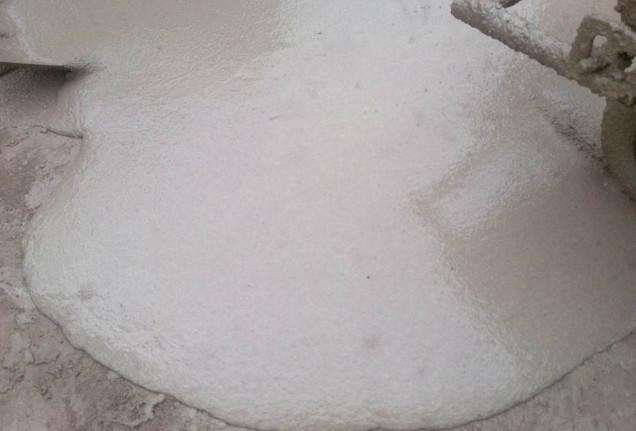
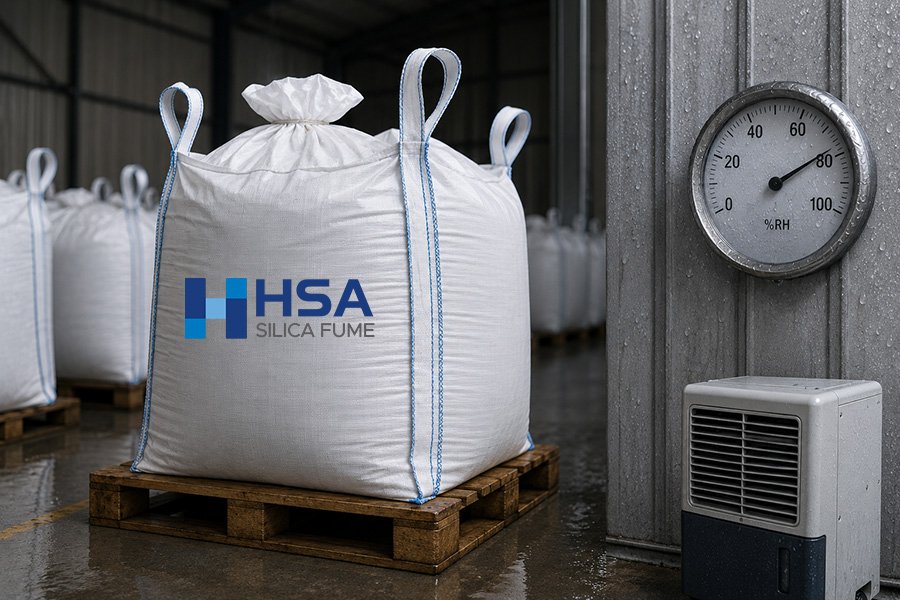
Bulk silica fume stored in high-humidity tropical or coastal conditions can pre-hydrate in the bag, rendering it useless before it ever reaches the mixer. That premature pozzolanic reaction—triggered by moisture ingress—can cost a single large infrastructure project tens of thousands of dollars in rejected material, lost reactivity, and catastrophic concrete underperformance. This article lays out the exact storage protocols required to protect jumbo bags of microsilica where ambient relative humidity routinely exceeds 85%.
Why Silica Fume Is So Aggressively Hygroscopic
Microsilica’s extreme moisture sensitivity is not an accident—it is a direct function of particle physics. With a BET surface area typically ranging from 15 to 30 m²/g, undensified grades present an enormous amorphous silica surface eager to adsorb water vapor. That adsorption initiates a surface hydroxylation that can propagate into gel formation within hours under the wrong conditions.
Once the silica surface begins forming silanol groups (Si-OH), the material’s pozzolanic potential drops sharply. Engineers relying on a consistent pozzolanic reaction to densify the interfacial transition zone will instead get inert agglomerates that act as micro-flaws. For projects specifying high-performance concrete with a w/b ratio below 0.25, even a 2% loss of reactive amorphous content can push compressive strength outside the acceptance envelope.
Pre-Delivery Inspection: What to Reject on Arrival
Humidity damage often begins long before the bags sit in your yard. A disciplined incoming inspection catches compromised material before it contaminates the rest of your inventory. Start by checking the outer polypropylene fabric for any pinprick tears, especially along bottom seams where forklift tine rash is common.
Next, look for these specific rejection triggers:
- Bridged or hard lumps visible through the bag wall—a sign of partial hydration and vapor-phase silica gel formation
- Condensate staining on the inner polyethylene liner, which signals a dew-point crossing event during ocean or road transit
- Heat evolution when pressing a palm against the bag surface; pre-hydrated silica fume can exotherm slightly as adsorbed water continues reacting
- Weight gain beyond the certified net mass, measured on a calibrated floor scale before warehousing
Rejecting a single compromised jumbo bag protects the rest of the silo or stack from a localized moisture front that will migrate through shared headspace. For specifications citing ASTM C1240, any sign of hydration voids the certificate of compliance regardless of what the chemical analysis later shows.
Environmental Thresholds for Safe Storage
Microsilica does not demand impossible conditions—it simply demands consistent ones. The danger zone sits above 70% relative humidity at temperatures exceeding 25°C, where the combination accelerates vapor-phase transport through the bag’s micro-pores. Below that threshold, properly lined jumbo bags can safely sit for months.
The table below gives operational storage limits tied to silica fume density grades. These values assume an intact, multi-layer barrier bag with a sealed spout and no prior exposure history.
| Silica Fume Grade | Max Safe RH (%) | Max Temp (°C) | Max Storage Duration |
|---|---|---|---|
| Undensified (150-250 kg/m³) | 65 | 25 | 3 months |
| Densified (500-700 kg/m³) | 75 | 30 | 6 months |
| Densified + Extra Barrier Liner | 85 | 35 | 4 months* |
| Undensified + Climate-Controlled Shed | 55 | 22 | 12 months |
*Requires quarterly LOI and moisture content verification per EN 13263-1.
The key variable here is particle packing within the bag. Densified silica fume offers far less internal surface area for moisture diffusion because the agglomerated particles reduce the effective vapor pathway, buying you an extra 10-15% RH tolerance. This alone often justifies the densified premium when specifying 94 grade silica fume for concrete in Southeast Asian or Gulf-region projects.
Stacking Configurations That Lower Condensation Risk
How you stack the bags dictates whether the microclimate inside the pile stays above the dew point. The classic mistake is stacking jumbo bags directly on a concrete slab with no thermal break. At night, the slab temperature drops below the ambient dew point, and moisture condenses against the bottom bag’s liner—exactly where it does the most damage.
Correct stacking follows three principles:
- Install a ventilated thermal break. Place the lowest tier on plastic pallets or timber dunnage that allows at least 150 mm of airflow between the slab and the bag bottom
- Maintain bag-to-wall clearance. Keep a 1-meter gap between any bag face and the warehouse exterior wall to prevent solar-driven thermal gradients from pushing moisture inward
- Use a pyramid stack for single-extraction lots. For material destined for one continuous pour, cross-stack in a 3-2-1 pyramid with the spouts facing inward, which minimizes the exposed liner surface area and reduces the headspace-to-material ratio
For refractory-grade material with tighter loss-on-ignition limits—like 92 grade silica fume for refractory castable applications—even minor condensation can spike the LOI enough to fail a batch. Stacking discipline here is not a suggestion; it is a quality-control gate.
Monitoring Protocols and Corrective Actions
No storage strategy survives without data. Monitoring adds cost, but the cost of discovering hydration only at the mixer is an order of magnitude higher when you factor in batching delays, return freight, and re-testing.
At minimum, deploy a calibrated thermo-hygrometer with a data logger inside the storage area, positioned at bag-mid-height between two stacks. Set an alert threshold at 70% RH. Complement this with a twice-monthly LOI spot check: extract a 200 g sample from a top-corner bag using a sealed thief sampler, then run loss on ignition at 950°C per ASTM C1240. An LOI deviation exceeding 0.5% from the supplier’s certified value demands immediate investigation—move the affected bags to a dry quarantine zone and test three more from the same stack.
A frequently overlooked practice is rotating stock so that the oldest bags feed the next pour. Silica fume does not improve with age. For projects consuming densified 92 grade silica fume for concrete over a span of months, label each jumbo bag with its arrival date and enforce a first-in, first-out discipline rigidly.
Recovering Material After Brief Exposure
Not every moisture spike means the bag is scrap. If humidity control failed for a known, short window—say, a hurricane compromised warehouse doors for 36 hours—you can sometimes salvage the material. The decision hinges on whether the reaction progressed beyond surface hydroxylation into actual C-S-H gel formation.
Run the following sequence before writing off the inventory:
- Pass the entire bag contents through a 150 µm sieve into a dry, sealed container. Any retained soft gel agglomerates confirm gel-phase hydration and justify rejection
- Measure the 45 µm wet-sieve retention on the passed fraction; a value more than 2% above the supplier’s original certificate indicates agglomeration that even a high-shear mixer may not fully disperse
- For ultra-high-performance concrete applications where the ITZ densification demand is absolute, accept only material whose post-exposure LOI is within 0.3% of the original value
Salvaged material should never be blended back into a new, pristine jumbo bag. Store it in a dedicated, labeled FIBC and schedule it for the next non-critical blind or mass concrete pour where minor reactivity loss remains within the mix design’s safety margin. When ordering replacement material, consider specifying 96 grade silica fume for refractory if your application demands the absolute lowest LOI tolerance—the higher purity gives you more margin against ambient moisture pickup.
Specifying the Right Bag Construction for Your Climate
The ultimate humidity defense starts with the bag itself. Standard jumbo bags with a single inner polyethylene liner are adequate for temperate, low-humidity logistics, but they fail predictably in monsoonal, coastal, or equatorial storage settings. Climate-appropriate bag specification is not an upcharge—it is a precondition of material integrity.
For high-humidity environments, demand a multi-layer barrier construction: an outer UV-stabilized polypropylene woven shell, a middle aluminum foil laminate as the vapor barrier, and an inner virgin polyethylene liner that is heat-sealed rather than tied. The spout and filling neck must use a self-sealing closure that does not rely on operator diligence alone. One widely adopted configuration adds a desiccant pouch within the sealed foil layer, sized to absorb any residual trapped air moisture during ocean container sweating events.
Procurement professionals ordering 85 grade silica fume for less demanding applications should still apply the same bag-quality logic. A lower SiO₂ content does not make the material less hygroscopic; if anything, the slightly coarser particle distribution in 85-grade products can create interstitial voids that promote faster vapor migration through the bag interior. Write the bag spec into the purchase order—supplier acceptance of ASTM C1240 alone does not guarantee the packaging can survive your local wet season.
Practical takeaway: The jumbo bag is a micro-warehouse. In high-humidity environments, its liner is the only thing keeping your silica fume from becoming inert silica gel. Invest in the barrier, enforce the inspection, and monitor the microenvironment relentlessly.
Frequently Asked Questions
Q: What relative humidity level triggers caking in stored silica fume?
A: Caking risk increases sharply above 60% RH. In sustained relative humidity >70%, adsorbed moisture can exceed the 3% limit specified in ASTM C1240 / EN 13263 within 48 hours if packaging is not vapor-proof.
Q: Should I use densified or undensified silica fume for long-term storage in a humid warehouse?
A: Densified silica fume (300–600 kg/m³ bulk density) is preferred because the agglomerated particles reduce exposed surface area and moisture ingress. Undensified (200–300 kg/m³) has higher BET surface area (>20 m²/g) and absorbs humidity significantly faster.
Q: How should jumbo bags be placed on a pallet or floor to minimize moisture damage?
A: Always store jumbo bags on a raised pallet (minimum 150 mm clearance) and never directly on concrete or earth. Concrete slabs can wick ground moisture; use a polyethylene vapor barrier between the pallet and the bag.
Q: What is the best practice for covering jumbo bags in an outdoor staging area?
A: Cover with a breathable but water-repellent tarp (e.g., woven polypropylene with breathable membrane). Do not use sealed plastic sheeting directly on the bags—it can trap condensation. Maintain at least 5 cm air gap between tarp and bag surface.
Q: How do I test if already-stored silica fume has been compromised by moisture?
A: Measure loss on ignition (LOI) and free moisture content per ASTM C1240. Acceptable LOI is ≤3% for Grade 85/94. Visually, check for hard lumps that do not break under moderate finger pressure—such lumps indicate premature hydration and reduced pozzolanic activity.
About Henan Superior Abrasives (HSA)
Henan Superior Abrasives (HSA) is a China-based manufacturer and global supplier of high-quality silica fume (microsilica) for concrete and refractory applications. Supplying both densified and undensified grades compliant with ASTM C1240 and EN 13263, HSA serves customers in 30+ countries with reliable microsilica solutions for HPC, UHPC, precast concrete, shotcrete, and other high-performance construction materials.
Get a Quote or Free Sample
Ready to improve your concrete performance with premium silica fume? Contact our technical team today — we respond within 24 hours and can arrange free samples for qualified projects.
- 📧 Email: sales@superior-abrasives.com
- 💬 WhatsApp: +86-186-3863-8803