Specifying silica fume from an overseas supplier without an on-site audit introduces real risk: a batch with SiO₂ below 85%, an LOI above 6%, or a moisture content that triggers clumping can compromise pozzolanic reactivity, stall a UHPC mix design, or trigger outright rejection at the job site. The cost is not just the rejected material — it is the schedule delay, the re-batching expense, and the reputational exposure with the end client. Remote supplier qualification, done systematically, eliminates most of that risk before a single container ships.
Start With the Certificate of Analysis — Then Stress-Test It
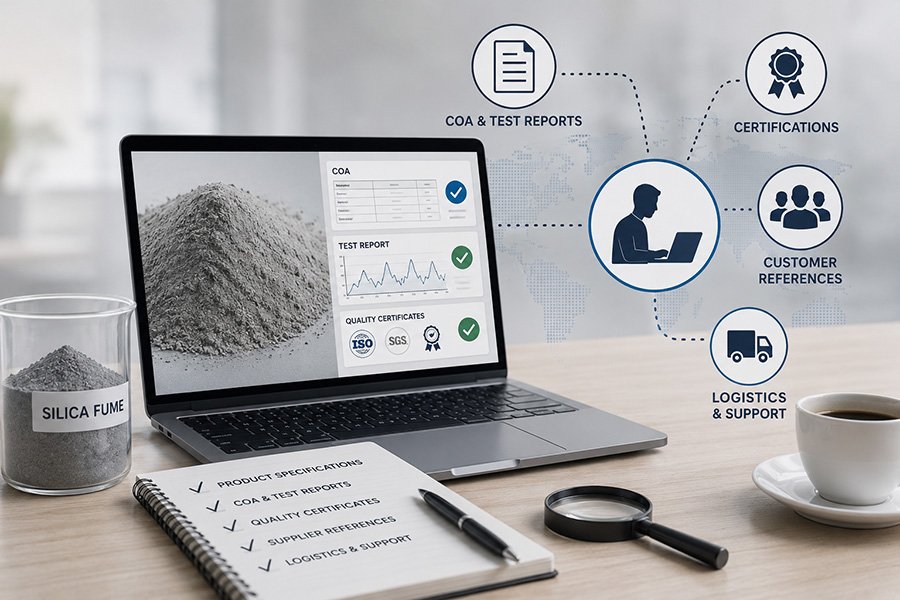
Every credible silica fume supplier issues a Certificate of Analysis (COA) per batch. The COA should report SiO₂ content, LOI (loss on ignition), moisture content, specific surface area (BET), accelerated pozzolanic activity index (PAI), and oversize retention on a 45 µm sieve. Acceptable thresholds under ASTM C1240 include SiO₂ ≥ 85%, LOI ≤ 6.0%, moisture ≤ 3.0%, and a PAI ≥ 105% relative to the control mix at 7 days.
Request COAs from at least three consecutive production batches, not just one. Consistency across batches reveals process control quality; a supplier whose SiO₂ swings from 88% to 95% between lots is running an inconsistent furnace or blending inventory. Cross-reference the reported BET surface area (typically 15,000–25,000 m²/kg for undensified product) against the particle morphology description — amorphous, spherical particles below 1 µm diameter are the source of silica fume’s pozzolanicity. If the supplier cannot provide multi-batch data on request, treat that as a disqualifying signal.
Decode the SiO₂ Grade Tiers and Match Them to Your Application
Not all silica fume is interchangeable. Suppliers typically offer several purity tiers — 85%, 92%, 94%, 96%, and 98% SiO₂ — each suited to different performance demands. For standard high-performance concrete (HPC) in structural columns or bridge decks, a 92% or 94% grade silica fume for concrete delivers adequate pozzolanic reaction without over-spending on purity. UHPC formulations and oil-well cement systems, by contrast, often require 96–98% SiO₂ to meet compressive strength targets above 150 MPa and to control the w/b ratio precisely.
Understanding how silica fume compares against other supplementary cementitious materials also sharpens procurement decisions. The differences between fly ash, slag, and silica fume are substantial in terms of surface area, reaction kinetics, and chloride resistance — a supplier who conflates these materials or overstates silica fume’s equivalence to slag should raise caution. Ask the supplier directly which grade they recommend for your w/b ratio and curing regime, and evaluate the technical depth of their answer.
Key Quality Parameters: Benchmarks at a Glance
Use the table below as a remote qualification checklist when reviewing a supplier’s COA or product datasheet against ASTM C1240 and EN 13263-1 requirements.
| Parameter | ASTM C1240 Limit | EN 13263-1 Limit | Red-Flag Value |
|---|---|---|---|
| SiO₂ Content | ≥ 85.0% | ≥ 85.0% | < 85% or inconsistent across batches |
| Loss on Ignition (LOI) | ≤ 6.0% | ≤ 4.0% | > 4% for UHPC or refractory use |
| Moisture Content | ≤ 3.0% | ≤ 3.0% | > 3% (clumping, dosing error risk) |
| 45 µm Sieve Oversize | ≤ 10.0% | ≤ 10.0% | > 10% (coarse contamination) |
| Pozzolanic Activity Index (PAI) | ≥ 105% at 7 days | Activity index ≥ 100% | < 100% (inert filler risk) |
| Specific Surface Area (BET) | Report only | ≥ 15,000 m²/kg | < 13,000 m²/kg (low reactivity) |
Third-Party Testing Is the Most Reliable Remote Audit Tool
A COA issued by the supplier’s own laboratory is a starting point, not a conclusion. For any first order above one 20-foot container, commission independent testing through an accredited laboratory — SGS, Bureau Veritas, or an AASHTO-accredited facility in your country. Request that the supplier allow sample collection at the point of bagging or loading, not from a retained reference sample held in their office. Insist on sealed and numbered sample bags with photos of the bagging process; this protects both parties.
Specify exactly which tests the third-party lab should run: XRF for elemental oxide composition, BET nitrogen adsorption for surface area, TGA for LOI, and laser diffraction or SEM imaging for particle size distribution (PSD). If the supplier resists independent sampling or insists on shipping the sample themselves, that resistance is informative. Reputable manufacturers routinely accommodate third-party inspection because they are confident in their process control.
Physical Format and Packaging Integrity Signal Operational Competence
Silica fume ships as either densified (bulk density 500–700 kg/m³) or undensified (bulk density 150–350 kg/m³) product, and the choice affects batching equipment compatibility and dosing precision in the field. For high-reactivity refractory mixes, undensified silica fume used for refractory applications is generally preferred because re-dispersion in a densified pellet depends heavily on shear energy during mixing — energy that refractory gunite systems may not deliver.
Evaluate the supplier’s packaging documentation: inner PE liner thickness (minimum 0.08 mm), outer woven polypropylene bag strength, and palletisation method for sea freight. Request photos of a recent shipment’s loading inspection. Moisture ingress during a 30-day ocean transit is a real degradation pathway; bags with compromised seals raise moisture content and can cause partial hydration of the cementitious matrix in the bag itself, reducing effective SiO₂ availability at point of use.
Documented Project References and Application-Specific Track Record
A supplier’s experience with your specific application category — whether that is super high-rise building concrete, marine infrastructure, or precast tunnel segments — is a practical proxy for technical competence. Ask for verifiable project references: client name, project location, approximate volume supplied, and SiO₂ grade used. A supplier who has exported 94% silica fume to a 100-storey tower project in Southeast Asia has demonstrated supply chain reliability, quality consistency over multiple shipments, and the ability to meet project-specific COA requirements.
Beyond references, evaluate the depth of technical support the supplier provides before the sale. Can they recommend a dosage rate (typically 5–10% bwoc for HPC, up to 25–30% by cementitious weight for UHPC) appropriate to your mix design? Do they understand how PCE superplasticizer demand increases with silica fume addition and how that interacts with your target w/b ratio? The quality of pre-sale technical engagement is a reliable indicator of post-shipment support capacity. For a deeper look at how silica fume elevates structural concrete performance, see this overview of the significance of silica fume in enhancing the quality of concrete.
- Request multi-batch COAs (minimum three consecutive lots) and compare SiO₂ and LOI variance — a standard deviation above ±1.5% SiO₂ indicates poor process control.
- Confirm third-party inspection access: suppliers who permit SGS or BV sampling at the plant demonstrate confidence in their quality management system.
- Verify export history through shipping records or customs data — platforms like ImportGenius or Panjiva allow buyers to confirm a supplier’s actual shipment volume and destination markets.
- Assess technical response quality: a supplier who answers dosage and compatibility questions with specific data rather than generalities has application-trained staff, not just sales personnel.
- Check packaging specifications against your transit conditions — densified silica fume in double-lined 1-tonne jumbo bags is standard for containerised ocean freight; anything less for long voyages is a moisture risk.
Frequently Asked Questions
Q: What SiO₂ content should I require as a minimum from a silica fume supplier?
A: ASTM C1240 and EN 13263-1 both set 85% SiO₂ as the minimum acceptable threshold for use as a supplementary cementitious material. For UHPC applications targeting compressive strengths above 150 MPa, most mix designs specify 94–96% SiO₂ or higher to ensure sufficient amorphous silica for the secondary pozzolanic reaction with calcium hydroxide (Ca(OH)₂) liberated during cement hydration. Request XRF-confirmed oxide analysis, not supplier self-declaration alone.
Q: How do I verify a Chinese silica fume supplier’s claims without visiting the factory?
A: Commission third-party sampling and testing through SGS, Bureau Veritas, or an equivalent accredited inspection body at the point of bagging. Specify XRF for SiO₂ content, TGA for LOI, BET nitrogen adsorption for specific surface area, and laser diffraction for particle size distribution. Additionally, cross-reference the supplier’s export history using platforms like ImportGenius or Panjiva to confirm actual shipping volumes and destination markets before committing to a trial order.
Q: What LOI value is acceptable for silica fume used in high-performance concrete?
A: ASTM C1240 permits an LOI up to 6.0%, but EN 13263-1 caps it at 4.0%. For high-performance concrete (HPC) and UHPC applications, specify LOI ≤ 3.0% wherever possible. Elevated LOI — caused by residual carbon or unburned organic material from the furnace process — increases water demand, disrupts air-entrainment control, and can interfere with PCE superplasticizer effectiveness. Refractory applications are particularly sensitive and typically require LOI ≤ 2.0%.
Q: What is the difference between densified and undensified silica fume, and does it affect quality?
A: Densification is a mechanical process that agglomerates undensified silica fume (bulk density 150–350 kg/m³) into micro-pellets with bulk density 500–700 kg/m³ to improve handling, reduce dust, and simplify transport logistics. The chemical composition — SiO₂ content, LOI, specific surface area — is unchanged by densification. However, densified product requires adequate shear energy during mixing to fully break down agglomerates. In low-shear mixing environments such as refractory guniting, undensified silica fume ensures superior particle dispersion and full reactivity.
Q: How many samples should I request before approving a silica fume supplier?
A: Request COAs from a minimum of three consecutive production batches before approving a new supplier. For trial orders, arrange third-party sampling of the actual shipment lot — not a reference sample held at the plant. Evaluate batch-to-batch variance: SiO₂ standard deviation above ±1.5% and LOI swings above ±1.0% between batches indicate insufficient furnace or process control. Consistent multi-batch data is a stronger qualification signal than any single impressive COA result.
About Henan Superior Abrasives (HSA)
Henan Superior Abrasives (HSA) is a China-based manufacturer and global supplier of high-quality silica fume (microsilica) for concrete and refractory applications. Supplying both densified and undensified grades compliant with ASTM C1240 and EN 13263, HSA serves customers in 30+ countries with reliable microsilica solutions for HPC, UHPC, precast concrete, shotcrete, and other high-performance construction materials.
Get a Quote or Free Sample
Ready to improve your concrete performance with premium silica fume? Contact our technical team today — we respond within 24 hours and can arrange free samples for qualified projects.
- 📧 Email: sales@superior-abrasives.com
- 💬 WhatsApp: +86-186-3863-8803