Shipping silica fume internationally without understanding the stark physical differences between densified and undensified forms can erase profit margins overnight. A single 20‑foot container loaded incorrectly with undensified microsilica might carry less than half the payload of an optimized densified shipment, while still incurring identical freight charges. That invisible cost per ton can turn a competitive bid into a loss leader before the vessel even departs port. Getting container loading right is a direct lever on landed cost control, product integrity, and downstream mix performance.
Silica Fume Density Gap That Defines Container Strategy
Undensified silica fume leaves the furnace with a bulk density typically ranging from 200 to 350 kg/m³. That airy, low‑density state is a direct consequence of the ultra‑fine amorphous SiO₂ particles — averaging 0.15 µm — and the high specific surface area created during ferrosilicon alloy production. Densified fume, by contrast, undergoes mechanical or plasma‑assisted agglomeration, compacting the primary particles into clusters that push bulk density into the 500–750 kg/m³ band. This near‑tripling of density completely redefines how much product fits inside a standard 20‑foot container.
Engineers who overlook this gap often set unrealistic shipment targets. Because ocean freight cost is calculated per container, not per ton, the effective freight rate per kilogram of undensified fume can be nearly three times higher if the container is volume‑constrained rather than weight‑constrained. A silica fume bulk specific gravity assessment should always precede loading plan development, as the loose pour density dictates not only how many metric tons will fit but also the physical packaging configuration required to avoid load shifting.
Even minor batch‑to‑batch density variations — common in undensified grades due to furnace cycle fluctuations — can render a planned stacking pattern obsolete. Therefore, a loading protocol that samples and verifies density of each production lot before container stuffing becomes a non‑negotiable step for predictable logistics costs.
Weight vs. Volume: Payload Calculation Framework for a 20‑footer
A standard 20‑foot general‑purpose container offers roughly 33 m³ of internal volume and a maximum gross payload in the order of 25–28 metric tons, depending on container tare weight. The limiting factor for silica fume is rarely structural capacity but instead the interplay between bulk density and usable internal dimensions.
The table below illustrates how dramatically payload can shift between forms when loading a 20‑foot container with a typical 26‑ton payload limit and 33 m³ internal capacity, assuming palletized bag configurations that preserve some air gaps for ventilation and handling access:
| Parameter | Undensified SF | Densified SF |
|---|---|---|
| Loose bulk density (kg/m³) | 250 – 350 | 550 – 700 |
| Practical stowable volume (m³) | ~28 | ~28 |
| Stowable weight at given density (tons) | 7.0 – 9.8 | 15.4 – 19.6 |
| Container weight limit breach? | No (volume‑constrained) | Often yes (weight‑constrained) |
| Typical achieved payload (tons) | 8 – 10 | 22 – 26 |
| Freight cost per metric ton shipped | 2.5 – 3.0× higher | Baseline |
Undensified fume rarely exceeds 10 metric tons per container without extraordinary compression, which itself endangers the product. For projects where undensified refractory‑grade fume is specified, such as undensified silica fume used for refractory applications, accepting a lower container payload is often unavoidable. The logistics team must price accordingly, knowing that a 20‑foot unit will ship 8–10 tons, not 24, and that freight allocation per ton must reflect this reality.
Smart buyers negotiate flexi‑tank or bulk‑bag volumetric discounts with carriers when undensified fume volumes are high, but for most project‑scale demands, switching to densified fume for concrete and mortar applications immediately cuts shipping cost per tonne by 50–65%.
Physical Stability Risks That Dictate In‑Transit Load Integrity
Undensified silica fume’s extreme fineness and electrostatic charge make it susceptible to fluidization‑like flow under vibration, compaction settlement, and dust explosion hazards if mismanaged. During road feeder moves or ocean transit, the product can settle by 15–20% of its original volume, loosening strap tension and creating internal voids that allow bags to shift dramatically. That shift often ruptures woven polypropylene bag seams, releasing airborne microsilica that contaminates the entire container and poses serious respiratory risks during unpacking.
Densified fume granules, while far more stable, introduce a different risk profile. If bulk density approaches 700 kg/m³ and bags are stacked without intermediate dunnage, point pressure can crush the lower tier granules into a near‑compacted solid layer resembling a re‑densified cake. This so‑called “dead load” effect can raise the requirement for post‑arrival de‑agglomeration, forcing end‑users to run the material through a high‑shear mixer or a dispersion unit that undensified users could bypass. A careful bag‑level weight distribution and use of slip sheets mitigate this effect considerably.
Sea freight exposes all silica fume loads to condensation cycles caused by diurnal temperature swings inside the container. Without adequate vapor‑barrier packaging, the hygroscopic nature of silica fume leads to irreversible hydration crusting at the bag surface, effectively creating clumps that fail to disperse during concrete batching. Ensuring effective moisture exclusion is therefore a direct prerequisite for maintaining the pozzolanic reactivity and C‑S‑H gel formation expected in HPC and UHPC.
Bagging, Palletizing, and Stowage Configurations That Prevent Failure
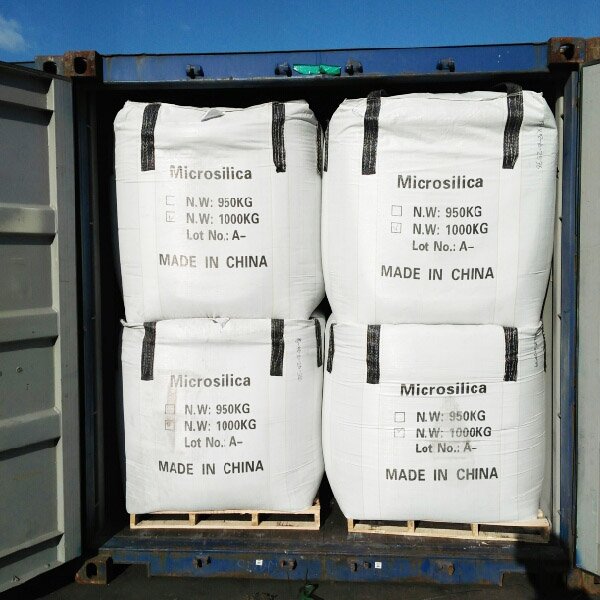
Selecting the right bag construction is the first defense line. For undensified fume, double‑layer paper‑polyethylene valve bags or laminated woven PP with a buried PE liner reduce both vapor transmission and dust leakage. These bags must incorporate a one‑way degassing valve if pneumatic filling is used, preventing ballooning while blocking ambient moisture ingress. For densified grades, heavy‑duty 25‑kg or 1‑ton FIBCs (bulk bags) with an internal PE coating and a skirted spout‑top are standard, but a strap‑safe design that prevents column collapse under vibration is non‑negotiable.
Palletizing configuration matters just as much. On a Euro‑pallet (1200×800 mm), stacking undensified fume beyond 1.2‑meter height without interlocking layers invites dramatic load shifting. A better approach uses octagonal stacking with a shrink‑wrap perimeter and a top‑cap cardboard panel. Densified bags can be stacked higher — often 1.5–1.8 meters — but only if vertical containment straps are tensioned to a calculated 180–220 daN, and anti‑slip paper sheets are placed every three layers. Poor strap tension is a leading cause of container gate rejections at destination ports because surveyors can visually confirm load tilting.
For undensified products destined for high‑end dispersion applications, understanding the degree of agglomeration that can happen during transit is critical. Products with improved packing design, such as those described in our super dispersibility undensified microsilica guide, benefit from vacuum‑packed liners that compress the material just enough to limit settlement without creating hard agglomerates that resist subsequent mixing.
Moisture Control Protocols: Desiccants, Liners, and Container Seals
Container rain — condensation drips from the roof — is a proven enemy of silica fume cargo. Humidity absorbed during loading in tropical ports can condense during the cool‑night leg of a voyage, dripping directly onto top‑tier bags. Undensified fume bags hit by dripping moisture develop a hard, grey crust that can penetrate 2–3 cm deep, representing a total loss for that portion because it will not disperse in a concrete mix. Densified fume shows slightly better resistance because the larger granule size restricts wicking, but a fully saturated granule cluster can still persist as an inert aggregate in an otherwise reactive mix.
A specification‑grade moisture barrier calls for a full‑container laminated HDPE liner (200‑micron minimum) applied before stuffing, combined with silica gel or calcium chloride desiccant poles hung vertically along the side walls. The desiccant quantity should follow the formula: 8–12 kg per TEU for vulnerable undensified loads, depending on voyage duration and climatic zones traversed. For densified loads, 6–8 kg of desiccant per TEU often suffices — provided bags are film‑wrapped and container door seals are triple‑checked for compression set.
Ventilation is generally contraindicated for silica fume. Passive container vents that equalize pressure can also admit salt‑laden air or humidity spikes, accelerating hydration. Unless a shipment is moving entirely through arid regions, all container vents should be sealed after a desiccant‑lined liner is installed. The door gasket should be a continuous EPDM rubber seal, not a foam strip that loses elasticity after one thermal cycle.
Documentation and Labeling That Keep Shipments Moving at Customs
Undensified and densified silica fume share the same HS code (6815.99 in many jurisdictions, but always verify local tariff books) but bifurcate on physical‑state declaration. Undensified fume listed as “amorphous silica powder” with a high specific surface area declaration can trigger additional health‑safety scrutiny, especially under REACH or TSCA, because the fine powder category is flagged for respiratory protection requirements. Densified fume, often declared as “agglomerated microsilica granules,” tends to pass inspection with fewer MSDS‑related delays because the reduced dust‑free nature lowers classification risk.
Every container manifests must clearly state the net weight versus gross weight delta precisely, because weight‑constrained densified shipments can appear overweight if pallets are included in the manifest ambiguity. A consolidated load of micro silica powder shipments should carry a notarized loading survey, a packing list showing batch numbers against bag count, and a certificate of compliance with ASTM C1240 or EN 13263, as applicable. Customs officers at destination ports increasingly demand these documents in digital format before container release, so forward shipping these to the importer 48 hours pre‑arrival prevents demurrage charges.
Labeling each bag with LOI, SiO₂ grade, and production date in English plus destination‑country language helps site supervisors reject any damaged or water‑intruded bags without holding up the entire batch. This small step prevents the far larger cost of pumping and placing concrete that fails strength development due to inadvertently hydrated microsilica.
Frequently Asked Questions
Q: What is the typical maximum payload for densified silica fume in a 20‑foot container?
A: With a loose bulk density of 550–700 kg/m³, a 20‑footer can accommodate 22–26 metric tons of densified silica fume, limited by container weight capacity (often ~28 tons gross minus tare) rather than volume. Palletized loads may slightly lower this figure to 20–24 tons depending on pallet weight and void spaces.
Q: How can I prevent undensified silica fume from compacting during sea transit?
A: Use double‑layer valve bags with PE liners, limit bag‑stack height to 1.2 m on pallets with interlocking layers, and apply full‑container HDPE liners. Avoiding over‑compression ensures post‑transit bulk density stays within 250–350 kg/m³ and does not create hard agglomerates that require re‑grinding.
Q: Is it possible to mix densified and undensified silica fume in the same container?
A: It is strongly discouraged. The two forms differ in bulk density by a factor of 2–3, causing uneven weight distribution and potential load shifting. Container surveyors typically reject mixed‑form shipments as they violate ISPM‑15 load integrity guidelines and complicate customs clearance.
Q: What moisture control measures are essential for silica fume container shipping?
A: A 200‑micron HDPE container liner, 8–12 kg of desiccant poles per TEU for undensified loads, sealed ventilation ports, and continuous EPDM door gaskets. Avoid foam seals and passive vents; even minimal condensation can irreversibly hydrate the fume and destroy its pozzolanic reactivity.
Q: Which silica fume form offers better shipping cost efficiency?
A: Densified silica fume reduces freight cost per metric ton by 50–65% compared to undensified when shipping in 20‑foot containers, because it can triple the payload without exceeding weight limits. For applications where undensified is technically mandatory, like some refractory castables, lower payload is unavoidable and must be priced into the supply contract.
About Henan Superior Abrasives (HSA)
Henan Superior Abrasives (HSA) is a China-based global supplier of high-quality silica fume (microsilica) for concrete and refractory applications. Supplying both densified and undensified grades compliant with ASTM C1240 and EN 13263, HSA serves customers in 30+ countries with reliable microsilica solutions for HPC, UHPC, precast concrete, shotcrete, and other high-performance construction materials.
Get a Quote or Free Sample
Ready to improve your concrete performance with premium silica fume? Contact our technical team today — we respond within 24 hours and can arrange free samples for qualified projects.
- 📧 Email: sales@superior-abrasives.com
- 💬 WhatsApp: +86-186-3863-8803