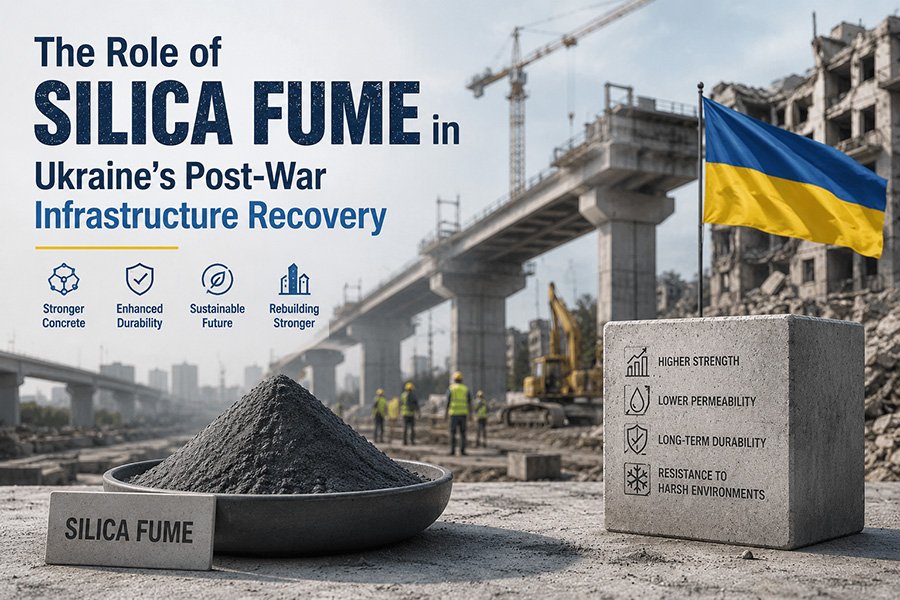
The scale of destruction to Ukraine’s transport networks, energy facilities, and urban centers demands a reconstruction strategy that prevents premature failure. Ordinary concrete structures will be rapidly compromised by freeze-thaw cycles and de-icing salts, requiring costly repairs within years. Silica fume’s role in Ukraine’s post-war infrastructure recovery is to provide the essential pozzolanic reaction that refines the concrete pore structure, enabling engineers to meet strict durability and speed requirements simultaneously.
Reinforcing for Generations: Why Standard Concrete Isn’t Enough for Critical Infrastructure
When rebuilding bridges, highways, and water treatment plants, the concrete mix design must deliver a service life measured in decades, not years. Standard concrete relies on a porous interfacial transition zone (ITZ) between aggregate and cement paste, a weak link that allows chloride ingress, sulfate attack, and carbonation. By introducing silica fume—a highly reactive micro silica with an average particle size 100 times finer than cement—the pozzolanic reaction consumes calcium hydroxide and generates additional calcium silicate hydrate (C-S-H) gel directly within the ITZ. This reaction densifies the matrix, reducing capillary porosity and virtually eliminating bleed water channels.
For Ukraine’s infrastructure, this densification translates into drastically lower permeability. Chloride diffusion coefficients can drop by up to 90% compared to ordinary Portland cement concrete, providing robust protection for steel reinforcement. Structures exposed to the Black Sea coast, de-icing salts, or aggressive industrial soils will maintain their structural integrity far longer when microsilica is incorporated. The same mechanism also increases compressive strength, often exceeding 100 MPa in properly designed ultra-high performance concrete (UHPC) formulations.
Accelerated Construction Timelines Through High Early Strength Development
Reconstruction must proceed at an unprecedented pace. Delaying formwork stripping or waiting weeks for strength gain is not viable when restoring essential transport corridors. Silica fume’s ultra-fine particle size accelerates the rate of hydration and pozzolanic reactions, yielding significantly higher early-age strength. Mixes with 7–10% silica fume by weight of cement routinely achieve compressive strengths of 40–50 MPa within 24 hours, allowing precast elements to be produced in rapid succession and cast-in-place sections to be stressed or reopened sooner.
Engineers can exploit this early strength without compromising workability by combining silica fume with polycarboxylate ether (PCE) superplasticizers. Because the microsilica particles physically fill the gaps between cement grains, the water demand at a given consistency can be reduced, lowering the water-to-binder (w/b) ratio far below what is possible with fly ash or slag alone. The result is a low-viscosity, high-strength concrete suitable for pumping and high-rate placement. Specific benefits of this approach for Ukraine’s fast-track recovery include:
- Up to 40% reduction in curing period before form removal
- Feasibility of daily cycle precast beam and column production
- Early traffic loading on repaired bridge decks and roadways
- Consistent performance in cold weather with maturity-based curing control
Specifying Microsilica Grades for Ukrainian Climatic and Seismic Demands
The diverse scope of reconstruction—from earthquake-resistant high-rise residential blocks to long-span bridges—means no single silica fume grade fits every application. Ukraine’s adoption of Eurocode standards also requires materials that conform to EN 13263 for silica fume used in concrete. When selecting a grade, specifiers must balance SiO₂ purity, bulk density, and compatibility with local batching plant infrastructure.
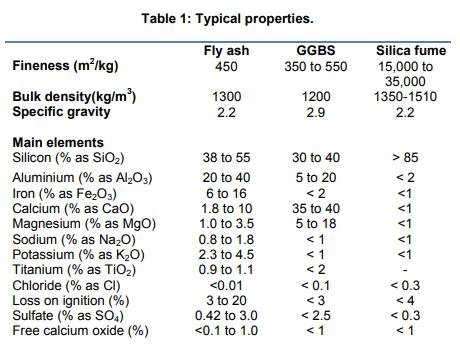
The table below presents the typical grades available from international producers and their most relevant applications for Ukrainian reconstruction projects. All grades listed meet or exceed the minimum 85% SiO₂ threshold required for a Class F pozzolan under ASTM C1240.
| SiO₂ Grade | Bulk Density (Densified) | Typical Application in Ukraine |
|---|---|---|
| 92% | 550–650 kg/m³ | Cast-in-place HPC for marine piers and large foundations |
| 94% | 550–650 kg/m³ | Precast UHPC girders, high-speed railway sleepers |
| 96% | 600–700 kg/m³ | Shotcrete for tunnel lining and slope stabilization |
| 98% | 600–700 kg/m³ | Severe chemical attack environments, nuclear containment linings |
Undensified silica fume, with its much lower bulk density, remains preferred for automated slurry mixing systems, while densified forms dramatically reduce transport costs and simplify handling in standard ready-mix plants. For Ukraine’s scale of demand, the logistical advantage of densified microsilica shipped in bulk bags or containerized loads cannot be overstated.
Defeating Freeze-Thaw Cycles and De-Icing Salt Attack
Ukraine’s continental climate imposes hundreds of freeze-thaw cycles annually on exposed concrete. Without adequate air void spacing and a low-permeability matrix, water-saturated pores expand upon freezing, causing progressive internal cracking and surface scaling. Microsilica addresses this by reducing the size and connectivity of capillary pores to below the critical threshold where ice formation becomes destructive. When combined with an optimized air-entraining admixture, silica fume concrete shows a spacing factor well under 0.20 mm, meeting the strictest frost-resistance classifications.
De-icing salts present an equally aggressive menace. Chloride ions from road salts accelerate reinforcement corrosion, a problem widespread in existing Ukrainian infrastructure. Silica fume’s reduction of the chloride migration coefficient—often below 1×10⁻¹² m²/s—delays the onset of corrosion by decades. For bridge decks and elevated highways in cities like Kyiv, Kharkiv, and Lviv, specifying 8–10% silica fume in the overlay or full-depth deck mix is a proven strategy to avoid the fate of salt-damaged structures that require costly hydro-demolition and re-decking after only 15 years.
Building a Resilient Supply Chain: Sourcing Silica Fume from China
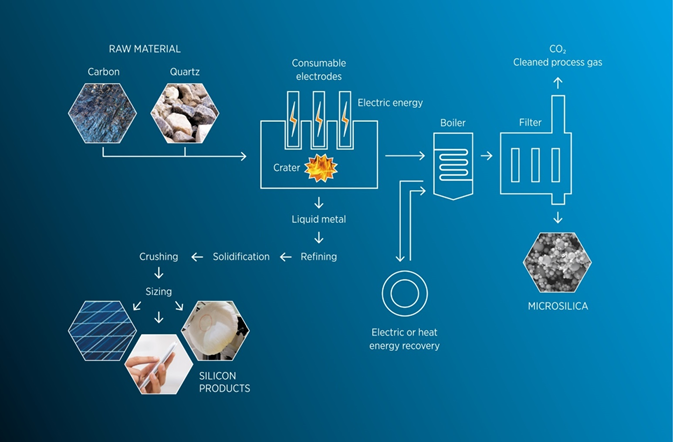
The sheer volume of material required for a nationwide rebuild means procurement must be not only cost-effective but also logistically resilient. Chinese manufacturers, leveraging integrated ferrosilicon and silicon metal production, offer consistent, high-purity microsilica in both densified and undensified forms. The availability of 20-ton container shipments directly to Black Sea ports ensures that even remote construction sites can maintain steady inventory. For road base stabilization in logistics hubs, silica fume for soil stabilization can transform marginal subgrades into load-bearing layers, reducing the aggregate needed and accelerating earthworks.
Energy sector reconstruction—including oil and gas transmission pipelines—also benefits from microsilica’S versatility. 92 grade silica fume for oil well cementing provides the required low-permeability seal at elevated downhole temperatures, a critical need as Ukraine restores its energy independence. Additionally, heritage and structural repair crews can rely on pre-blended, shrinkage-compensated mortar products, such as those based on silica flour concrete mortar, to restore damaged buildings without compromising the original aesthetic. Selecting a supplier that can provide rigorous batch testing and full traceability documentation will be essential for auditors and international funding bodies overseeing the reconstruction programs.
Frequently Asked Questions
Q: What silica fume grade is best for Ukraine’s bridge reconstruction projects?
A: For general HPC bridge structures, a 92% SiO₂ densified grade meeting EN 13263 is typically sufficient. For UHPC girders and decks requiring compressive strengths above 120 MPa, a 94% or 96% grade with a BET surface area over 15 m²/g is recommended to maximize pozzolanic reactivity and eliminate the ITZ. Always confirm that the silica fume supplier provides a complete oxide analysis and uniformity test report per ASTM C1240.
Q: How does silica fume improve freeze-thaw resistance in Ukrainian conditions?
A: Silica fume refines the capillary pore system to sizes below 30 nm, where water cannot freeze at temperatures above -20°C. This, combined with a proper air-void system, reduces the saturation degree and eliminates internal pressure buildup. When 6–10% silica fume by cement weight is used with an air content of 5–7%, testing per CEN/TR 15177 shows a frost resistance factor well above the 75% threshold required for severe exposure classes.
Q: Can silica fume be used for rapid precast production in Ukraine’s reconstruction?
A: Absolutely. Mixes with 8% silica fume and a w/b ratio of 0.20–0.25, combined with PCE superplasticizers, can achieve one-day compressive strengths of 50–60 MPa. This enables daily mold turnaround for precast beams, columns, and hollow-core slabs, dramatically accelerating the delivery of housing and commercial structures without sacrificing long-term durability.
Q: What is the typical dosage of silica fume in UHPC for critical infrastructure?
A: UHPC formulations typically require 10–20% silica fume by weight of cementitious materials to achieve full particle packing and a dense matrix. In bridge applications, dosages between 12–15% yield compressive strengths exceeding 150 MPa and direct tensile strengths above 8 MPa when combined with high-strength steel fibers. These dosage levels ensure a chloride migration coefficient below 2×10⁻¹³ m²/s, effectively impervious to de-icing salt ingress.
Q: How can I source silica fume reliably for a reconstruction project in Ukraine?
A: Look for a manufacturer with dedicated export capacity, consistent SiO₂ content above 85%, and the ability to ship densified material in 20-ton containers to Black Sea ports. Suppliers should provide ISO 9001 certification and independent test data for each lot. Procuring directly from a major Chinese producer often secures better pricing and lead times while ensuring continuous supply for large-scale infrastructure programs.
About Henan Superior Abrasives (HSA)
Henan Superior Abrasives (HSA) is a China-based global supplier of high-quality silica fume (microsilica) for concrete and refractory applications. Supplying both densified and undensified grades compliant with ASTM C1240 and EN 13263, HSA serves customers in 30+ countries with reliable microsilica solutions for HPC, UHPC, precast concrete, shotcrete, and other high-performance construction materials.
Get a Quote or Free Sample
Ready to improve your concrete performance with premium silica fume? Contact our technical team today — we respond within 24 hours and can arrange free samples for qualified projects.
- 📧 Email: sales@superior-abrasives.com
- 💬 WhatsApp: +86-186-3863-8803