Your high-performance concrete mix is underperforming, not from a chemical incompatibility, but from a persistent physical flaw. When silica fume agglomerates into millimeter-scale balls that survive the mixing process, you introduce reactive silica pockets, compromise in-situ strength, and risk failing a chloride permeability test. Eliminating these undispersed nodules is a non-negotiable step toward achieving a dense, homogeneous microstructure and meeting the durability requirements of a 100-year service life specification.
Diagnosing the Agglomeration Mechanism: Electrostatics and Van der Waals
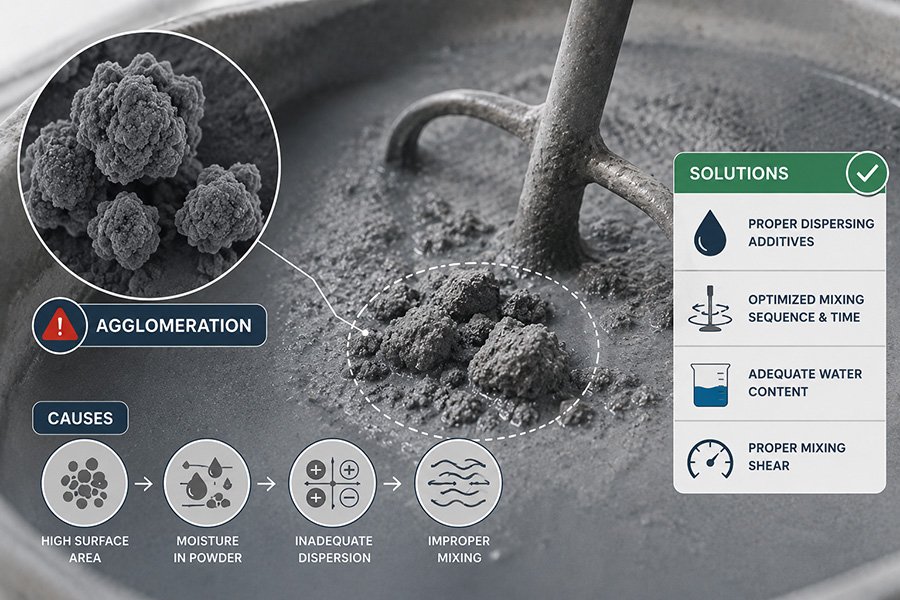
Understanding Why is My Silica Fume Agglomerating? begins at the particle surface. As-manufactured densified silica fume consists of agglomerations tens of microns across, held together by strong inter-particle forces. During pneumatic loading and high-shear mixing, these clusters often resist breakdown. The root cause is rarely a single factor but a competition between cohesion and dispersion energy. In its densified form, the bulk material possesses a high BET surface area — typically 15–30 m²/g — creating massive surface energy that drives particles to cling together unless the mixing shear exceeds the cohesive bond strength.
Ambient moisture exacerbates this condition. Microsilica’s hygroscopic nature allows capillary condensation between particles, forming liquid bridges that act like glue. A moisture content exceeding 1.0% dramatically increases the apparent cohesion, making deflocculation nearly impossible in a standard pan mixer. The resulting agglomerates are not merely cosmetic defects; they represent a failure to convert the densified powder into its primary particle state necessary for filling the ITZ (interfacial transition zone).
Densified vs. Undensified: A Breakdown of Dispersion Energy
Procurement decisions directly impact mixing science. Choosing a product format is a trade-off between handling logistics and dispersion mechanics. Densified silica fume, while free-flowing and dust-free, demands significantly more shear energy to disintegrate. Its agglomerates possess a bulk density approaching the true density of silica fume specific gravity, meaning external mechanical energy is required to separate the compacted particles. Undensified fume, with its low bulk density, disperses rapidly but presents severe dosing and dust control challenges.
The dispersive energy available in the mixer must overcome the inter-particle adhesion. In ASTM C1240 testing, a retained mass on a 45-µm sieve exceeding 10% for an undensified product directly indicates poor dispersion and a high probability of agglomeration in the fresh concrete. For densified products, this sieve analysis is performed after an ultrasonic dispersion treatment, mimicking the idealized mixing energy that often remains theoretical on a job site.
Batching Sequence Errors That Cement the Problem
A common operator error transforms a grade 94 silica fume into a liability. Adding densified 94 grade silica fume for concrete directly into a dry mixer or onto dry aggregates without a preceding wetting phase will guarantee agglomerate formation. The particle packing forces between sand, stone, and the silica fume conglomerate effectively crush the microsilica into surface crevices, where it compacts further. When water finally hits this mixture, the outer layer of the agglomerate hydrates instantly, forming a low-permeability C-S-H gel shell that seals the interior from further water penetration.
To prevent this kinetic trap, introduce the silica fume into a pre-loaded mixer already containing 80–90% of the mix water and the PCE superplasticizer. This staging ensures the powder enters a low-viscosity slurry where high shear rates can prevail, rupturing agglomerates before hydration products form hard boundaries. Delaying the addition by just 30 seconds after initial aggregate wetting can transform dispersion efficiency.
Mixing Equipment and Specific Energy Deficiency
Your mixer might be the silent culprit. Gravity mixers and low-turbulence drum mixers generate insufficient shear rates to break the cohesive forces binding densified microsilica. Effective dispersion requires a high-energy mixing zone, such as that found in a twin-shaft compulsory mixer or a high-shear colloidal mixer. The critical parameter is the imparted specific mixing energy, measured in watt-hours per cubic meter. Without reaching a threshold energy, the particle collisions lack the impulse required to overcome van der Waals forces.
| Mixer Type | Shear Capability | Risk of Microsilica Agglomerates |
|---|---|---|
| Twin-Shaft Compulsory | High (intense particle-to-particle shear) | Very Low (if correctly sequenced) |
| Planetary Counter-Current | High (multi-tool vortex action) | Low |
| Pan Mixer (Paddle) | Moderate (relies on star tool configuration) | Moderate (requires extended mixing time) |
| Revolving Drum (Transit) | Low (cascading flow, limited impact) | Extremely High (dispersal not guaranteed) |
When working with a drum mixer at high speed, extending the mixing cycle to a minimum of 5–7 minutes after the final constituent addition becomes mandatory. Even then, undispersed balls of silica fume may persist at the discharge point. Switching to a silica fume for refractory castable approach — pre-slurrying the microsilica — becomes a cost-effective fix without a capital equipment upgrade.
Chemical Compatibility: Superplasticizer Selection and Hydration Kinetics
Not all polycarboxylate ether (PCE) superplasticizers are equal when paired with microsilica. An incompatible PCE can induce a rapid, localized gelation of the silica fume surface, forming a stabilized suspension of agglomerates rather than a truly dispersed paste. Chemically, this occurs when the PCE’s carboxylate group density fails to provide adequate electrosteric stabilization against the high pH and calcium ion concentration of the pore solution. The immediate consequence is a loss of workability, often misinterpreted as rapid slump loss, prompting the crew to add water and increase the w/b ratio.
The ideal PCE possesses a long side-chain length and an anchor group that adsorbs gently onto the silica surface without displacing the silanol groups prematurely. The dispersing action must dominate over the bridging flocculation caused by free Ca²⁺ ions. In ternary binder systems using differences fly ash slag silica fume, finding a PCE that simultaneously optimizes dispersion and maintains slump life across all supplementary cementitious materials is the central challenge for the mix design chemist.
Pre-Slurry: The Definitive Solution for High-Criticality Mixes
For ultra-high performance concrete (UHPC) and marine structures where zero defects is the only tolerance, relying on dry powder dispersion is an unnecessary risk. Converting the microsilica into a pumpable and pre-dispersed slurry eliminates agglomeration before the material reaches the batch scale. This method mechanically de-agglomerates the fume in a high-shear colloidal mill or a specialized blending tank, suspending the individual particles in water at a controlled pH with a compatible dispersing agent.
The operational protocol requires attention to detail. A slurry with a 50% solids content by mass can be prepared and stored, provided the suspension remains agitated to prevent settling. The key quality control metrics during slurry preparation include:
- Hegman Grind Gauge: Verifying particle fineness to a consistent sub-5 µm dispersion state, guaranteeing no large agglomerates persist.
- Specific Gravity Monitoring: Continuously confirming the solid-to-water ratio is stable, preventing batch-to-batch variability in the final concrete paste volume.
- Zeta Potential Analysis: Measuring the surface charge of suspended particles to ensure electrosteric repulsion remains optimal, countering re-agglomeration during storage.
- Loss on Ignition (LOI): Cross-checking the slurry’s solid fraction against process control data to ensure the carbon content has not altered the dispersion chemistry.
While the capital and space for a slurry plant may seem prohibitive, the long-term value becomes evident in high-volume precast operations where inter-batch uniformity eliminates costly rejections. For remote batching projects where densified fume remains the standard format—such as those evaluating the harga silica fume per kg—the slurry method can be implemented using a mobile recirculation unit to ensure the imported powder yields its full pozzolanic potential.
Frequently Asked Questions
Q: What causes silica fume to agglomerate during mixing?
A: Agglomeration primarily results from silica fume’s extremely high BET surface area (15–30 m²/g for undensified, 1–3 m²/g after densification) and strong interparticle van der Waals forces, especially when added dry to the mixer without proper dispersion. Additional factors include high moisture content (>3% by weight), insufficient mixing shear energy, or adding silica fume too quickly after the initial water contact.
Q: How can I prevent silica fume from clumping in UHPC mixes?
A: Use a slurry method: pre-mix silica fume with 50–60% of the mix water and a high-range water reducer (HRWR) at 1–2% by weight of cementitious materials for 2–3 minutes. Alternatively, employ a colloidal mixer or high-shear paddle for at least 4 minutes at >60 rpm. Ensure the water-to-binder ratio is above 0.20 and that your HRWR is compatible (polycarboxylate ether recommended).
Q: Does densified silica fume agglomerate differently than undensified?
A: Yes. Densified silica fume (bulk density 500–700 kg/m³) contains preformed agglomerates that break apart more easily with moderate shear forces, but can leave micron-sized clusters if not mixed long enough. Undensified (150–300 kg/m³) disperses more readily but is difficult to handle due to dust and requires 30–50% more mixing time to achieve full de-agglomeration.
Q: What test method can I use to verify silica fume dispersion in concrete?
A: Perform a wash-out test on fresh concrete: sieve a sample through a 45-µm (#325) mesh. If more than 10% by weight is retained, agglomerates are present. For hardened concrete, polished cross-section imaging (SEM or optical microscopy at 100–500×) can identify residual silica fume clusters larger than 20–50 µm, which reduce strength by up to 15%.
Q: What role does storage humidity play in silica fume agglomeration?
A: Storage humidity above 70% RH can increase silica fume’s moisture content beyond 1.5%, promoting pre-hydration and hard agglomerates. For densified grades, keep them in sealed silos or moisture-proof bags with internal humidity <60%. Undensified material should be used within 30 days of production in humid climates. EN 13263 requires LOI <4.0% and moisture <3.0% for standard application.
About Henan Superior Abrasives (HSA)
Henan Superior Abrasives (HSA) is a China-based manufacturer and global supplier of high-quality silica fume (microsilica) for concrete and refractory applications. Supplying both densified and undensified grades compliant with ASTM C1240 and EN 13263, HSA serves customers in 30+ countries with reliable microsilica solutions for HPC, UHPC, precast concrete, shotcrete, and other high-performance construction materials.
Get a Quote or Free Sample
Ready to improve your concrete performance with premium silica fume? Contact our technical team today — we respond within 24 hours and can arrange free samples for qualified projects.
- 📧 Email: sales@superior-abrasives.com
- 💬 WhatsApp: +86-186-3863-8803