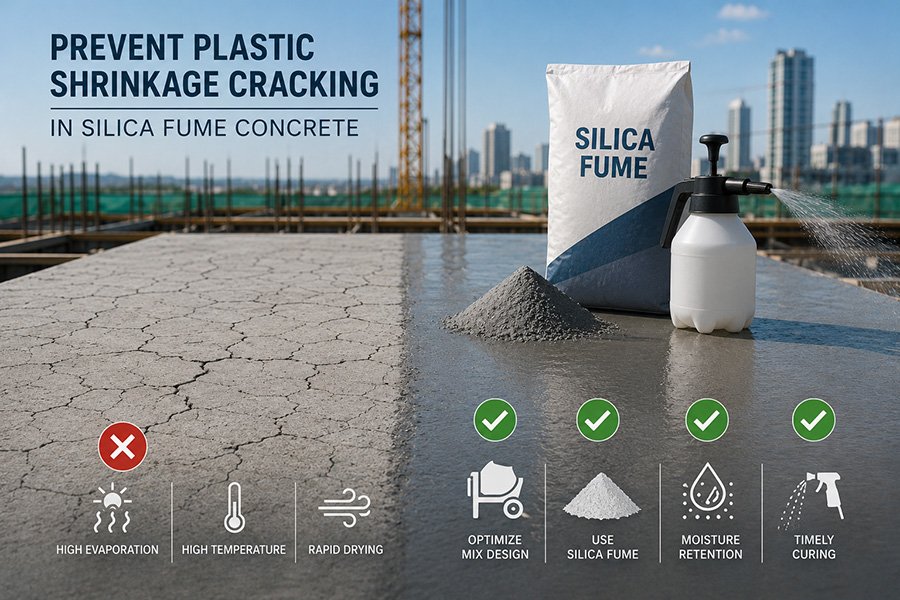
Plastic shrinkage cracking in silica fume concrete can cut a slab’s service life by 30% or more before curing even begins. When bleed water evaporates faster than it rises, capillary tension builds in the near-surface paste – and at w/b ratios below 0.40, silica fume’s extreme fineness virtually eliminates bleeding. Engineers specifying high-performance concrete (HPC) or ultra-high-performance concrete (UHPC) face a narrow window: manage evaporation rates and paste rheology simultaneously, or risk microcracking that negates the densified ITZ (interfacial transition zone) and pozzolanic gains silica fume otherwise delivers.
Why Silica Fume Amplifies Early-Age Cracking Risk
Microsilica particles average 0.1–0.3 µm in diameter, roughly 100× finer than portland cement grains. This extreme specific surface – often exceeding 15,000 m²/kg by BET measurement – creates a paste that can move from a 100 mm slump to near-zero bleed within 60 minutes of placement. With no bleed water to replenish surface moisture, even a 1.0 kg/m²/h evaporation rate triggers plastic shrinkage. Laboratory data confirms that plain cement pastes tolerate evaporation rates up to 0.5 kg/m²/h before cracking initiates; silica fume concrete, however, cracks at rates as low as 0.2 kg/m²/h under identical conditions.
The problem compounds when silica fume dosage exceeds 8% by mass of cementitious material. At this threshold, particle packing densifies the matrix so effectively that capillary pore continuity collapses, trapping internal moisture while leaving the surface starved. The pozzolanic reaction that later strengthens the C-S-H gel contributes nothing during the plastic state – the concrete has not yet set, so chemical shrinkage does not yet dominate. The sole driver is physical: rapid moisture loss from an unbled, low-permeability surface.
Mix Design Adjustments That Reduce Bleeding Suppression
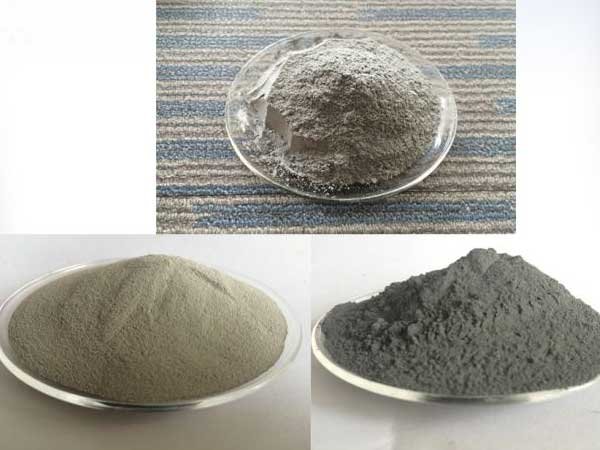
Specifiers often treat densified and undensified silica fume as interchangeable, but the form dramatically affects early-age behavior. Undensified grades disperse more uniformly and can reduce the plastication demand, while densified silica fume – unless thoroughly sheared during mixing – may leave agglomerated pockets that neither bleed nor hydrate normally. For critical flatwork, engineers should consider a 92 grade silica fume designed for concrete applications, where purity and particle size distribution are optimized for rheology control.
Three mix design levers directly mitigate plastic shrinkage cracking:
- Limit silica fume dosage to 5–8% for slabs exposed to wind or low humidity – full UHPC formulations at 15–25% demand rigorous evaporation countermeasures.
- Increase paste volume by 2–3% through supplementary cementitious materials that bleed, such as Class F fly ash at 15–20%, creating a composite binder that retains some capillary connectivity.
- Target a PCE superplasticizer with extended slump retention rather than rapid-dispersing types; viscosity-modifying admixtures can also stabilize surface moisture without retarding set excessively.
When a project requires higher silica fume content for durability or strength targets, a 94 grade silica fume for concrete balances reactivity with manageable water demand, provided the batching sequence gives sufficient high-shear mixing time.
Evaporation Control: The Critical First 4 Hours
Plastic shrinkage cracking occurs before final set, typically within the first 2–4 hours after placement. During this window, the evaporation rate – not the total water loss – dictates cracking severity. ACI 305’s nomograph remains the practical field tool: when evaporation rate exceeds 0.25 kg/m²/h for silica fume concrete, immediate countermeasures become mandatory. Wind speed exerts a non-linear effect; a jump from 8 km/h to 24 km/h can quadruple the evaporation rate even at constant temperature and humidity.
Contractors working with silica fume mixes should implement staged protection protocols. Fogging systems that maintain a 1–2°C surface temperature reduction through evaporative cooling are effective, but mist must be continuous – intermittent spraying creates wet-dry cycles that aggravate stress gradients. Wind breaks reduce effective wind speed at the slab surface, but their geometry matters: a 1.2 m-high barrier downwind can cut evaporation by 40% at distances up to 3 m behind it.
| Evaporation Rate (kg/m²/h) | Cracking Risk in Plain Concrete | Cracking Risk in Silica Fume Concrete | Required Countermeasure |
|---|---|---|---|
| < 0.25 | Low | Moderate | Monitor; apply curing membrane within 30 min |
| 0.25 – 0.50 | Moderate | High | Continuous fogging + wind breaks |
| 0.50 – 0.75 | High | Very High | Evaporation retardant + fogging + defer placement |
| > 0.75 | Very High | Extreme – placement not advised | Reschedule or use ASTM C1240-compliant set control |
Curing Compound Selection and Application Timing
Silica fume concrete’s near-zero bleed means the timing of curing compound application shifts earlier than conventional concrete. ASTM C309 Type 1 clear compounds applied at 150–200 ft²/gal must hit the surface while it still glistens – typically within 15–20 minutes of strike-off for slabs in moderate conditions. Waiting until the bleed water sheen disappears, as is common practice with plain concrete, already allows capillary tension to build in the top 5–10 mm. Solvent-based curing compounds generally form films faster than water-based emulsions at low temperatures, a critical consideration in early-season placements.
For projects specifying a 85 grade silica fume in less demanding applications, the extended set time relative to higher grades buys an additional 15–25 minutes of application latitude. Nonetheless, a two-stage curing strategy – an evaporation retardant sprayed immediately after screeding, followed by the curing membrane after final floating – provides the most robust protection. LOI (loss on ignition) values below 3% in the silica fume ensure no carbon interference with film formation; higher LOI material can create micro-porosity that defeats the membrane’s purpose.
Specification and Compliance: Embedding Plastic Shrinkage Prevention
ASTM C1240 and EN 13263 establish silica fume’s chemical and physical requirements but say nothing about plastic state behavior. Engineers must therefore embed shrinkage-prevention measures directly in project specifications. A prescriptive approach – mandating a maximum evaporation rate of 0.25 kg/m²/h at placement, continuous fogging where wind exceeds 16 km/h, and curing compound application within 20 minutes of screeding – closes the gap that generic standards leave open. Performance-based alternatives can reference ASTM C1579, the restrained plastic shrinkage test using a steel ring, though acceptance criteria should be agreed before mix approval.
Specifications that treat silica fume as a drop-in replacement for fly ash or slag routinely produce surface cracking within the first winter cycle, when microcracks fill with water and freeze. – HSA Technical Bulletin
Batching sequence and mixing energy also merit specification. Densified silica fume requires a minimum of 90 seconds of high-shear mixing after all materials enter the drum; undensified grades can disperse in 60 seconds but demand enclosed handling to control dust. A 96 grade silica fume produced for refractory applications may carry a coarser agglomeration structure that concrete mixers cannot fully break down, so verifying grade appropriateness through the supplier’s technical data sheet before batching is essential. As a China-based manufacturer and global exporter operating in over 30 countries, Henan Superior Abrasives (HSA) supplies ASTM C1240 and EN 13263-compliant silica fume in undensified and densified forms, with lot-specific LOI, SiO₂ content, and particle size documentation to support mixed design precision. For technical inquiries, specification support, or sample requests, contact our engineering team at sales@superior-abrasives.com or via WhatsApp at +86-186-3863-8803.
Frequently Asked Questions
Q: Why is silica fume concrete more prone to plastic shrinkage cracking?
A: Silica fume particles (0.1–0.3 µm, BET surface area >15 m²/g) increase water demand and reduce bleed water. Without adequate water retention, the high surface area accelerates surface evaporation, triggering tensile stresses before the concrete gains sufficient strength. ASTM C1240 notes that silica fume concretes with w/b ratios below 0.40 require immediate curing.
Q: What is the maximum evaporation rate allowed before cracking occurs?
A: ACI 305R recommends keeping evaporation rate below 0.2 lb/ft²/hr (1.0 kg/m²/hr). Use the ACI nomograph to adjust concrete temperature, air temperature, relative humidity, and wind speed. For silica fume mixes, many specifiers target ≤0.15 lb/ft²/hr due to reduced bleeding.
Q: What specific mix design adjustments reduce plastic shrinkage cracking risk?
A: Three proven adjustments: (1) Set silica fume replacement at 5–10% by weight of cement; exceeding 15% increases risk. (2) Use a low-alkali, Type I/II cement with minimal C₃A. (3) Incorporate a polycarboxylate-based superplasticizer (PCE) to keep w/b ≥0.35 while maintaining workability. Avoid water-reducing retarders that delay setting under high wind.
Q: What curing practices are mandatory during the first 24 hours?
A: Immediately after finishing (within 20–30 minutes), apply a monomolecular evaporation retardant (e.g., an aliphatic alcohol emulsion) at 200–300 ft²/gal. Follow with fog spraying or wet burlap covered in polyethylene. Maintain 100% relative humidity for at least 7 days per ASTM C1240. On hot, windy days (>20 mph wind), install windbreaks and sunshades to lower surface temperature.
Q: Can unsaturated polyester or PVA fibers help control cracking?
A: Yes. Polypropylene microfibers (0.5–1.0 in, dosage 0.1–0.3% by volume) distribute tensile forces across thousands of fibers per cubic inch, reducing crack width by 40–60% in silica fume concrete. They do not eliminate the need for curing, but they provide vital reinforcement during the plastic shrinkage window (first 2–6 hours). Ensure fibers comply with ASTM C1116.
About Henan Superior Abrasives (HSA)
Henan Superior Abrasives (HSA) is a China-based manufacturer and global supplier of high-quality silica fume (microsilica) for concrete and refractory applications. Supplying both densified and undensified grades compliant with ASTM C1240 and EN 13263, HSA serves customers in 30+ countries with reliable microsilica solutions for HPC, UHPC, precast concrete, shotcrete, and other high-performance construction materials.
Get a Quote or Free Sample
Ready to improve your concrete performance with premium silica fume? Contact our technical team today — we respond within 24 hours and can arrange free samples for qualified projects.
- 📧 Email: sales@superior-abrasives.com
- 💬 WhatsApp: +86-186-3863-8803