The Hidden Cost Trap in Silica Fume Procurement for Indian Projects
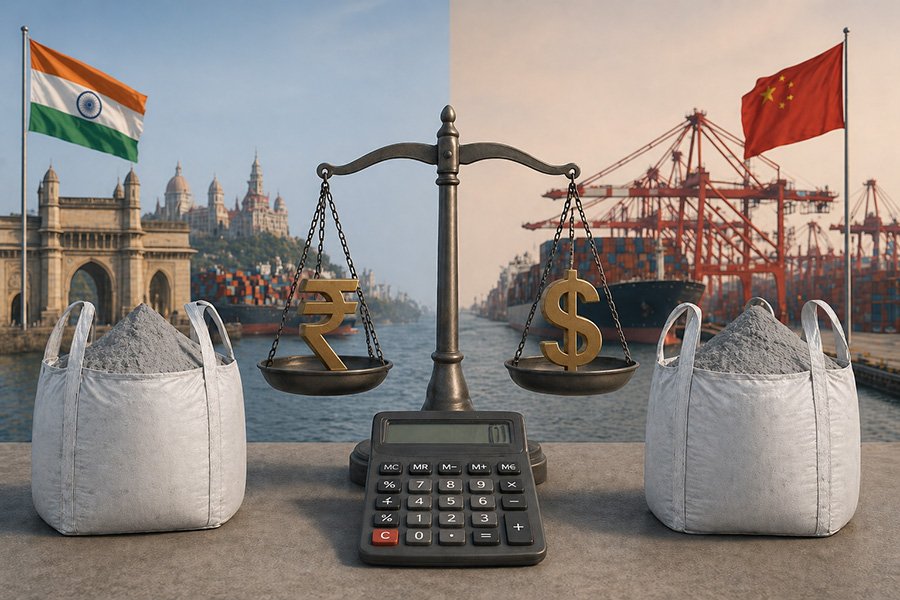
A Mumbai-based precast yard recently lost INR 3.2 lakh on a single UHPC pour after selecting a silica fume supplier based solely on the FOB Qingdao price. The delivered cost, after factoring in freight, insurance, and customs, was 28% higher than the initial quote. This common pitfall undermines project budgets and can force last-minute changes to a mix design. Understanding the full landed cost—comparing CIF Mumbai vs FOB Qingdao—is not an accounting exercise; it is a prerequisite for maintaining concrete performance and financial control.
Why FOB Qingdao Quotes Mislead Indian Concrete Specifiers
An FOB (Free on Board) Qingdao price covers the cost of goods, packaging, and loading onto the vessel at the Chinese port. For a buyer in Chennai or Delhi, this is merely the starting figure. The true cost includes ocean freight from Qingdao to Nhava Sheva or Mundra, marine insurance (typically 0.3–0.5% of the cargo value), and a complex web of Indian import duties.
The current import duty structure for silica fume (HS code 2811.22) under the India–ASEAN FTA does not apply to Chinese goods. Indian buyers must budget for a 10% basic customs duty, 10% social welfare surcharge, and 18% GST on the assessable value. Additionally, port handling fees (wharfage, demurrage, and container detention) at Indian ports can add $15–$25 per metric ton. A quote showing FOB Qingdao at $280/MT can balloon to $380–$420/MT CIF Mumbai—a gap large enough to blow a project’s admixture budget.
Comparing CIF Mumbai and FOB Qingdao: A Real-World Cost Breakdown
To illustrate the magnitude of these costs, consider a standard 20-ton container of densified silica fume (92% SiO₂) sourced from Henan Superior Abrasives. The table below contrasts the FOB Qingdao quote against the full CIF Mumbai landed cost as of Q2 2025.
| Cost Component | FOB Qingdao Basis (USD/MT) | CIF Mumbai Basis (USD/MT) |
|---|---|---|
| Base product price (92% densified) | 290 | 290 |
| Ocean freight & insurance | — | 62 |
| Basic customs duty (10%) | — | 35.20 |
| Social welfare surcharge (10% of duty) | — | 3.52 |
| Port handling & clearing fees | — | 18 |
| IGST (18% on assessable value) | — | 73.44 |
| Total landed cost | 290 | 482 |
A 66% premium over the FOB Qingdao figure is not unusual. Indian procurement teams that fail to model this delta often face a choice: absorb the overrun or substitute a lower-grade material. Both options compromise structural performance.
How Grade Selection Influences Landed Cost Calculations
The silica fume grade chosen directly affects the CIF Mumbai calculation. Higher SiO₂ content (94% or 96%) typically commands a higher base price but offers greater pozzolanic reactivity per kilogram, potentially reducing the required dosage. For concrete applications targeting a w/b ratio below 0.30, a 94 Grade Silica Fume For Concrete can achieve target 28-day compressive strengths at 8% cement replacement, whereas an 85% grade might require 12% replacement—increasing the total material volume and, consequently, freight and duty costs.
For refractory castables, the purity requirement is even stricter. A 96 Grade Silica Fume For Refractory with LOI below 1.0% minimizes gas evolution during firing, but its premium price must be weighed against the higher freight-to-value ratio. Conversely, 85 Grade Silica Fume may appear cheaper upfront but often requires additional dispersing admixtures to achieve the same rheology, introducing another variable into the cost equation.
Choosing Between Densified and Undensified Forms in an Import Context
Physical form impacts both the FOB Qingdao price and the CIF Mumbai logistics cost. Densified silica fume (bulk density 550–650 kg/m³) packs more material per container, reducing the per-ton freight charge. Undensified material (bulk density 200–350 kg/m³) requires double the container volume for the same weight—a 40-foot container holds only 18–20 MT versus 26–28 MT for densified.
- Freight efficiency: Densified saves $12–$18/MT in container freight from Qingdao to Mumbai.
- Handling ease: Densified flows readily in pneumatic systems; undensified tends to cake in Indian monsoon humidity.
- Dispersion requirement: Densified particles must be de-agglomerated using a PCE superplasticizer at the mixer—often doubling the high-range water reducer dosage versus undensified.
For a UHPC project using 92 Grade Silica Fume For Concrete in densified form, the total delivered cost can be 7–9% lower than undensified, provided the mixing protocol includes an extended shear cycle.
Tariff Classification Risks That Increase CIF Mumbai Costs
Misclassification of silica fume under Indian customs tariff can trigger penalties and clearance delays. The correct HS code is 2811.22 (silicon dioxide), but some importers mistakenly use 2504.90 (natural graphite) or 2621.90 (other slag and ash). A recent advisory from the Mumbai Customs Commissionerate flagged that silica fume with LOI above 6% may be reclassified as waste, attracting a higher 25% duty and a pollution clearance requirement.
Reputable suppliers provide a certificate of analysis (COA) and a country of origin certificate to support correct classification. For refractory applications, 92 Grade Silica Fume For Refractory with LOI under 3% should be explicitly declared to avoid dispute. Procurement teams should request these documents before the vessel sails from Qingdao to prevent demurrage costs at Nhava Sheva.
Mitigating Currency Fluctuation Risk in Silica Fume Contracts
Exchange rate volatility between the Chinese yuan (CNY) and Indian rupee (INR) adds a further layer of cost uncertainty. A 2% change in the CNY/INR rate alters the CIF Mumbai price by approximately $8–$10/MT. Indian buyers can reduce this risk by negotiating contracts in USD and specifying an exchange rate adjustment clause tied to a 30-day average from the RBI reference rate.
This is particularly important when committing to a long-term supply of 94 Grade Silica Fume For Concrete for a multi-year infrastructure project. Standardizing the currency basis in the procurement tender ensures that the true cost comparison between CIF Mumbai and FOB Qingdao holds for the contract duration.
Frequently Asked Questions
Q: What is the typical freight cost difference between FOB Qingdao and CIF Mumbai for silica fume?
A: For a 20-ton container (approx. 26–28 m³), sea freight from Qingdao to Nhava Sheva (Mumbai port) typically ranges between $1,200 and $2,000 as of 2025, depending on season, vessel space, and fuel surcharges. This adds $60–$100 per metric ton to the FOB price.
Q: What customs duty and GST apply to silica fume imported into India?
A: Silica fume (HS code 2811.22.00) attracts 7.5% basic customs duty plus 10% social welfare surcharge (effective rate ~8.25%). IGST at 18% is levied on the assessable value (CIF + duty). Additionally, a 1% handling fee and port charges (~₹3,000–₹5,000 per container) apply.
Q: How do densified vs. undensified silica fume affect logistics cost to India?
A: Densified silica fume (500–700 kg/m³) allows 20–25 metric tons per 20-foot container vs. 15–18 tons for undensified (300–400 kg/m³). This reduces per-ton freight and handling costs by 20–30%. For Indian buyers, densified grade often yields a lower landed cost despite a slightly higher FOB price.
Q: Should I specify CIF Mumbai or FOB Qingdao when importing silica fume?
A: FOB Qingdao gives you control over freight and insurance procurement, which can lower costs if you have a preferred logistics partner. CIF Mumbai transfers risk and cost to the seller but often includes a markup of 5–10% over actual freight. For large or regular volumes, FOB with a trusted freight forwarder is usually more economical.
Q: What hidden costs should Indian buyers include in the landed cost calculation?
A: Beyond CIF + duty + IGST, add: port congestion surcharge (variable, ₹2,000–₹5,000), container detention fees (if clearance delays exceed free days), fumigation certificate (~₹3,000), and inland transport from Nhava Sheva to your site (₹10,000–₹30,000 depending on distance). These can add $50–$120 per ton.